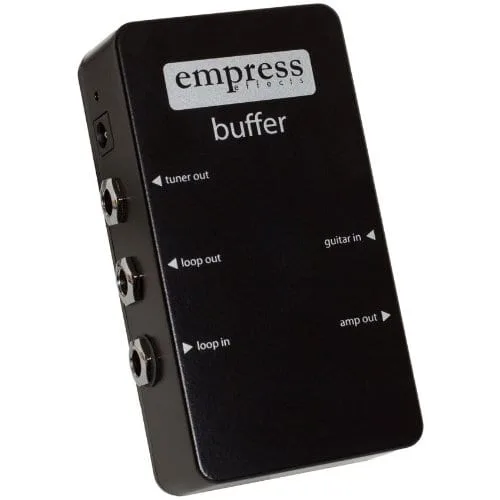


The Empress Effects Buffer is a small analog buffer pedal from Canadian maker Empress Effects. A buffer takes the high impedance signal coming out of your guitar and converts it to a low impedance signal, so it can travel through long cables and a large pedalboard without losing strength or top end1. Empress designed the Buffer to eliminate the signal loss that comes from long unbuffered cable runs, keeping your tone unchanged by your cables2.
Empress describes the circuit plainly: "All Analog Signal Path - no digitals in here!"3. There is no conversion, no modeling, just a unity gain amplifier stage that changes the impedance of your signal from high to low.
What a buffer does for your sound
Long guitar cables and long chains of true-bypass pedals add capacitance to your signal, which rolls off high frequencies and dulls your tone, what players call "tone suck"4. A buffer, short for buffer amplifier, lowers the output impedance and strengthens the weak high impedance guitar signal so it can run over longer cable lengths with no tone degradation5. As JHS puts it, "a buffer takes a high impedance signal and converts it to a low impedance signal," restoring your signal flow to be as strong as it can be1.
A well-designed buffer is not meant to add anything. Lehle's Joki Schaller makes the point directly: a high-end buffer circuit has no sound of its own, and the extra treble players sometimes hear comes from the amp's treble knob having been turned up earlier to compensate for cable loss6. Cheap buffers that are a side effect of some other active circuit can make a signal sound "plastic and artificial," which is the case against cutting corners here6. MusicRadar's buying guide notes that a strongly buffered signal has a noticeable fidelity, edge and presence, and that this is neither a good nor a bad thing, just a change worth knowing about7.
Power and size
The Buffer's manual, available from Empress Effects, covers its power and setup details2. In circuit terms, Empress's design follows the standard buffer topology: a very high input impedance and a very low output impedance, which is what lets it take a weak high-impedance guitar signal and drive it over long cable runs without tone degradation6. Because it is an active circuit rather than a simple passive box, it needs power to do its job, so treat it like any other powered pedal on your board when planning your power supply.
Physically it is a compact box, 4.5 inches long by 2.5 inches wide3, small enough to tuck at the front edge of a board. Its 1MΩ input impedance matches what a guitar expects to see, and its 510Ω output impedance is low enough to drive long cables3. Lehle's rule of thumb is that the input impedance of the next device should always be higher than the source impedance, and about three times higher is a good amount6; the Empress' 510Ω output leaves plenty of room for any amp or pedal input.
Where to put it in your chain
The standard advice is to place a buffer at the beginning of the signal chain, before the long cable and the effects, so the signal is strengthened as early as possible6. MusicRadar adds that if you are adding a buffer to an existing board, it is usually best placed after your drive pedals7.
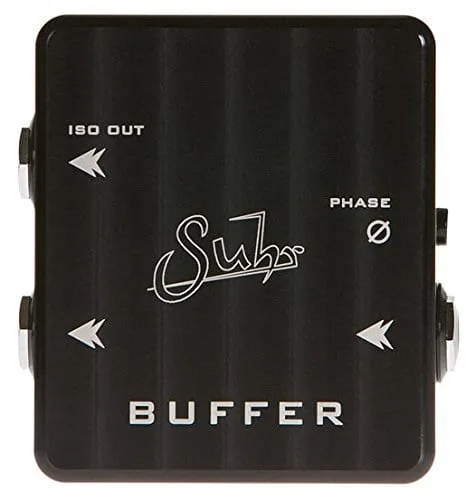
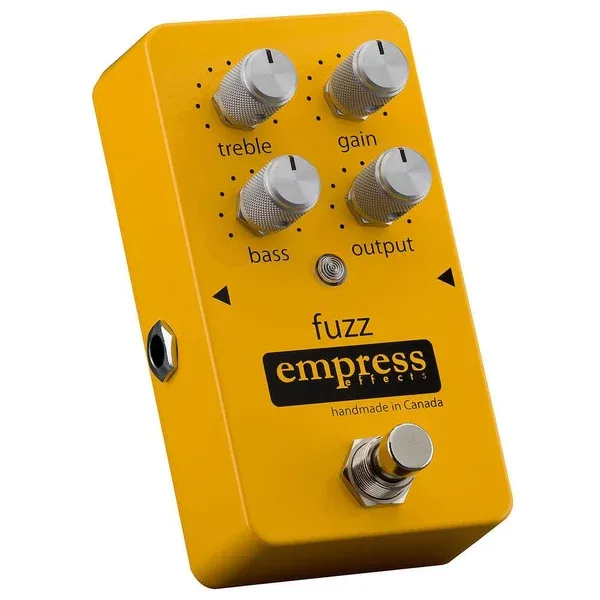
The main exception is fuzz. Lehle notes that most fuzz pedals, treble boosters and wah pedals do not like a buffered, low impedance signal, and recommends this order: guitar, then fuzz, wah and treble boost, then the buffer, then the rest of the effects chain, then the amp6. MusicRadar agrees that vintage-style fuzzes, germanium fuzzes especially, tend not to like buffers in front of them7. Suhr gives the same guidance for its own Suhr Buffer: place it after vintage fuzz pedals such as a Fuzz Face or Tone Bender so those pedals keep their character and their relationship with your instrument's electronics8.
One thing a buffer cannot do is recover signal that is already lost. Lehle is blunt that a buffer at the end of the chain does not regain what long cables before it have taken away, so the front of the chain is where the Empress earns its place6. JHS adds that you may need more than one buffer only in large rigs, generally with 10 or more true-bypass pedals1.
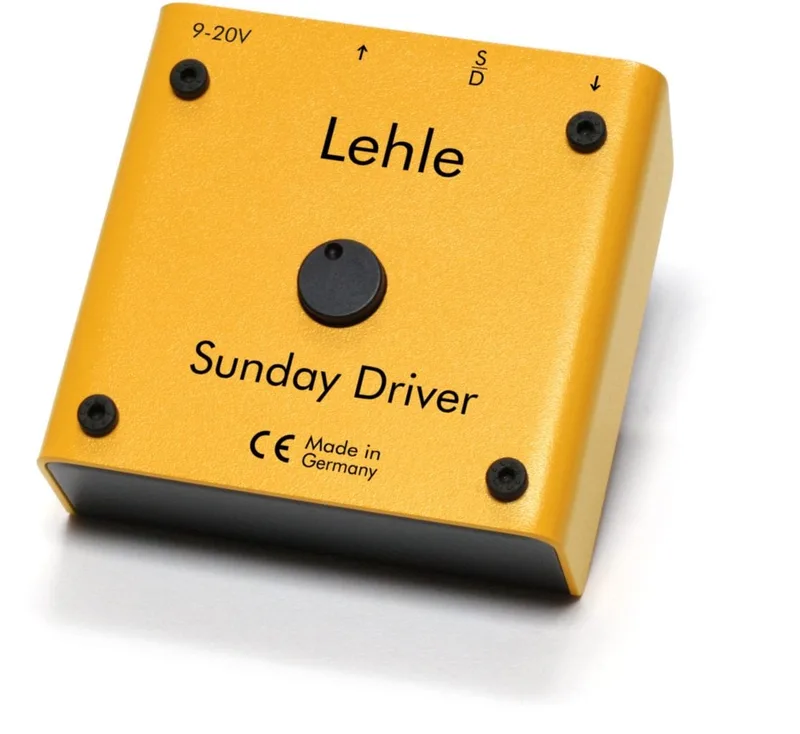
On buffering in general, this Sweetwater video with Lehle's Joki Schaller, made around the Lehle Sunday Driver II, explains what a buffer is and walks through the specifications and modes of a buffer and booster pedal.
Other Empress buffers: Buffer+, Buffer++ and S&D Buffer
Empress sells a family of buffering products, and the plain Buffer is the simplest of them2.
| Model | What it adds over the basic Buffer | Status |
|---|---|---|
| Buffer+ | Designed as a complete I/O interface for the pedalboard9 | Current |
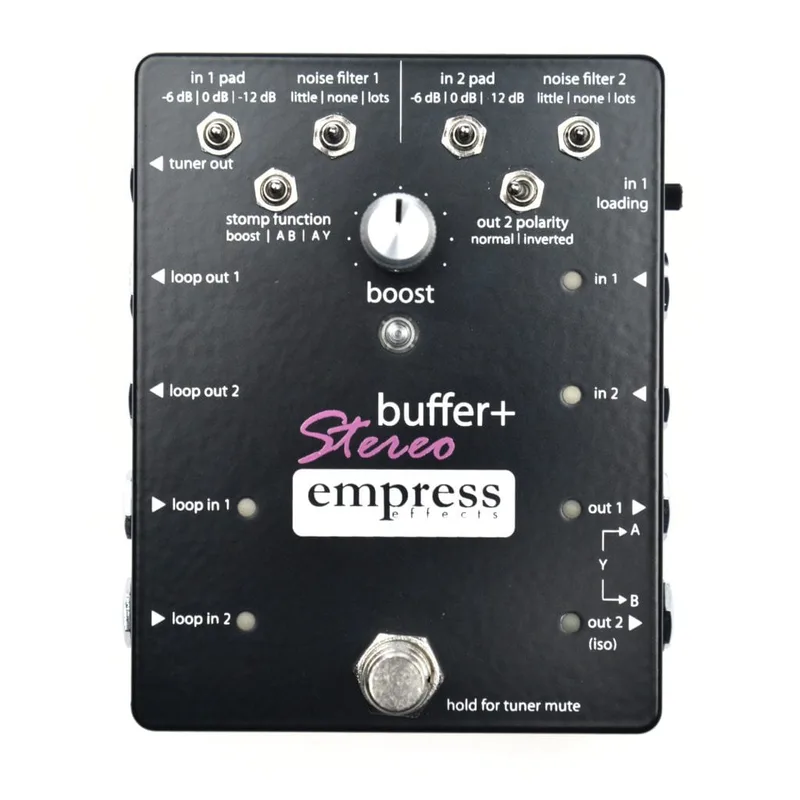
| Buffer+ Stereo | All the features of the Buffer+ plus full stereo in/out connectivity and two selectable noise filters10 | Current |
| Buffer++ | Stereo effects loop with noise filtering; multiple operating modes | Sold out11 |
| S&D Buffer | A separate buffer product in the Empress lineup12 | Current |
The Buffer+ was designed, in Empress' words, to be "the complete I/O interface for the pedal board, while maintaining the highest fidelity"9. Bass Musician Magazine's Jake Wolf reviewed it and concluded: "the Buffer+ is another in a long line of winners from Empress and may be an excellent solution for tone preservation, cable management, boost, and noise suppression overall"13.
The Buffer++ goes further, with a stereo effects loop with noise filtering and an input 1 impedance selectable from 10kΩ to 1MΩ11. One of its operating modes, Instrument Select with separate rigs and shared effects, is aimed at players switching between two rigs that share a single mono effects chain, for example electric guitar into an amp on input 1 and output 1, and acoustic guitar into a PA on input 2 and output 211. It runs on 9V DC center negative and Empress specifies its noise floor as below -110dBu11. As of October 2026 it is listed as sold out on Empress' product page11.
The Stereo Buffer Plus, announced at NAMM in January 2015, was described by Delicious Audio as "probably the ultimate in analog I/O for the guitarist": a double buffer unit in one box set up for stereo, with multi-impedance options on the first input and, per Empress, ten operating possibilities across its output modes, which can be mixed and matched for stereo outputs or summed to mono14.
Videos
Premier Guitar
Empress Effects
Stu's Guitar Channel
Questions
Is the Empress Buffer analog?
Yes. Empress describes it as an all analog signal path with no digital conversion, and RockBoard's PedalPedia listing also lists its circuit type as analog. The buffer simply converts your guitar's high impedance signal to a low impedance one so it survives long cable runs without losing top end.
Where should the Empress Buffer go in my signal chain?
The usual advice is at the beginning of the signal chain, before the long cable run to your pedalboard and amp, so the signal is strengthened as early as possible. If you use vintage fuzz, treble booster or wah pedals, those generally prefer the high impedance signal straight from the guitar, so place them before the buffer.
Can I put a buffer before a fuzz pedal?
Most fuzz pedals, treble boosters and wahs prefer a high impedance signal straight from the guitar, so a buffer in front of them can change their character. Vintage-style fuzzes, germanium fuzzes especially, are the ones most often affected. The common recommendation is to run the fuzz first, then the buffer.
Is the Empress Buffer++ still available?
The Empress Buffer++ is listed as sold out on Empress Effects' product page as of October 2026. It was a more feature-rich unit than the basic Buffer, adding a stereo effects loop with noise filtering and multiple operating modes for switching between rigs.
How long a cable can I run after a buffer?
BOSS's technical article on buffers says you can usually run as much as 100 feet of cable after a buffer with little to no signal loss. That is the general rule for any quality buffer, including the Empress, which is designed to eliminate signal loss from long unbuffered cable runs.
Sources (14)
- UNDERSTANDING BUFFERS, JHS Pedals
- Buffer by Empress Effects, RockBoard PedalPedia, 2026
- Buffer - Empress Effects Inc., Empress Effects Inc.
- BUFFERS VS. TRUE BYPASS, Morley
- Why Buffers are Important for Great Tone, BOSS (articles.boss.info), 2024-02-05
- Do I need a buffer?, blog.lehle.com, 2017-06-14
- Effects pedals: True bypass Vs buffers, MusicRadar, 2023-07-13
- Suhr Buffer, Suhr (www.suhr.com)
- Buffer+ - Empress Effects Inc., Empress Effects Inc.
- Buffer+ Stereo, Empress Effects Inc.
- Buffer++, Empress Effects Inc.
- S&D Buffer, Empress Effects Inc.
- Review: Empress Buffer+, Bass Musician Magazine, 2022-05-02
- NAMM Pedal News: Empress Stereo Buffer+, Delicious Audio, 2015-01-30