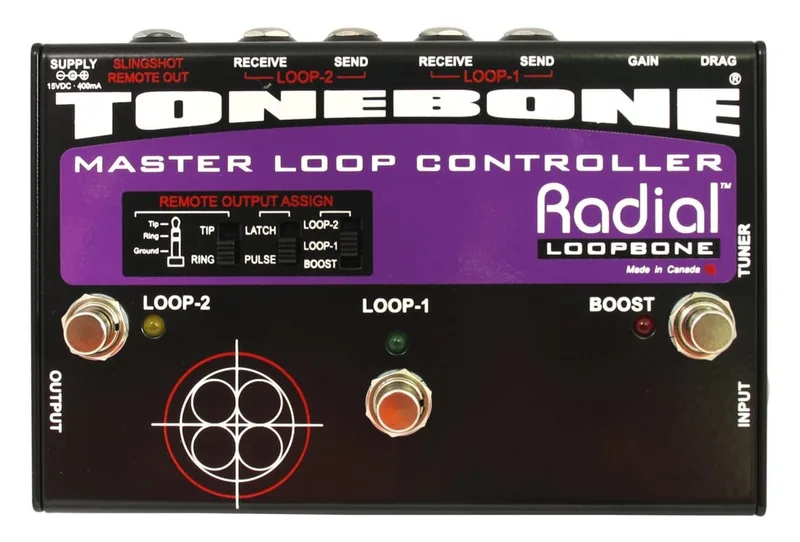

The Radial Tonebone Loopbone is an effects-loop switcher from Radial that lets a guitarist insert, remove, and combine pedals through two independent signal chains, while avoiding the tone loss of other switchers and the noise that true-bypass alternatives can introduce1. It is a switching pedal rather than a looper in the recording sense: it does not record or replay phrases, it switches pedal loops in and out of your signal path.
Radial states that the Loopbone "has been discontinued and is no longer shipping"1. The User Guide remains available in the Resources section of the product page1.
What it does
The Loopbone's job is to put your pedals on switchable loops so you can take them out of the signal chain entirely when they are off. Radial describes it as a high-performance effects-loop switcher that lets you insert, remove, and combine pedals via two independent signal chains, while eliminating the tone-robbing problems of other switchers and the induced noise of true-bypass alternatives1.
The two effects loops are wired in series, so the first loop feeds into the second1. In practice that means you can split your pedals into two groups, for example time-based effects in one and gain pedals in the other, and switch each group in or out independently.
The design starts with Radial's 100% discrete class-A buffer circuit, which the company credits for audio fidelity and low noise1. Radial says the class-A buffering delivers your full tone without affecting the bottom end, a claim that matters as much for bass players as for guitarists1. Switching noise is handled with active class-A buffers and photocells that ramp up the signal level, which Radial says eliminates clicking and popping3.
Controls and connections
Vintage Guitar's review, by Bob Tekippe, lists the unit's connections and controls:
| Control or jack | What it does |
|---|---|
| Two sets of effects send/receive jacks | Connect the two pedal loops2 |
| Slingshot jack | Remote control connection2 |
| Adjustable gain | Sets the level through the unit2 |
| Drag Control | Load correction that eliminates signal loss2 |
| Tuner-out jack | Keeps a tuner out of the main signal path2 |
Drag Control is Radial's load correction circuit, which the company says lets you reintroduce the natural tone and feel of the guitar as if it were connected directly to a tube amplifier1. For anyone who has plugged a modern buffered pedalboard into an amp and missed the feel of a straight guitar-to-amp connection, this is the control aimed at that problem.
The boost and what reviewers said
The Loopbone also includes a boost, and Tekippe's review in Vintage Guitar was positive about it:
"The Loopbone's boost feature is fantastic - and you can manipulate gain boost with its inset control."
The review found the boost produced a transparent volume boost with a slight edge on the clean setting, and an equally transparent, searing solo boost when used with the distorted loop2. The review also noted the adjustable gain, the drag control, and the tuner-out jack as features2.
At the time of that review, in August 2005, the Loopbone carried a retail price of $3002.
Loopbone versus a true-bypass looper
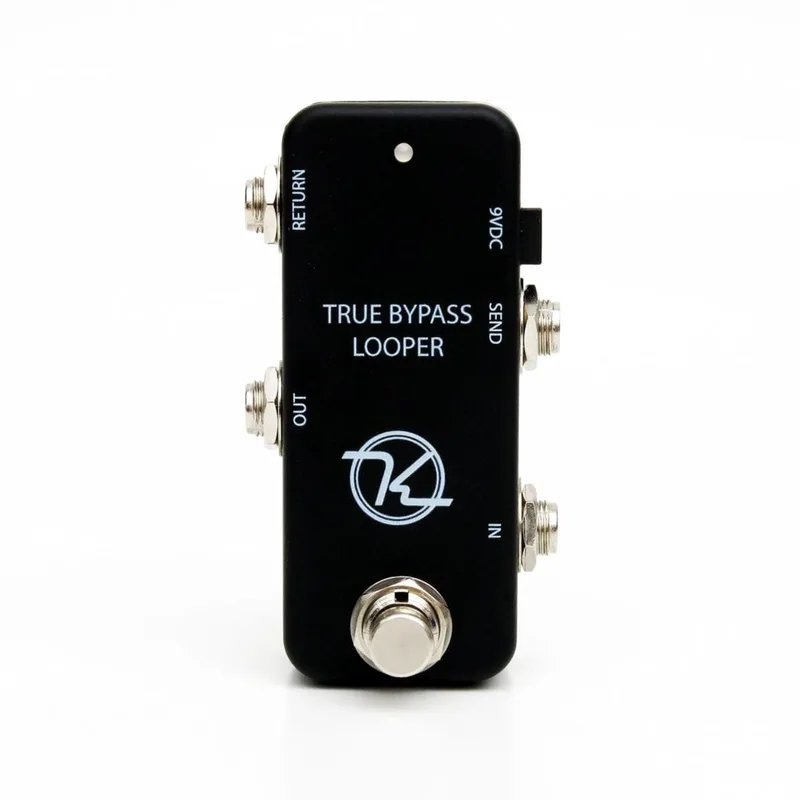
A true-bypass loop switcher, like the Keeley True Bypass Looper, simply connects the loop's jacks straight through when the loop is off. The Loopbone takes the opposite approach: it keeps the signal running through active class-A buffers at all times, and uses photocells to ramp the signal level during switching so the change is not audible as a click or pop3. Radial's position is that true-bypass switching itself induces noise, and that a good buffer avoids both that noise and the tone loss of lesser switchers1. Players who prefer to keep the guitar's raw signal untouched when effects are off may prefer a true-bypass design; players who want a consistent, buffered signal path with quiet switching are who the Loopbone was built for.
Videos
Bright Tech Vision
Questions
Is the Radial Loopbone discontinued?
Yes. Radial states that the Loopbone has been discontinued and is no longer shipping. It now appears only as a legacy product page, with the User Guide still available in the Resources section of Radial's site.
What is the Radial Loopbone's Slingshot jack?
The Slingshot jack is one of the Loopbone's connections, alongside its two sets of effects send and receive jacks. Vintage Guitar's review lists it among the unit's inputs and outputs. Radial's Slingshot system is used to remotely control switching functions on compatible gear.
Are the Loopbone's two effects loops in series or parallel?
They are in series. Radial states the two effects loops are wired in series so the first loop can be fed into the second, letting you chain two pedal groups and switch either one in or out of the signal path.
Does the Radial Loopbone work with bass?
Radial says the Loopbone's 100% discrete class-A buffering delivers your full tone without affecting the bottom end, which points to it holding up on bass as well as guitar. The company's description is written for guitarists but makes no instrument restriction.
Does the Radial Loopbone have a tuner output?
Yes. Vintage Guitar's review notes the Loopbone has a tuner-out jack, along with adjustable gain and a drag control that eliminates signal loss. A tuner output lets you keep a tuner connected and out of the main signal path.
Where can I find the Radial Loopbone manual?
The User Guide is listed in the Resources section of the Loopbone's product page on Radial's website. Even though the product is discontinued, the page and its documentation remain available there.
Sources (3)
- Loopbone, Radial Engineering, 2021-03-17
- Radial Cabbone, Switchbone, and Loopbone, Vintage Guitar magazine, 2010-04-05
- BigShot EFX FAQ, Radial Engineering, 2018-05-14