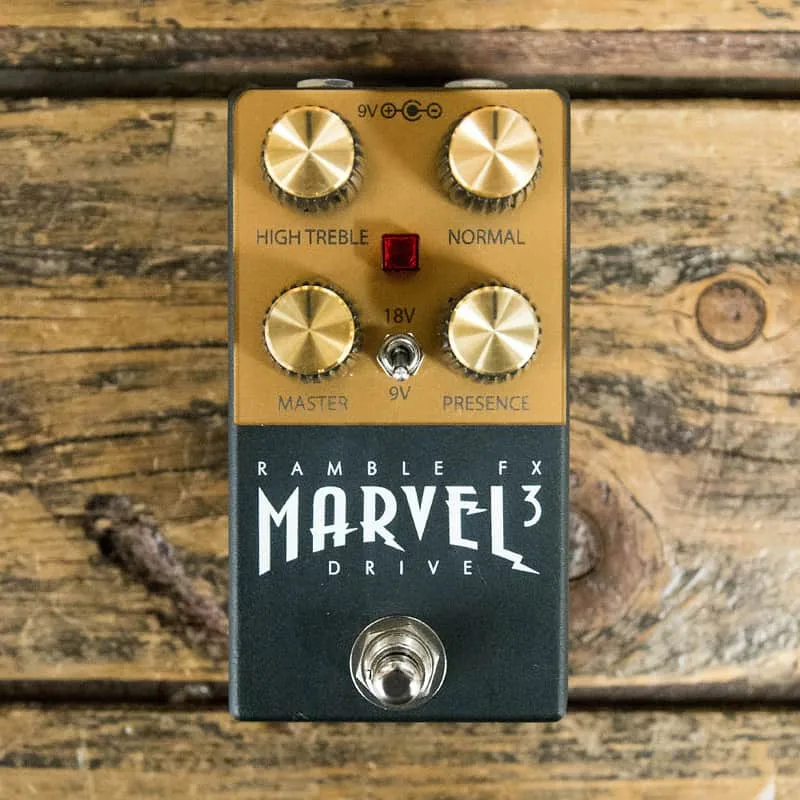


The Ramble FX Marvel Drive is a distortion pedal from Ramble FX that recreates the sound of a vintage Marshall plexi amplifier, the classic 4-input kind, in a stompbox. Where most "Marshall in a box" pedals lean on op-amp clipping stages, the Marvel Drive uses four separate JFET gain stages and no integrated circuit, which the circuit trace attributes to its touch-sensitive, dynamic distortion character12.
The pedal's whole design mirrors the old amp it copies. Its two gain controls work like the jumpered HIGH TREBLE and NORMAL inputs of a 4-input Marshall, so you blend a brighter, throatier voice against a rounder, bassier one, then set the overall level with a master volume1. Pedal of the Day's 2018 review of the V3 found it stood out among the many pedals claiming to be a Marshall in a box:
"While a LOT of effects out there claim to be a 'Marshall in a Box,' the Marvel Drive V3 really employs the techniques, circuitry and attitude of those old amps, to create a stunningly accurate portrayal" of the vintage Plexi sound.2
RockBoard's PedalPedia entry for the related Marvel 3 Drive sums the concept up as "A Marshall 'Plexi' in a box. Great sound !" and files it under both overdrive and distortion3.
A plexi built from JFETs
The Marvel Drive's circuit is based on the Marshall plexi amplifier circuit, and its topology is unusual among plexi-emulating pedals. The trace published by Guitar FX Layouts describes it as two JFET gain stages in parallel, one with a bright and throaty scream and one that brings the thump of a full stack, recreating the jumpered inputs of vintage 4-input Marshalls1. Four JFET stages in total do the amplifying, with no op-amp anywhere in the signal path1.
Each JFET has its own bias trimmer setting its drain voltage, which makes the build forgiving to adjust: the original drain voltages were Q1 at 4.0V, Q2 at 5.0V and Q5 at 5.35V1. The layout's author notes the trimmers make it easy to tweak the circuit into bias1.
What it sounds like, according to the people who have written about it: the Guitar FX Layouts entry calls it touch-sensitive, dynamic distortion suited to AC/DC, Led Zeppelin and Hendrix1. In Pete Thorn's demo video, the pedal covers everything from low mid gain through to really high gain solo tones4.
The controls: Normal, Treble, Master and Presence
The control set copies the front panel of the old amp it emulates14.
| Control | What it does |
|---|---|
| Normal | Volume for the normal channel; rounder, bassier character4 |
| High Treble | Volume for the high treble channel; brighter, treble-heavy gain42 |
| Master | Overall output volume4 |
| Presence | Top-end voicing; roll back for bright amps, roll up for darker amps4 |
The two channel volumes are the heart of the pedal. As Pete Thorn demonstrated, you effectively have two different volume controls: the Normal channel is much more bassy and round sounding, while the High Treble channel is the brighter voice, and the two can be blended together or used on their own4. The Guitar FX Layouts entry describes the same idea: the HIGH TREBLE and NORMAL volumes can be blended together for the perfect crunchy combination1.
The Presence control, found on later versions, is a practical matching tool. Thorn's advice from the demo: roll it back when playing through amps with a bright switch or a bright cap, and roll it up to around seven or eight for darker or more neutral amps4.
Power: 9V, 12V and 18V
The original Marvel Drive runs on a standard 9V supply, but it is not limited to it. A builder reported the traced circuit working "wonderful @12v with a bit more headroom and less sag" than at 9V1. The V3 takes headroom further with an internal power supply using a voltage doubler, giving more headroom at 18V2.
Pete Thorn's demo unit carried a switch for 18V or 9V operation, and he described the difference in level and feel: the 9V mode is a little quieter, while the 18V mode is quite a bit louder, more bold, with harder transients4.
Builders of the stripboard layout have one power-related tip: the 330uF electrolytic capacitor in the circuit is not critical, and any value of 10uF or above works in that position1.
Versions and the DIY layout
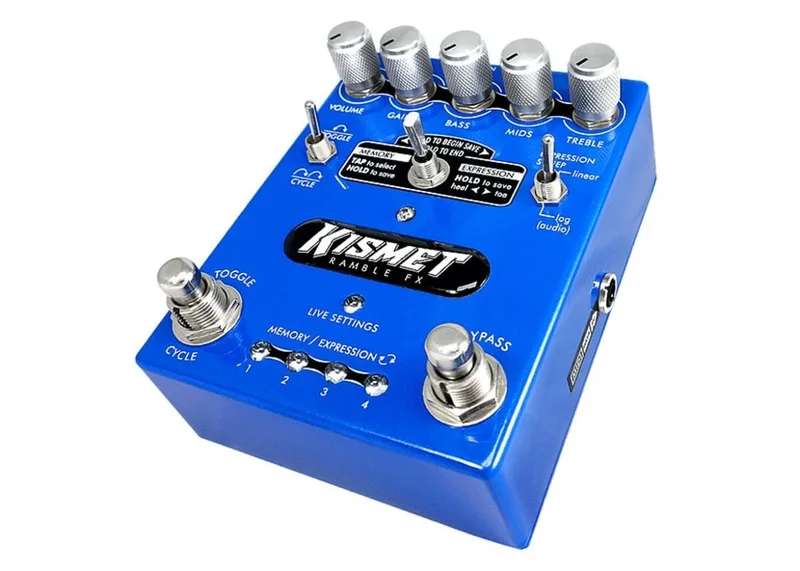
The Marvel Drive went through several versions. The original circuit was traced by PedalBlotter, and a later version added a Presence control; one builder built it "v3 style with a presence control and 18v charge bump"1. The V3, reviewed by Pedal of the Day in December 2018, is the overdrive pedal form of the design with the voltage doubler and dual gain knobs2. Ramble FX also makes the related Marvel 3 Drive and the Kismet overdrive/distortion pedal.
The pedal is also well known as a DIY project. On 10 July 2014, IvIark of Guitar FX Layouts published a stripboard layout for the PedalBlotter trace, in both horizontal and vertical formats1.
- Horizontal layout: 25 x 10 (stripboard columns x rows), fits a 1590B enclosure rotated 90 degrees with space at the sides1
- Vertical layout: 15 x 20, for builders who prefer that orientation1
- Status: verified working by builder johnk, who reported "it works perfect and sounds great"1
- Build cost: one builder put the complete DIY build at $15 to $20 in parts (2014)1
Common mods and build notes
The layout's comment thread, where much of the build knowledge of this circuit lives, settled on a few points:
- JFET selection: MPF102s are not good replacements for the J201s; a builder who tried them got low volume1.
- Brighter treble: the two 2n2 capacitors at the output stage cut what some builders found to be too much high end; replacing them with 470pF capacitors gives a brighter treble response, and socketing them is recommended so values can be swapped1.
- Adding Presence: a 20K pot with a 22n capacitor to ground before the volume pot adds a Presence control to the layout; the volume pot's lug 3 wire moves to the Presence pot's lug 31.
- Treble pot capacitors: the 100pF capacitors in the circuit mount directly on the Treble pot's lugs 2 and 31.
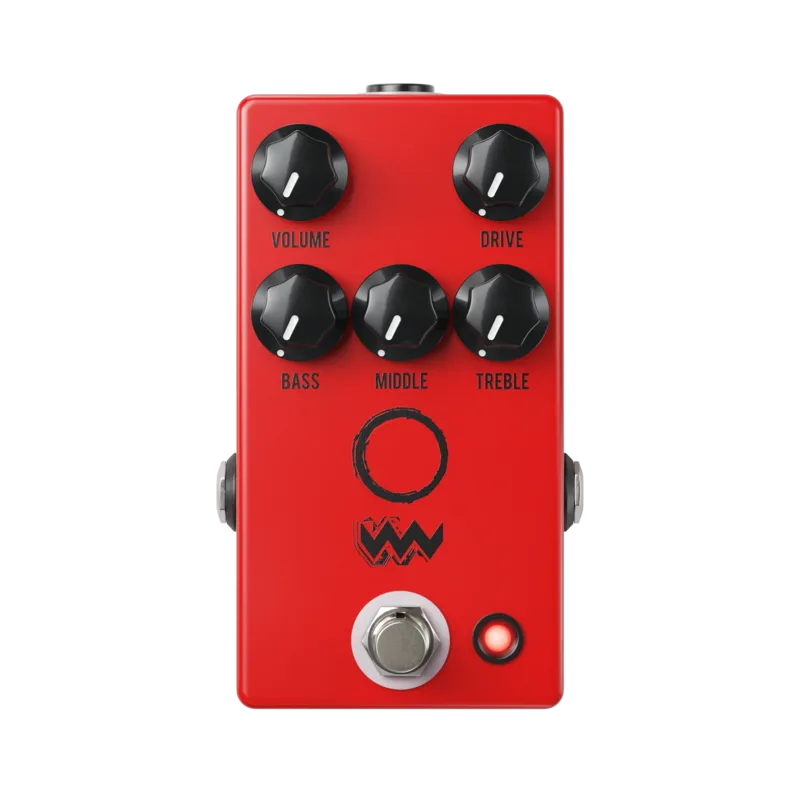
For comparison, adding a Presence control to a plexi-style pedal is not unique to Ramble FX: JHS added one to its Angry Charlie in its V2 revision5. The Marvel Drive's take on the plexi formula, though, is the parallel JFET channel architecture underneath the knobs1.
What reviewers and builders said
Published coverage of the Marvel Drive has been positive. Pedal of the Day's 2018 review of the V3 called it a stunningly accurate portrayal of the old Marshall Plexi amps, crediting the way it employs the techniques, circuitry and attitude of those amplifiers rather than just approximating their tone2. RockBoard's PedalPedia entry for the Marvel 3 Drive describes it simply as a Marshall "Plexi" in a box with a great sound3.
Builder reports from the layout thread add a note that high-gain players will care about: one builder was surprised by how little hum the pedal produces once boxed, at least for a circuit capable of such high gain levels1.
Pete Thorn's demo video walks through the dual channel volumes, the master, the presence control and the 9V/18V switch, with examples across the pedal's gain range from low mid gain to high gain solo tones4.
Videos
ProGuitarShopDemos
Brett Kingman
Questions
Can the Marvel Drive run at 12V?
Yes. A builder reported the original circuit working well at 12V, with a bit more headroom and less sag than at 9V. The V3 takes a different approach: an internal voltage doubler lets it run at 18V from a 9V supply for more headroom, with a switch selecting 9V or 18V operation.
Can I use MPF102 JFETs instead of J201s in a Marvel Drive build?
No. A builder who tried MPF102s as replacements for the J201s in the traced circuit ended up with low volume, concluding that MPF102s are not good substitutes. If you are building the stripboard layout, stick with J201s and set the drain voltages with the onboard bias trimmers.
How do I add a Presence control to the Marvel Drive layout?
On the stripboard layout, a Presence control can be added as a 20K pot with a 22n capacitor to ground before the volume pot. The wiring moves the volume pot's lug 3 wire to the Presence pot's lug 3 instead. Later official versions of the pedal added a Presence control as a standard knob.
How do I make the Marvel Drive brighter?
The most common mod is at the output stage: the two 2n2 capacitors there cut what some builders found to be too much high end, and replacing them with 470pF capacitors gives a brighter treble response. Builders are advised to socket those capacitors so values can be swapped easily.
Does the Marvel Drive hum at high gain?
According to builder reports, it is surprisingly quiet for a circuit capable of such high gain. One builder who boxed the stripboard build said he was surprised by how little hum the pedal produces, at least for a circuit with that much gain on tap.
Sources (5)
- Guitar FX Layouts: Ramble FX Marvel Drive, Guitar FX Layouts (tagboardeffects.blogspot.com), 2014-07-10
- Ramble FX Marvel Drive V3 Plexi Overdrive, Pedal of the Day, 2018-12-06
- Marvel 3 Drive by Ramble FX, RockBoard PedalPedia, 2026
- Ramble FX Marvel Drive, demo by Pete Thorn, YouTube (Pete Thorn channel), 2016-02-25
- ANGRY CHARLIE V3, JHS Pedals