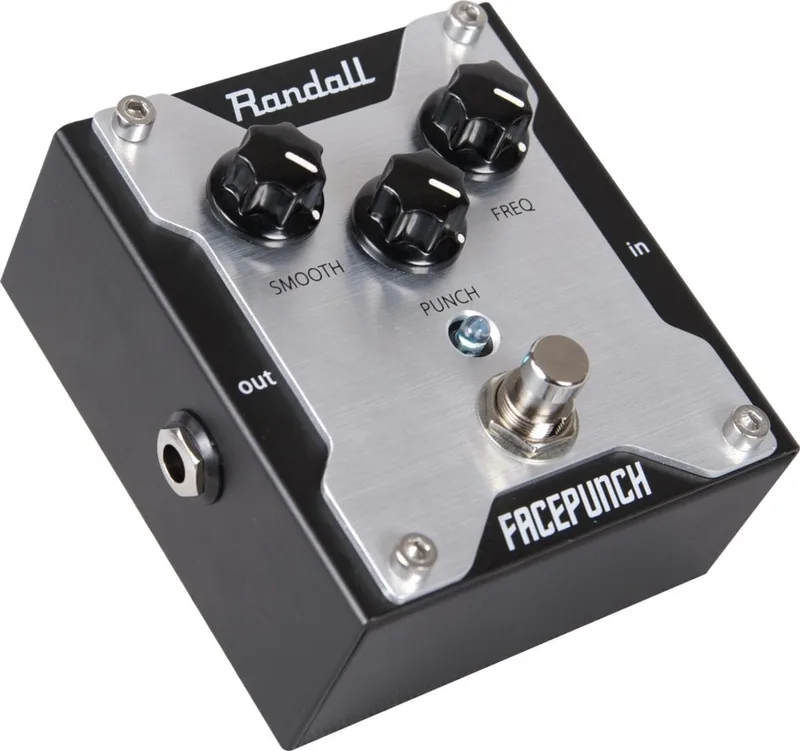


The Randall FACEPUNCH is a frequency-selective boost pedal from Randall, built on a discrete transistor design with what the maker describes as a "triode overload type of response"1. Rather than generating its own heavy distortion, it is designed to drive the front end of a tube amplifier into extreme gain: the PUNCH control sets the output level from roughly unity gain up to +20 dB, while FREQ tightens or adds back thickness and SMOOTH adjusts the top-end edginess1. It is an analog pedal, listed at $224.992.
Controls and how it shapes the sound
The pedal has three controls and a bypass footswitch. Randall describes the PUNCH control as adjusting the output signal drive from roughly unity gain to +20 dB, which is the level that pushes a tube amp's front end harder1. FREQ and SMOOTH shape the character of that push: FREQ tightens the low end or adds thickness back in, and SMOOTH dials the edginess of the top end1.
| Control | What it does |
|---|---|
| PUNCH | Output drive from roughly unity gain to +20 dB1 |
| FREQ | Tightens or adds back thickness1 |
| SMOOTH | Adjusts top-end edginess1 |
| Bypass footswitch | Switches between true bypassed raw instrument signal and the signal through the pedal's electronics1 |
Because it is a boost rather than a full distortion or fuzz pedal, the FACEPUNCH works by hitting your amplifier harder rather than clipping the signal itself. That makes it a different tool from a self-contained overdrive pedal: the heavy sound comes from the amp reacting to the boosted, frequency-shaped signal1.
Power and connections
The FACEPUNCH runs on most center-negative 9V DC supplies, and Randall prefers its own PPS1 supply, which provides 15 volts DC and offers more gain and headroom than a standard 9 volt supply1. Maximum current draw is 5 mA, which is low enough that it places little demand on a pedalboard power supply1. A 9 volt battery fits in a compartment with an easy change system, so the pedal does not have to be removed from the pedalboard to swap it1. The external power supply connection is on the pedal, but the supply itself is not included1.
Running the pedal at 15V DC through the Randall PPS1 gives more gain and headroom than a standard 9V supply, according to Randall. If you want the full +20 dB of push, the higher voltage is the maker's preferred option1.
Connections are simple: a 1/4" instrument input for the guitar, and a 1/4" line output with no speaker emulation1. Randall says the output connects to a guitar amplifier input, an effects loop return, a power amp, or the next pedal in the effects chain1. The lack of speaker emulation means the output is a raw line-level signal, so it pairs with whatever amp or cab simulation you use elsewhere in your rig rather than providing it itself.
Where it came from
The FACEPUNCH was announced alongside two other Randall pedals, the MOR and the RGOD, to be premiered at NAMM 20143. It comes from Randall, a maker better known for amplifiers, and the pedal's design brief, driving a tube amp's front end, reflects that amplifier background.
Videos
George Kapa
The Tone King
MJPGuitar
Questions
Does the Randall Facepunch take a battery?
Yes. It takes a 9 volt battery in a compartment with an easy change system, so you can swap the battery without removing the pedal from your pedalboard. It also has an external power supply connection, though the supply itself is not included with the pedal.
Is the Randall Facepunch true bypass?
Yes. The bypass footswitch selects between the true bypassed raw instrument signal and the signal fed through the pedal's electronics, so when it is off your guitar passes through untouched.
Does the Facepunch have speaker emulation on its output?
No. The 1/4 inch line output has no speaker emulation. Randall says it connects to a guitar amplifier input, an effects loop return, a power amp, or the next pedal in your effects chain.
Can I plug the Facepunch into an effects loop return?
Yes. Randall lists the effects loop return as one of the intended connections for the line output, alongside a guitar amplifier input, a power amp, or the next pedal in the chain.
Sources (3)
- Randall Facepunch Overdrive Owner's manual, Randall Amplification
- Randall Facepunch, onethousandpedals.com
- NAMM Three new Randall pedals unveiled, Audiofanzine, 2014-01-21