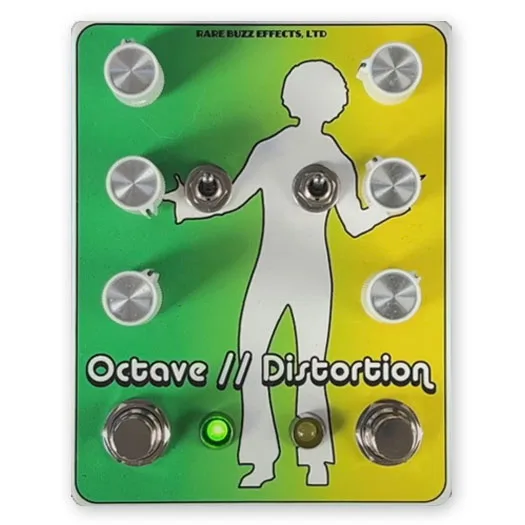


The Rare Buzz Effects Octave Distortion is a combo pedal that marries the company's 1970 Distortion and 1970 Octave pedals in a single enclosure. It packs a boost, an analog octave and a classic high gain distortion circuit into one box, with separate controls and footswitches for the two effects1.
Delicious Audio described it as a tonal platform for heavier styles: "The octave // distortion is a booming platform for garage rock, doom metal, and more," and a driving lead tone that sits well in a mix1. It belongs to Rare Buzz Effects' 1970 series, which is housed in powder-coated, UV-printed enclosures and features true-bypass switching and premium parts throughout1.
An octave and a distortion in one enclosure
The pedal is essentially two Rare Buzz Effects circuits sharing one box: the 1970 Octave feeding the 1970 Distortion. The two effects can be played separately or in series, and with both active the internal signal chain runs boost into analog octave into high gain distortion1.
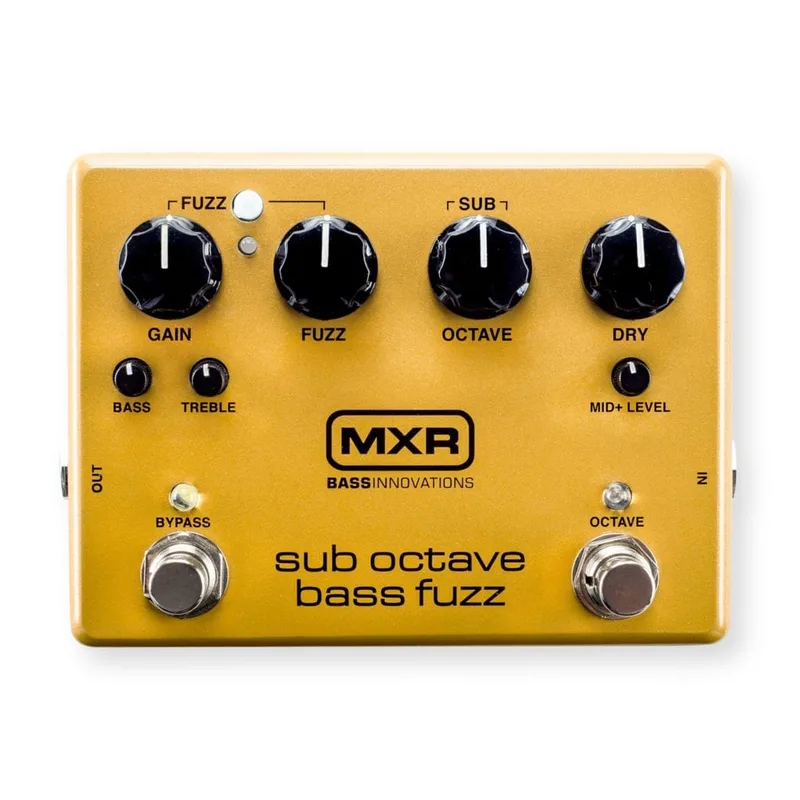
That two-in-one layout puts it in a small family of pedals that treat the octave and the dirt as independent blocks rather than one fused circuit. Premier Guitar's reviewer made the same point about the MXR Sub Octave Bass Fuzz: "you can run the fuzz or sub octave solo, so you're effectively getting two great-sounding effects in one"2. The Elysian Pedals It's Not Brain Surgery octave fuzz takes the idea one step further with a switch that inverts the order of its two effects3. The Rare Buzz pedal does not offer that: the octave always feeds the distortion. For a fixed-order contrast, the Dr. No Road Runner keeps its fuzz and wah always active, with no way to use either alone4.
For players shopping by effect type, the octave side relates to octave and pitch pedals and the distortion side to distortion pedals.
The controls
Each side of the pedal has its own control set. On the octave side, a Gain knob controls the amount of boost fed into the octave circuit and acts as a buffer for the mix control; Boost sets the final output of the octave effect; and Octave is a full range blend control that adjusts the amount of octave signal in the mix1.
The distortion side carries a Filter knob, a variable low-pass filter for the tone of the effect, and a 3-way Voice switch for the clipping stage1.
| Control | Side | What it does |
|---|---|---|
| Gain | Octave | Controls the amount of boost fed into the octave circuit; acts as a buffer for the mix control1 |
| Boost | Octave | Adjusts the final output of the octave effect1 |
| Octave | Octave | Full range blend control for the amount of octave signal in the mix1 |
| Diodes switch | Octave | Germanium diodes (up) for a more traditional octave sound, Schottky diodes (down) for a more synth-like one1 |
| Filter | Distortion | Variable low-pass filter controlling the tone of the effect1 |
| Voice switch | Distortion | Selects one of three diode pairs in the clipping stage: silicon diodes up, LEDs middle, Schottky diodes down1 |
Diode options
Both sides of the pedal let you choose clipping diodes, which is where much of its tonal range lives1.
- Distortion side, Voice switch: a 3-way switch giving traditional silicon diodes, LEDs and Schottky diodes in the clipping stage. Up is silicon, middle is LEDs, down is Schottky1.
- Octave side, Diodes switch: germanium diodes in the up position for a more traditional octave sound, Schottky diodes in the down position, which Delicious Audio described as sounding more synthy1.
"The 3-way Voice switch gives you traditional Silicon diodes, LEDs and Schottky diodes clipping"1
Running the two effects
Because each effect has its own footswitch, you can use the octave alone, the distortion alone, or both together. When both are on, the signal always runs octave into distortion, so the distortion's clipping stage sees the octave's output rather than the other way around1. Players who want the reversed order, distortion into octave, would need a separate octave pedal placed after their dirt box, since this pedal fixes the order internally.
Videos
collector//emitter
Harsh Tones, Inc.
Questions
Can the Rare Buzz Octave Distortion run the octave and distortion separately?
Yes. The two effects have separate controls and footswitches, so each side can be switched on and off on its own. When both are engaged, the pedal runs them in series, with the octave feeding the distortion.
Does the Rare Buzz Octave Distortion have true bypass?
Yes. The entire 1970 series, which this pedal belongs to, features true-bypass switching and premium parts, so the signal passes untouched when both effects are off.
What diode options does the Rare Buzz Octave Distortion have?
The distortion side has a 3-way Voice switch selecting silicon diodes, LEDs or Schottky diodes in the clipping stage. The octave side has a Diodes switch choosing germanium diodes for a more traditional octave sound or Schottky diodes for a more synth-like one.
What order do the effects run in when both are on?
With both effects active, the internal signal chain runs boost into the analog octave into the high gain distortion. The octave always feeds the distortion; the order cannot be inverted.
Does the Rare Buzz Octave Distortion have two footswitches?
Yes. The octave and distortion sides each have their own footswitch and their own set of controls, so either effect can be engaged independently.
Sources (4)
- Rare Buzz Effects Octave Distortion, Delicious Audio, 2022-12-15
- MXR M287 Sub Octave Bass Fuzz Review, Premier Guitar, 2017-09-07
- Elysian Pedals It's Not Brain Surgery Octave Fuzz, Pedal of the Day, 2023-07-23
- Dr. No Road Runner Fuzz Wah Pedal Review, Premier Guitar, 2016-02-19