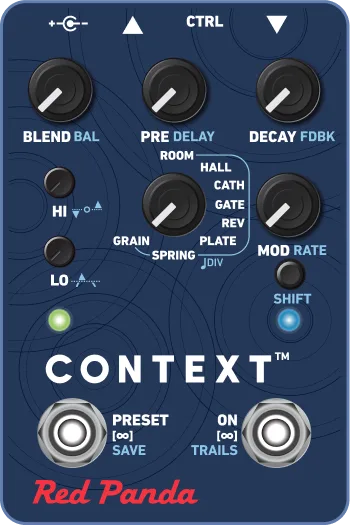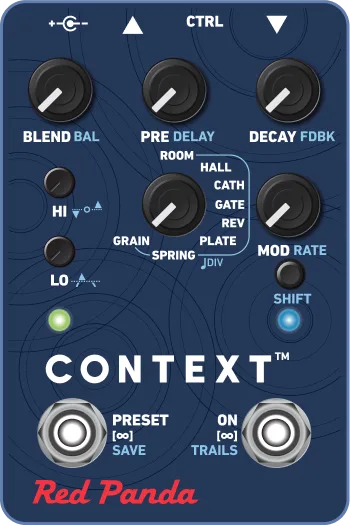


The Red Panda Context 2 is an algorithmic reverb pedal inspired by 1980s rack-mount digital reverbs, made by Red Panda. It is the second version of the company's Context reverb pedal, unveiled in January 2020, and it packs eight reverb modes, delay plus reverb in every mode, stereo input and output, and USB MIDI into a compact stompbox123.
For a player, the pitch is character rather than neutrality: modes run from a fast-building room to a granular reverb inspired by a 1978 rack unit, with a modulation knob, dynamics processing, and infinite sustain under your foot. It sells for $329.00 as of October 202645.
The reverb modes, from spring to granular
The Context 2 carries eight reverb modes in total: room, hall, cathedral, gated reverb, reverse reverb, plate, spring, and granular reverb7. The patch sheet also lists a Grain Plate mode6, and Delicious Audio's stereo reverb buying guide describes V2 as adding modulation, "spring" and "grain" settings over the original8.
What the modes do:
| Mode | What it does |
|---|---|
| Room | Fast build-up with multiple initial reflections9 |
| Hall, Cathedral | Larger spaces within the eight-mode lineup1 |
| Gated, Reverse | Gated and reverse reverb algorithms7 |
| Plate | Plate reverb algorithm7 |
| Spring | Spring reverb with a small amount of inherent modulation5 |
| Granular / Grain Plate | Granular reverb, listed as Grain Plate on the patch sheet16 |
The granular mode has a specific lineage. GuitarPlayer's reviewer notes that it is inspired by the 1978 Ursa Major Space Station, a rack unit that used multiple, modulated delay taps to create reverb5. On the spring side, the same reviewer found a small amount of modulation inherent in the implementation, possibly a slight pitch waver, but concluded that Spring mode delivered the drippy vibe of that style of reverb, and that the waver was inaudible when playing in a band5.
A modulation knob changes the amount and character of different modulation types, including a square-wave tremolo in Spring mode5. Divisions for pre-delay and tremolo rate are also available, via MIDI or Red Panda's web editor9.
Controls, foot switches, and presets
The knobs go deeper than their face labels. Holding a shift button while turning them accesses delay time, delay feedback, modulation rate, and dynamics, and a double-tap locks that alternate parameter mode5. An expression pedal or CV can be assigned to any combination of parameters5.
The two foot switches do more than bypass:
- Infinite sustain: Holding down either foot switch creates infinite sustain, with two performance variations: holding the left switch gives reverb on notes played over the pad, while the right switch keeps those notes dry5.
- Preset selection: The left foot switch acts as a preset selector to call up a single preset, letting you switch between it and the sound set with the controls5.
In all, 127 presets are available via MIDI or Red Panda's optional remote foot switch5. Over USB MIDI you can control parameters and sync delay and pre-delay to a DAW clock5.
Power and connections
The Context 2 draws 250 mA at 9V DC, center negative, through a 2.1mm I.D. x 5.5mm O.D. barrel connector3. That draw rules out a battery, and players sharing a daisy-chain supply should check that the chain can deliver the current.
The pedal is analog buffered bypass, not true bypass3. Input impedance is 1 MΩ and output impedance is under 1 kΩ3. Maximum input level varies by configuration: +5.2 dBu at default, +0.5 dBu in high gain mode, +8 dBu max with unity gain, and +12 dBu max with a -3 dB pad3. Frequency response is 20 to 20 kHz, +0/-0.5 dB3.
From Context to Context 2
Red Panda unveiled the second version of its Context reverb pedal on January 22, 2020, at NAMM, with a $299 pre-order price and shipping expected late April 2020210. Guitar World called it a significant upgrade over the existing Context pedal, with three new reverb algorithms1.
What V2 added over the original:
- Stereo input and output5
- USB MIDI1
- Full assignability for expression pedals5
- Delay plus reverb in all modes5
- Modulation, "spring" and "grain" settings8
The original Context stored up to 127 presets and used TRS stereo connections10, so the preset count carried over while the connections and control surface grew.
What reviewers said
GuitarPlayer's 2026 review was positive on the sound: the reviewer found the Context 2 offers high-quality ambience with no trace of metallic harshness in the tails, a flexible tone shaping section, and vast versatility in a small footprint5. The dynamics processing also earned praise, with the reviewer finding the ducking and expanding options yielded very expressive results5. The overall verdict summed it up as:
"Great-sounding, character-filled reverb and delay."
GuitarPlayer's reviewer, overall verdict5
Gearnews reviewed the Context V2 in January 2020, noting the eight reverb modes and the addition of USB-MIDI7.
Firmware and updates
To check the firmware version, hold down the PRESET (left) foot switch while connecting power, keep holding for 2 seconds, and the pedal enters USB Mass Storage mode, where you can read the VERSION.TXT file3.
Videos
Guitar World
Red Panda Lab
Do Noise
Questions
Is the Red Panda Context 2 true bypass?
No. The Context 2 uses an analog buffered bypass, as stated in the maker's owner's manual. It is not a true bypass pedal, so the signal path always passes through the pedal's buffer when the effect is off.
Is the Context 2 stereo?
Yes. The Context 2 has stereo input and output, which was one of the additions over the original Context. The original Context used TRS stereo connections, and the second version brought stereo input/output alongside USB MIDI.
How many presets does the Red Panda Context 2 hold?
The Context 2 makes 127 presets available via MIDI or Red Panda's optional remote foot switch. The left foot switch on the pedal itself acts as a preset selector, letting you call up a single preset and switch between it and the sound set with the knobs.
How do I check the firmware version on the Context 2?
Hold down the PRESET (left) foot switch while connecting power, keep holding for 2 seconds, and the pedal enters USB Mass Storage mode. You can then read the VERSION.TXT file to see the firmware version.
Can the Context 2 sync to a DAW clock?
Yes. Over USB MIDI, parameters can be controlled and delay and pre-delay can sync to a DAW clock. Divisions for pre-delay and tremolo rate are also available via MIDI or Red Panda's web editor.
Who designed the Red Panda Context 2?
Curt Malouin handled design and engineering for the Context 2, credited in the owner's manual. Graphics were by Sylvie Demers and Eric Iverson, and Eric Iverson also contributed sound consulting.
Sources (10)
- GW live at NAMM 2020: Take a look at Red Panda's upgraded Context 2 Reverb pedal, Guitar World, 2020-01-20
- NAMM 2020: Red Panda’s Context reverb pedal gets a huge upgrade for 2020, Guitar.com, 2020-01-22
- Context 2 Owners Manual.pdf, Red Panda LLC, 2021-11
- Red Panda Context, Red Panda Lab
- Red Panda Context 2 Stereo Reverb Review, GuitarPlayer (www.guitarplayer.com), 2021-01-28
- Context 2 Patch Sheet, Red Panda Lab, 2022
- Red Panda Context V2: A great reverb pedal just got better, gearnews.com, 2020-01-25
- Best Stereo Reverb Pedals For Synths For Texture, Ambiance, And Automation, Delicious Audio, 2024-02-23
- MODES DIVISIONS, Red Panda Lab, 2024
- CONTEXT, Red Panda Lab, 2024