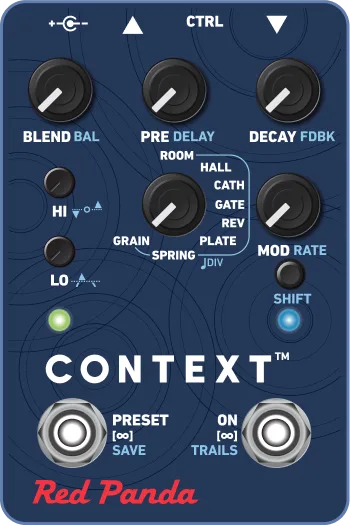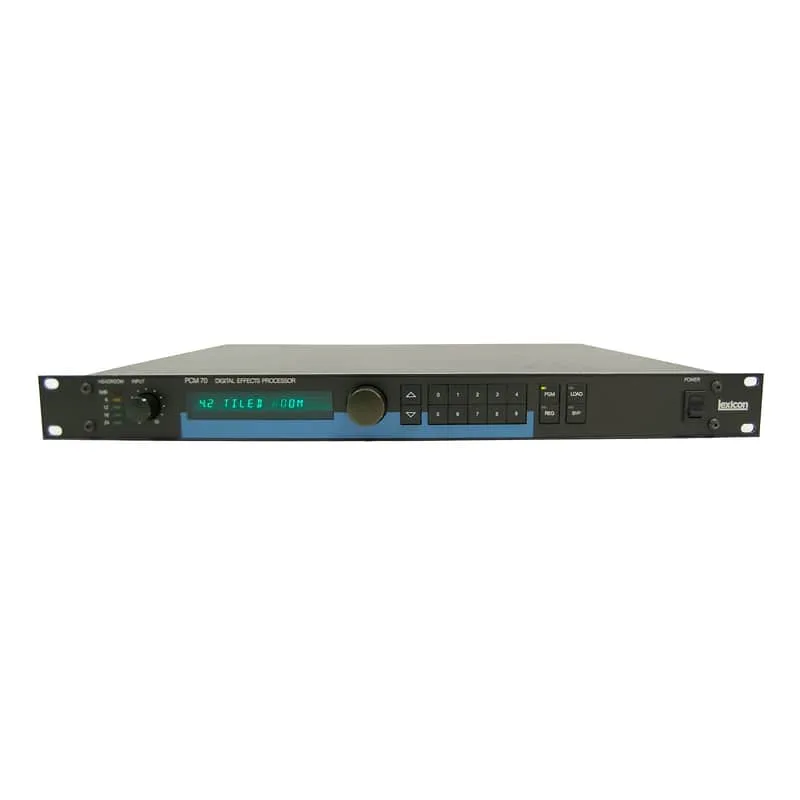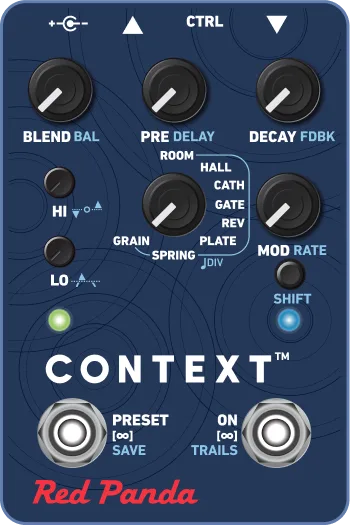


The Red Panda Context is a reverb pedal inspired by 1980s rackmount digital reverbs, the kind of units players once had to mount in a flight case to carry1. Released in 2013, it put that rack character on a pedalboard in what reviewers called a relatively small enclosure, with TRS stereo connections and a delay section built in alongside the reverb23. Red Panda describes it as a studio-quality reverb that places your instrument in a room, hall, cathedral, metal plate, or less natural spaces2.
The original Context ran for eight years before Red Panda overhauled it, launching the Context 2 at NAMM in January 202045. The first version is now superseded, but its design set the template: an algorithmic reverb with deep control, freeze functions, and preset storage that most compact reverb pedals of its era did not offer.
A reverb inspired by 1980s rack units
Where most reverb pedals chase spring plates or ambient shoegaze wash, the Context went back to rackmount digital reverbs. GuitarPlayer's reviewer noted that upon its release in 2013 it carved out its own place in a crowded field of reverb pedals by being the only one to draw inspiration from 1980s rackmount units, naming the Alesis Midiverb II and Quadraverb and the Lexicon PCM70 as reference points7. The Context 2's Granular mode goes even further back, taking its cue from the 1978 Ursa Major Space Station, which used multiple modulated delay taps to create reverb7.
For a player, that lineage means the Context leans toward the focused, characterful spaces of studio rack units rather than endless ambient tails. Pedal of the Day's 2014 review described the individual modes in those terms: Room "gets right to the point, shoving the reverb right down your amp's throat," while Hall is "more open and ambient, a much slower response than the Room mode"3.
Reverb modes
The original Context offered six modes7:
| Mode | What reviewers said it does |
|---|---|
| Room | Immediate, in-your-face reverb3 |
| Hall | More open and ambient, slower response than Room3 |
| Cathedral | "Extremely live and bright-sounding"3 |
| Gated | A snippet of reverb before an abrupt cutoff3 |
| Plate | Metal plate reverb2 |
| Delay | "Mixes your reverb signal into a beautiful set of repeats"3 |
The Context 2 expanded this to eight modes: Room, Hall, Cathedral, Gate, Reverse, Plate, Spring and Grain, adding granular, reverse and spring reverb algorithms to the original set510.
A BAL control blends between the two halves of the pedal. Centered, reverb and delay effect levels are equal; at the delay end any active delay is in full effect with no reverb, and at the reverb end any active reverb is in full effect with no delay11. The PREDELAY knob adjusts predelay time from 0 to 150 ms, and Red Panda notes that a longer predelay can create space and add definition within dense arrangements; hold SHIFT while turning it to adjust the delay time instead. Setting both DELAY and FDBK to zero turns the delay section off entirely12.
Bypass modes and trails
Bypass behavior is one of the Context's more configurable features. In the original hardware, the pedal is true bypass with the trails switch off; with trails on, the reverb dies naturally when you switch to bypass or change presets, rather than being cut off abruptly2. Pedal of the Day described this as true bypass with internally adjustable trailing when disengaged3.
Updated firmware offers four bypass modes8:
- DSP: the standard mode, with the dry signal passing through the DSP.
- ANALOG: dry signal passes through the DSP when the effect is on, and a buffered analog signal path in bypass. Depending on the input signal, there could be a small click when the effect is engaged.
- ANALOG + FX LEVEL: dry signal passes through a unity-gain analog signal path.
- KILL DRY: dry signal is always muted, useful for wet/dry parallel effects chains and mixer aux sends. BLEND acts as an effect level control but keeps the same response as in other modes.
Trails can also be turned on or off at the preset level using Red Panda's web-based editor; by default, presets follow the global trails setting8. The Context 2 moved this control onto the pedal itself: it has two footswitches, one that bypasses the effect and can also switch trails on or off, and one that accesses the preset with a save function4.
Freeze and sustain functions
Holding the switch engages one of three reverb freeze effects, configurable using the web editor or MIDI8. One of them, Infinite Sustain, holds the current reverb with the input still active, so continuing to play causes the sound to build up to saturation8. This is the kind of function players otherwise reach for a looper or a dedicated freeze pedal to get, and here it is built into the reverb itself.
The Context 2 also adds a Dynamics section hidden behind the EQ knobs: Lo EQ shifts to a dynamics threshold and Hi EQ shifts to ducking or an expander, alongside shift functions on Decay (feedback), Modulation (rate), Pre (delay) and the Division mode control4.
Presets, control and connections
The Context holds 127 presets in memory, accessible via the web editor, TouchOSC or MIDI9. The first preset can be programmed and called up on board using the PRESET switch; on the Context 2, Gearnews notes that this preset is used together with the current knob positions, so two sounds can be called up directly4. The Context 2 also adds USB MIDI for storing presets5.
The pedal can be controlled with an assignable expression pedal, remote switch, remote tap, CV, or MIDI1. The Context 2's expression input allows effects to be modulated via an expression pedal4.
The original Context also acts as a high-quality buffer when trails are switched on, featuring WIMA film caps and a Burr-Brown 4134 op amp2. Pedal of the Day's review noted the high quality components throughout: Burr-Brown op amps, WIMA poly film caps and Neutrik jacks3.
History and versions
Red Panda released the original Context in 20137. It ran unchanged in its basic form for eight years before the company showed an upgraded version at NAMM in January 2020, which Guitar World described as a significant upgrade over the existing pedal413. The Context 2 added stereo in and out processing, USB-MIDI, the three new reverb algorithms, and the second footswitch45.
The Context 2 carries a list price of $299 (2021), in a navy blue texture powder coat enclosure with laser etched graphics, measuring 4.7 by 3.7 inches, with a one year warranty10. Its manual credits Curt Malouin with design and engineering and Eric Iverson with sound consulting6.
What reviewers said
Reviews across the pedal's life have been positive. Pedal of the Day called the original "just a hands-down great and versatile reverb pedal" and suggested it as a good introduction to Red Panda's pedals, a little more user-friendly than some of their other designs3. Gearnews called the Context 2 "a worthy successor to a great reverb pedal, with functional updates that make the successor interesting, even for people who already own the first version"4.
GuitarPlayer's verdict on the Context 2 summed it up as "Great-sounding, character-filled reverb and delay" with tons of easy access control in a small package7. In Guitar Pedal X's 2021 roundup of stereo reverb workstation pedals, the Context 2 placed 26th with one point1014.
"Great-sounding, character-filled reverb and delay."
Videos
Red Panda Lab
Red Panda Lab
Reverb
Questions
Is the Red Panda Context true bypass?
It depends on the trails setting. With trails switched off, the Context is true bypass. With trails on, the reverb dies naturally when you bypass the pedal instead of being cut off abruptly. The updated firmware offers four bypass modes: DSP, ANALOG, ANALOG + FX LEVEL and KILL DRY.
Is the Red Panda Context stereo?
Yes. The original Context has TRS stereo connections, and the Context 2 processes stereo signals in and out. Stereo operation is one of the features the pedal carried over from its rackmount inspirations.
How many presets does the Red Panda Context store?
The Context holds 127 presets in memory, accessible via the web editor, TouchOSC or MIDI. The first preset can be programmed and called up on the pedal itself using the PRESET switch, so two sounds can be reached directly from the unit.
What power supply does the Red Panda Context need?
A 9V DC center negative supply, Boss style, with a 2.1mm I.D. x 5.5mm O.D. barrel connector on the Context 2. The Context 2 draws about 100 mA, so a standard pedalboard power supply output will run it.
Sources (14)
- CONTEXT, Red Panda Lab, 2024
- context_instructions.cdr, Red Panda Lab, 2013-04
- Red Panda Context Reverb, Pedal of the Day, 2014-11-24
- Red Panda Context V2: A great reverb pedal just got better, gearnews.com, 2020-01-25
- NAMM 2020: Red Panda’s Context reverb pedal gets a huge upgrade for 2020, Guitar.com, 2020-01-22
- Context 2 Owners Manual.pdf, Red Panda LLC, 2021-11
- Red Panda Context 2 Stereo Reverb Review, GuitarPlayer (www.guitarplayer.com), 2021-01-28
- BYPASS, Red Panda Lab, 2024
- PRESET, Red Panda Lab, 2024
- Guitar Pedal X, Guitar Pedal X, 2021-08-16
- BLEND BALANCE, Red Panda Lab, 2024
- PREDELAY, Red Panda Lab, 2024
- GW live at NAMM 2020: Take a look at Red Panda's upgraded Context 2 Reverb pedal, Guitar World, 2020-01-20
- The Best Guitar Pedals Of 2020 according To The Internet Experts, Delicious Audio, 2021-01-21