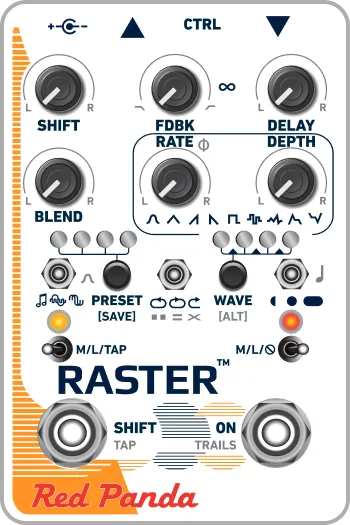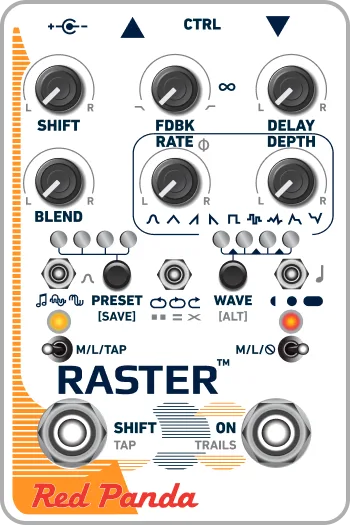


The Red Panda Raster is a digital delay pedal with a pitch and phase shifter built into the feedback loop, so the shifting happens to each repeat rather than to your whole signal. Instead of echoes that simply fade, the repeats can climb in pitch, detune, reverse, or push into self-oscillation. Red Panda describes it as a pitch shifting delay with modulation, with up to 1600 ms of delay time and modulation in one of seven waveforms1.
The original Raster launched in 2015 at $249, designed and manufactured in Detroit, Michigan2. It was succeeded by the Raster 2, announced in July 2021, which more than doubled the delay time from 750 ms to 1600 ms345. This page covers both, with the emphasis on the original pedal.
A delay with pitch and phase shifting in the feedback loop
The Raster's core idea is where the shifting sits: inside the feedback loop, so each repeat is shifted again on the way through. The pitch shifter operates in three modes, with three types of feedback, for a total of 8 different combinations10. Tuned pitch shifting covers plus or minus 12 semitones, and micro pitch shifting is also available9.
Three delay ranges let you dial in resonant feedback and change delay time instantly for rhythmic shifts1. Knob responses are tuned for exploring self-oscillation and feedback on the verge of blowing up, but the pedal also works for clean delays up to 750 ms10.
The controls
The front panel keeps things immediate. The main controls:
| Control | What it does |
|---|---|
| Delay | Sets the delay time within one of four ranges12 |
| Feedback | Sets the number of repeats9 |
| Blend | Mixes the wet and dry signals9 |
| Shift | Adds pitch shifting to the delayed signal, activated by a second footswitch9 |
| Shift mode toggle | Selects one of three pitch shifting modes13 |
| Feedback mode toggle | Reverse delay, continuously shifted repeats, or single-shift mode8 |
| Wave switch | Selects the shape of the modulation14 |
| ON footswitch | Turns the pedal on and off15 |
| SHIFT footswitch | Engages and disengages pitch or phase shift, with an orange LED indicator10 |
The delay ranges are 0 to 400 ms, 0 to 800 ms, 0 to 1600 ms, and 0 to 3200 ms, with the fourth range accessed via MIDI, TouchOSC, or the web editor12. At the minimum setting with no feedback, there is no delay at all, for pure pitch shifting and amplitude modulation effects12. Fast knob movements jump smoothly to the new delay time; slow movements change it gradually while minimizing glitches, which enables drag, time stretching and glitchy stutter effects12.
Holding ALT and adjusting DELAY changes the offset or ratio between the left and right delay times, with ratios of 3:4, 2:3, 1:2, 3:8, 1:3, and 1:4 at higher settings; once a ratio is set, the DELAY knob moves both delay times proportionally12. An optional expression pedal can control the pitch shift amount, and the shift mode is footswitchable so you can change modes without reaching down8.
Shift modes, modulation and presets
The wave switch selects the modulation shape, and the sine wave position is smooth and non-linear, commonly used for chorus or flanging14. Modulation can be assigned to delay time, pitch shift, or effect level for glitchy pitch jumps, wow and flutter, and broken tape effects1.
The Raster holds 127 presets in memory, accessible via the web editor or MIDI. Presets 1 to 4 can also be accessed and programmed onboard using the PRESET switch: tap it to advance through presets 1 to 4, and on the fifth tap the pedal returns to live settings16.
Bypass is configurable through the web editor, TouchOSC, or MIDI, with modes including AUTO (the default), DSP, ANALOG, ANALOG + FX LEVEL, and KILL DRY. Trails are on by default, letting repeats decay naturally after bypass, and can be toggled by holding ALT and pressing ON15.
Power and connections
The Raster requires a 9V DC center negative, regulated power supply rated at 250 mA or higher, Boss style. Using an incorrect power supply may damage the pedal, and no battery operation is mentioned, so plan on a dedicated spot on your power supply10.
The pedal measures 4.35 by 3.25 by 2.5 inches (111 by 83 by 64 mm)17. I/O is mono in and stereo out by default, configurable through the editor, with a CV/expression input for an expression pedal6. The mini USB port supports firmware updates and MIDI, with 1/4 inch MIDI available through third-party adapters6.
The original Raster and the Raster 2
The Raster 2, announced in July 2021 at $299, keeps the original's simplicity while adding flexible modulation and extensive stereo functionality185. It is performance friendly, with 6 knobs and 9 switches, in a smaller enclosure measuring 3 inches wide with all jacks on top191. Delay configurations include reverse, parallel, series and ping pong options18.
Key differences side by side:
| Original Raster | Raster 2 | |
|---|---|---|
| Max delay | 750 ms8 | 1600 ms1 |
| Shift modes | Three pitch shifting modes13 | Transpose by semitones, detune, or phase/frequency shift, the latter shifting plus or minus 500 Hz7 |
| MIDI | Mini USB, 1/4 inch via adapter7 | USB MIDI in/out and 1/4 inch TRS MIDI input7 |
| Tap tempo | None; pitch shift switch takes the tap spot11 | Shift footswitch assignable to tap tempo115 |
| Width | 4.35 inches17 | 3 inches19 |
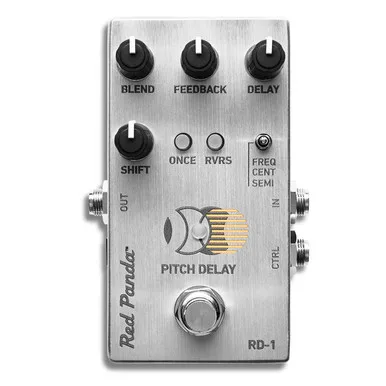
Red Panda engineer Curt Malouin designed the Raster 219. Red Panda has also released the RD-1 Pitch Delay, a simplified, knob-driven take on the same idea.
What reviewers said
Premier Guitar's reviewer noted that the Raster in some respects evolves from modulating analog delay units like the Electro-Harmonix Deluxe Memory Man, and found that with a Gibson Les Paul into a Soldano Lucky 13 half stack, repeats were clear but with a slightly lo-fi decay in the highs8. Of the shifting itself, the reviewer wrote:
"The results veer from subtle to cacophonous, from gentle chorusing and throbbing repeats to synth-like tones and all-out self-oscillating madness."8
Pedal of the Day's Mike B found the pedal intuitive once you sit down and figure out how everything works, both individually and together9. Delicious Audio's Ryan Dembinski highlighted the harmonized tone on the repeat, writing that it "adds a powerful and surprising feeling the overall tone"11.
Videos
ProGuitarShopDemos
The Pedal Zone
Mark Johnston
Questions
Does the Red Panda Raster have MIDI?
Yes. The original Raster's mini USB port supports MIDI along with firmware updates, and 1/4 inch MIDI works through third-party adapters. The Raster 2 adds USB MIDI in and out plus a 1/4 inch TRS MIDI input, sending and receiving on MIDI channel 1 by default, changeable via SysEx or the web editor.
Does the Raster do reverse delay?
Yes. A feedback mode toggle selects reverse delay, where all repeats are reversed, alongside forward delay with continuously shifted repeats and a single-shift mode where only the first repeat is pitch-shifted. The Raster 2 also offers parallel, series and ping pong delay configurations.
Is the Red Panda Raster stereo?
Yes. The Raster can be configured for stereo input and output, with the left and right delay times set either as a ratio or offset in milliseconds. The Raster 2 has 1/4 inch TRS stereo input and output jacks, defaulting to mono in and stereo out.
Does the Raster have tap tempo?
The original Raster has no dedicated tap tempo switch; the pitch shift switch sits where a tap tempo switch would be on some other delays. On the Raster 2, the Shift footswitch can be set to momentary, latching, or tap tempo operation.
Sources (19)
- RASTER, Red Panda Lab, 2024
- Red Panda Unveils the Raster Delay, Premier Guitar, 2015-04-28
- Raster 2, Red Panda
- Red Panda Raster 2 Delay, Delicious Audio, 2023-11-09
- The Red Panda Raster 2 digital delay boasts some serious upgrades, MusicRadar, 2021-07-19
- Microsoft Word, Red Panda Lab, 2021
- Raster 2 Owners Manual.pdf, Red Panda LLC, 2022-06
- Red Panda Lab Raster Delay Review, Premier Guitar, 2015-09-25
- Red Panda Raster Delay, Pedal of the Day, 2015-10-13
- raster_instructions.pdf, Red Panda Lab, 2017
- Red Panda Raster Delay, Delicious Audio, 2015-06-19
- DELAY, Red Panda Lab, 2024
- SHIFT MODE, Red Panda Lab, 2024
- WAVE, Red Panda Lab, 2024
- BYPASS, Red Panda Lab, 2024
- PRESET, www.redpandalab.com, 2024
- Stompbox Delivers Delay With Pitch Shifting, Sonic State, 2015-04-29
- Summer NAMM 2021: Red Panda’s Raster 2 offers up yet more pitch delay madness, Guitar.com, 2021-07-19
- Red Panda Reveals the Raster 2, Premier Guitar, 2021-07-16