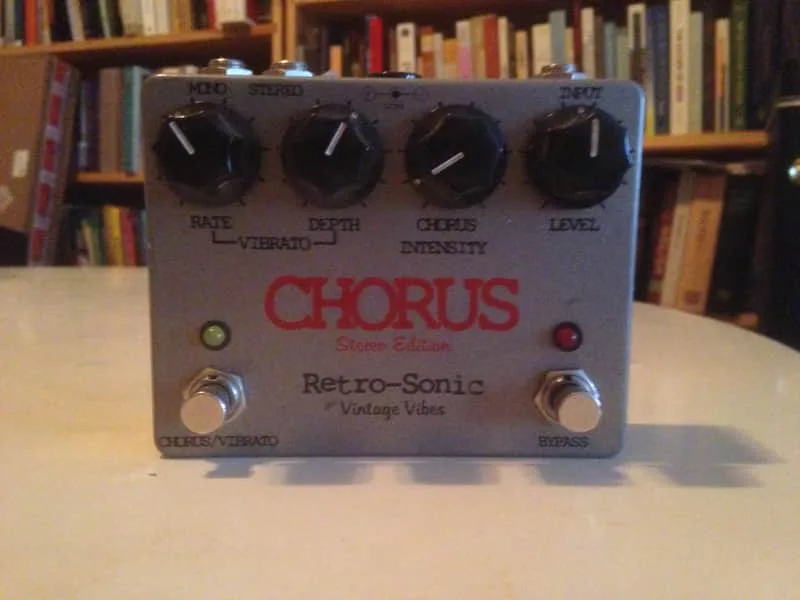


The Retro-Sonic Chorus is an all-analog chorus and vibrato pedal that recreates the sound of the late 70s Boss CE-1 Chorus Ensemble in a modern stompbox1. Retro-Sonic says it provides the distinctive lush chorus and true pitch-shift vibrato of that original pedal, and that it is capable of a wide range of sounds, from analog chorusing to pulsating vibrato2. The current version is a new model with modern features and upgraded components replacing the previous one3.
The pedal sits in the chorus lane, but it is really two effects in one box: a chorus and a vibrato, switchable from the top panel13.
What it does to your sound
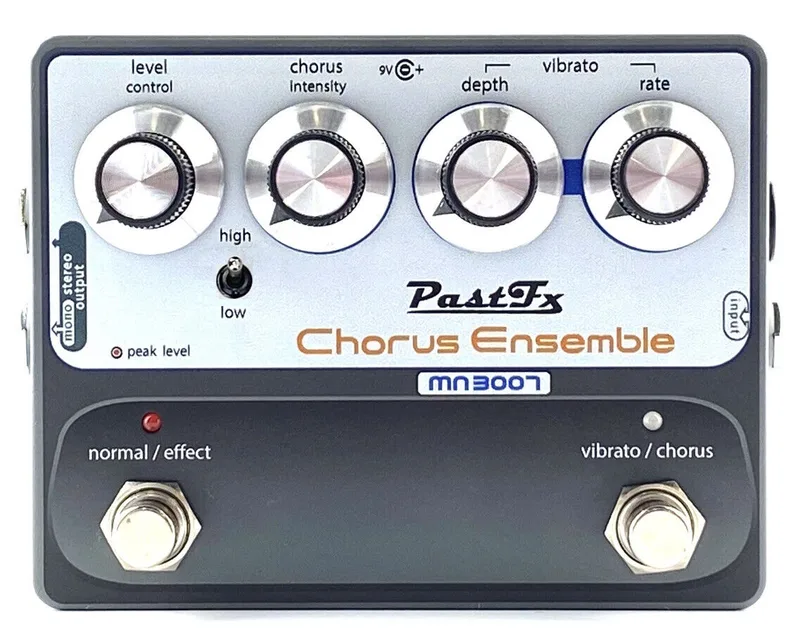
Chorus works by delaying the signal slightly and modulating that delay, then blending the delayed copy back with the dry signal. Because the Retro-Sonic is all analog, that delay comes from a bucket-brigade device (BBD) rather than a digital processor. Retro-Sonic's page says the pedal uses an MN3007 BBD2, though another Retro-Sonic page says it uses the MN3002 BBD as in the original CE-12; the maker's own pages disagree on which chip is fitted.
In chorus mode you get the thick, doubled sound the CE-1 was known for. In vibrato mode the dry signal is dropped and only the pitch-wobbled delayed signal remains, giving true pitch-shift vibrato. Like the original Boss CE-1 Chorus Ensemble, both effects share the same BBD circuit, so they cannot run at the same time5.
The controls and switches
The pedal carries separate rate and depth controls for each effect, plus a level control and the CE-1 preamp hi/lo function12.
| Control or switch | What it does |
|---|---|
| Chorus Rate | Sets the speed of the chorus modulation1 |
| Chorus Depth | Sets how deep the chorus modulation goes1 |
| Vibrato Rate | Sets the speed of the vibrato wobble1 |
| Vibrato Depth | Sets how deep the pitch shift swings1 |
| Level | Sets the output level1 |
| Color | Controls the amount of feedback signal applied3 |
| Normal/Effect switch | Stepping on it turns the effect on and off3 |
| Chorus/Vibrato switch | Selects which effect is active1 |
The chorus and vibrato functions are selectable through a footswitch control, which lets you keep your desired settings for each effect maintained separately, so switching between them does not mean dialing everything in again3.
The buffer switch
The pedal includes a built buffer that you can toggle for vintage or modern mode2. A buffer is a small preamp stage that keeps your signal strong through long cable runs and pedal chains. The vintage position preserves the character of the original CE-1 preamp circuit, while the modern position conditions the signal for contemporary rigs. Players who want the pedal to behave exactly like a 70s unit can leave it in vintage mode; players with big boards may prefer the modern setting.
A CE-1-based circuit and its newer version
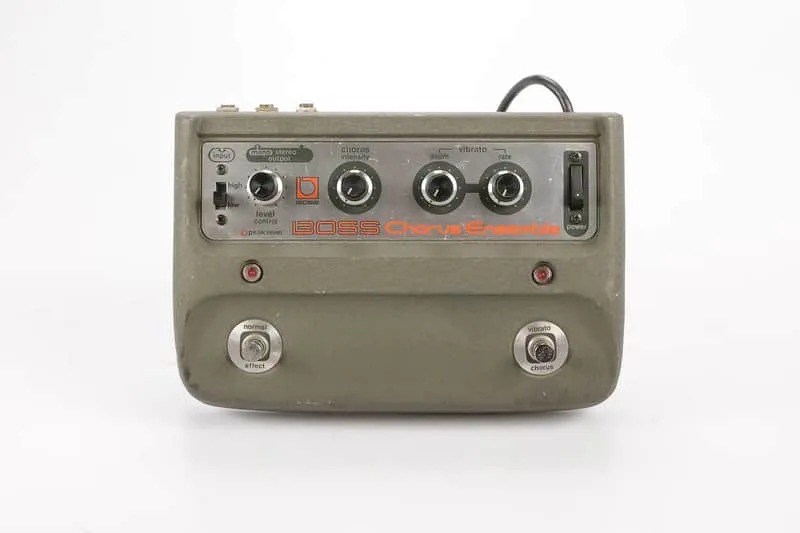
Retro-Sonic was founded in 2006 by Tim, and it all began with the Chorus, the company's first retro custom effect pedal, modeled on the Boss CE-1 Chorus Ensemble4. The CE-1 was a landmark of its era, and its stereo outputs were a feature not common in effects pedals at the time5.
The current Retro-Sonic Chorus is a new version of that first pedal. Retro-Sonic describes it as offering "the same, lush tones you know and love, now with new, modern features and upgraded components"3. Among those modern features are the stereo output jack for connecting a second amplifier, which sends the dry signal out2, and the toggleable buffer.
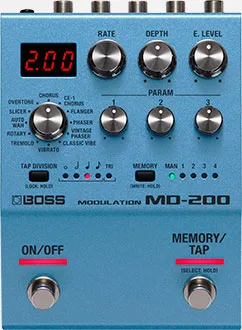
For comparison, Boss itself now covers the CE-1 sound digitally: the BOSS MD-200 includes a CE-1 Chorus mode that the maker describes as an authentic recreation of the CE-1 Chorus Ensemble, including the chorus and vibrato modes from the original pedal. The Retro-Sonic takes the analog route instead, using a BBD delay line like the original hardware621.
"The Retro-Sonic Chorus is capable of a wide range of sounds, from analog chorusing to pulsating vibrato."
Buying and availability
The pedal is listed at US$299.001. It is built to order: Retro-Sonic states that preorder pedals take approximately 4-6 weeks to ship from the date of order placement3.
Videos
ProGuitarShopDemos
musictoyznetwork rasch
wahwahwells
Questions
Does the Retro-Sonic Chorus have a stereo output?
Yes. It has a stereo output jack for connecting a second amplifier, which carries the dry signal. The main output jack is a standard quarter-inch phone jack, and the input is the same, so a two-amp setup needs only one extra cable.
What power supply does the Retro-Sonic Chorus use?
It runs on a 9VDC adapter with a negative center, the common standard for effect pedals. Retro-Sonic lists the power supply requirement as a 9VDC neg center adapter, so most standard pedalboard power supplies will work.
Can I use chorus and vibrato separately on the Retro-Sonic Chorus?
Yes. A Chorus/Vibrato switch selects which effect is active, and the two functions are selectable through a footswitch control so your settings for each are maintained separately. Like the original CE-1, both effects share one BBD circuit, so only one runs at a time.
What does the buffer switch do on the Retro-Sonic Chorus?
The pedal has a built buffer that you can toggle between vintage and modern mode. In vintage mode it behaves like the original CE-1 preamp circuit; in modern mode it conditions the signal for contemporary rigs. The buffer works whether or not the effect is engaged.
Which BBD chip is inside the Retro-Sonic Chorus?
Retro-Sonic's product page states that the pedal uses an MN3007 BBD, the bucket-brigade device at the heart of the analog delay line that creates the chorus and vibrato. A separate Retro-Sonic page says it uses the MN3002 BBD as in the original CE-1, so the maker's own pages disagree on which chip is fitted.
Sources (6)
- Chorus | retro-sonic, retro-sonic.com
- CHORUS | retro-sonic, retro-sonic.com
- New Chorus WIP, Retro-Sonic
- ABOUT US, retro-sonic.com
- TONEHOME, TONEHOME (www.tonehome.de)
- BOSS - MD-200 | Modulation, BOSS (boss.info)