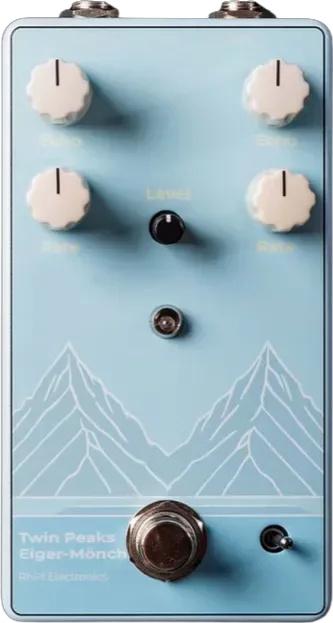


The RhPf Electronics Twin Peaks Eiger-Mönch is a dual delay pedal from RhPf Electronics, a maker based in Switzerland. It carries two independent delay lines: RockBoard's PedalPedia describes it as "a dual delay pedal with two independent lines, one lush and warm, the other crisp and bright," and Pedal of the Day called it "a unique dual parallel delay pedal with two parallel delay lines."12
Two delay lines, one warm and one clear
The idea behind the pedal is that each delay line has its own character. Pedal of the Day describes one line as delivering "warm, full-bodied depth longer repetitions," while the other "focuses on bright, crystal-clear articulation short repetitions." The maker's own framing on PedalPedia is the same split: one line lush and warm, the other crisp and bright.12
Because the lines are independent, a player can run a long, dark repeat and a short, bright one at the same time, or set the two lines to different speeds. Each line has its own Rate control, which Pedal of the Day says lets you "adjust the speed of each delay line independently to craft rhythmic echoes or dreamy, extended repeats."2
Controls
| Control | What it does |
|---|---|
| RATE | Adjusts the speed of each delay line independently2 |
| ECHO | Controls the amount of feedback and repeats for each delay line2 |
| LEVEL | Sets the overall delay volume mixed back into the dry signal2 |
| FEEDBACK TOGGLE | Chooses between parallel mode and cascading mode2 |
Parallel and cascading modes
The feedback toggle is the pedal's key switching control, and it selects how the two delay lines relate to each other21:
- Parallel mode (toggle right): Each delay line operates independently, mixing together at the output. Pedal of the Day describes the result as "spacious, wide stereo-like echoes."2
- Cascading mode (toggle left): The two delay lines feed into each other, "creating intricate rhythmic patterns, evolving textures, and accelerating repeats for ambient and experimental sound design."2
RockBoard's PedalPedia sums up the choice the same way: "Choose parallel for tight layering or cascading for evolving textures and rhythmic interplay."1
What reviewers said
Pedal of the Day reviewed the pedal on 1 March 2026, introducing RhPf Electronics as "our new friends at RhPf Electronics in Switzerland." The reviewer's verdict2:
"It looks clean, it sounds incredible and has a playful quality about it that’s both familiar and unique, making it an excellent vehicle for sonic exploration and experimentation…"
Manual and demo
RhPf Electronics publishes an English user manual for the Twin Peaks Eiger-Mönch as a PDF on its website, linked from PedalPedia. PedalPedia also lists a demo video by Loopy Demos in English.1
For more on the effect type and how dual delays sit on a board, see Delay Pedals.
Videos
Philip Czarnecki and RhpF Electronics
Pedal of the Day and RhpF Electronics
Questions
What is the difference between parallel and cascading mode on the Twin Peaks Eiger-Mönch?
In parallel mode, selected by flipping the feedback toggle right, each delay line operates independently and the two mix together at the output, which Pedal of the Day describes as spacious, wide stereo-like echoes. In cascading mode, toggle left, the two delay lines feed into each other, creating intricate rhythmic patterns, evolving textures, and accelerating repeats suited to ambient and experimental sound design.
Which way do I flip the toggle for cascading mode?
Cascading mode is selected with the feedback toggle flipped to the left. Flipping it to the right selects parallel mode, where the two delay lines run independently and mix at the output.
Can the two delay lines be set to different speeds?
Yes. Each delay line has its own Rate control, so the speed of each line is set independently. Pedal of the Day notes this lets you craft rhythmic echoes or dreamy, extended repeats, and each line also has its own Echo control for feedback and repeats.
Is there a manual for the RhPf Twin Peaks Eiger-Mönch?
Yes. RhPf Electronics publishes an English user manual for the Twin Peaks Eiger-Mönch as a PDF on its website, and RockBoard's PedalPedia page for the pedal links to it under Manual (EN).
Sources (2)
- Twin Peaks Eiger-Mönch by RhPf Electronics, RockBoard PedalPedia, 2026
- RhPf Electronics Twin Peaks Eiger-Mönch Dual Delay, Pedal of the Day, 2026-03-01