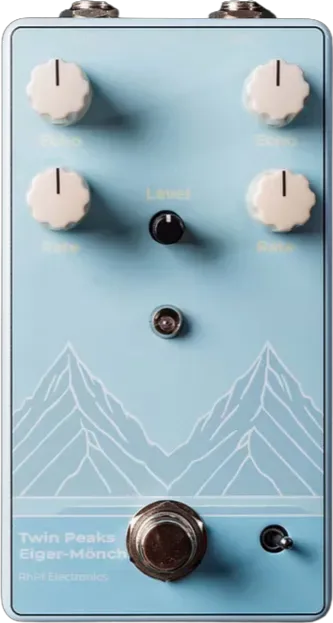


The RhPf Electronics Twin Peaks Eiger-Mönch is a dual delay pedal: two independent delay lines in a single enclosure, built by RhPf Electronics in Switzerland. RockBoard's PedalPedia describes it as having two independent lines, one lush and warm, the other crisp and bright, so a player can layer two different echo characters at once instead of choosing a single delay voicing1. Pedal of the Day, reviewing it in March 2026, called it "a unique dual parallel delay pedal with two parallel delay lines"2.
What the two delay lines do
The two lines are voiced differently by design. Pedal of the Day describes one as delivering "warm, full-bodied depth" on longer repetitions, while the other "focuses on bright, crystal-clear articulation" on shorter repetitions2. In practice that means one line can sit under a sound as a dark, ambient bed while the other adds a defined, articulate repeat on top, and the two can be dialed independently.
Parallel and cascading modes
The pedal's feedback toggle is the heart of how it works, choosing between two ways the delay lines relate to each other2:
- Parallel mode (toggle right): each delay line operates independently, and the two mix together at the output, which Pedal of the Day describes as spacious, wide, stereo-like echoes2.
- Cascading mode (toggle left): the two delay lines feed into each other, creating intricate rhythmic patterns, evolving textures, and accelerating repeats, which the reviewer points toward for ambient and experimental sound design2.
RhPf's own description puts the choice the same way: "Choose parallel for tight layering or cascading for evolving textures and rhythmic interplay"1.
Controls
| Control | What it does |
|---|---|
| Feedback toggle | Chooses between the parallel mode and the cascading mode2 |
| Rate | Adjusts the speed of each delay line independently, for rhythmic echoes or extended repeats2 |
| Echo | Sets the amount of feedback and repeats for each delay line, to fine-tune atmosphere and texture2 |
Because the Rate and Echo controls work per line, the two delays can be set to different speeds and different repeat counts at the same time, which is what makes the cascading mode's accelerating, interlocking patterns possible2.
Power and practical notes
The Eiger-Mönch takes a standard 9V DC, center negative supply and draws 50mA1. It is a hybrid circuit, combining analog and digital stages rather than being fully analog or fully digital1. RhPf publishes an English user manual for the pedal as a PDF, and a demo video by Philip Czarnecki is linked from the product's listing1.
The 50mA current draw means the pedal needs its own supply output with sufficient current; a low-current daisy-chain output may not be adequate1.
For where this pedal sits among its neighbors, see the site's Delay Pedals page.
Videos
Philip Czarnecki and RhpF Electronics
Pedal of the Day and RhpF Electronics
La Chaîne Guitare
Questions
What power supply does the Twin Peaks Eiger-Mönch need?
The Twin Peaks Eiger-Mönch runs on a 9V DC supply with a center negative plug, the standard arrangement for most pedalboard power supplies. It draws 50mA of current, so a supply with enough headroom on that output is needed. RhPf Electronics lists these figures on the product's specifications.
Is the Twin Peaks Eiger-Mönch analog or digital?
RhPf Electronics lists the circuit type of the Twin Peaks Eiger-Mönch as hybrid, meaning the design combines analog and digital stages rather than being fully one or the other.
Can the Eiger-Mönch run its two delays in parallel and in series?
Yes. The feedback toggle chooses between two arrangements. In parallel mode, each delay line operates independently and the two mix at the output. In cascading mode, the two delay lines feed into each other, producing rhythmic patterns, evolving textures and accelerating repeats.
Is there a manual for the RhPf Twin Peaks Eiger-Mönch?
Yes. RhPf Electronics publishes an English user manual for the Twin Peaks Eiger-Mönch as a PDF on its website, and the pedal's product listing links to it directly.
Sources (2)
- Twin Peaks Eiger-Mönch by RhPf Electronics, RockBoard PedalPedia, 2026
- RhPf Electronics Twin Peaks Eiger-Mönch Dual Delay, Pedal of the Day, 2026-03-01