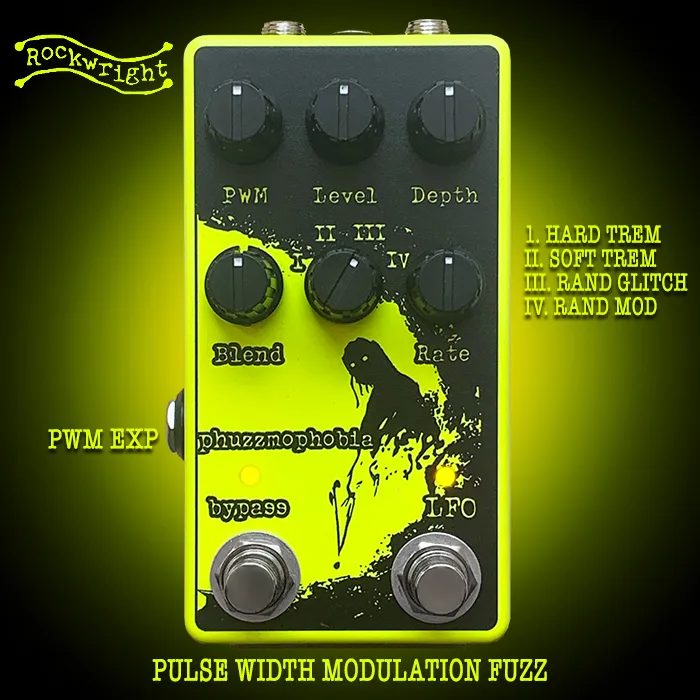
The Rockwright FX Phuzzmaphobia is a pulse width modulation fuzz, a compact fuzz pedal whose clipping character can be shaped and modulated rather than simply set. Guitar Pedal X describes it as "a pretty unique Modulated Fuzz - with a significant expanded range"1. It came out of a collaboration between Lucas of Rockwright FX and Phil of Pedal Experiments, who after Phil's October 2024 demo of the smallsound/BigSound Blarg o-tron o-tron "decided to collaborate on an evolved compact edition of that circuit"1.
Controls, modes and jacks
The pedal carries five knobs and two footswitches. The PWM Duty Cycle / EQ knob sets the pulse width character of the fuzz, Level sets output volume, Depth / Intensity of Modulation sets how strongly the modulation section acts, and Wet>Dry Blend mixes the processed fuzz against the dry signal1.
| Control | What it does |
|---|---|
| PWM Duty Cycle / EQ | Sets the pulse width modulation character of the fuzz |
| Level | Output volume |
| Depth / Intensity of Modulation | Depth of the modulation effect |
| Wet>Dry Blend | Blend between wet and dry signal |
| Mode | Selects one of four modulation modes |
The two footswitches work separately: one is the Bypass / On footswitch, the other engages the LFO modulation on its own, so the modulation can be switched in and out without touching the fuzz itself1.
The four modes are:
The first two give tremolo-style chopping in hard and soft shapes, while the last two bring in random movement, from glitchy stutter to broader random modulation1. Around the back, the jacks are a 1/4" TS input, a 1/4" TS output, a PWM EXP expression jack for foot control of the pulse width modulation, and the 9V DC center negative power input1. An expression pedal plugged into the PWM EXP jack lets a player sweep the PWM parameter while playing.
Where it came from
The Phuzzmaphobia traces back to the smallsound/BigSound Blarg o-tron o-tron, a circuit Guitar Pedal X calls super rare. After Phil of Pedal Experiments demoed the Blarg o-tron o-tron in October 2024, he and Lucas of Rockwright FX discussed the circuit and agreed to build an evolved compact edition of it together1.
What reviewers said
Guitar Pedal X's Stefan Karlsson reviewed the pedal in May 2026 and called it a superb compact evolution of the Blarg o-tron o-tron. Comparing the Rockwright circuit with the original, he came down in favor of the Rockwright version for his own use1.
He noted two editions of the Phuzzmaphobia itself: his own Neon Yellow edition, bought for £95 via the Rockwright FX Reverb.com store, and Phil's Sparkly Edition, which he found prettier but said the Neon Yellow was "close enough" to1.
Questions
What does pulse width modulation do in a fuzz pedal?
Pulse width modulation reshapes the fuzz signal by varying the width of a pulse waveform, so the character of the clipping changes rather than just its amount. In the Phuzzmaphobia, the PWM Duty Cycle / EQ knob sets that width, and the modulation section can move it automatically, producing tremolo-like, glitchy or random movement on top of the fuzz.
Can the Phuzzmaphobia be controlled with an expression pedal?
Yes. The pedal has a dedicated PWM EXP jack alongside its input and output, which accepts an expression pedal for control of the pulse width modulation. That lets a player sweep the PWM parameter with their foot while playing, rather than turning the knob by hand.
What are the four modulation modes?
The Phuzzmaphobia's mode control offers four settings: I Hard Trem, II Soft Trem, III Random Glitch and IV Random Modulation. The first two give tremolo-style chopping at hard and soft shapes, while the last two apply random movement, from glitchy stuttering to broader random modulation of the fuzz.
Who designed the Phuzzmaphobia?
The pedal was developed by Lucas of Rockwright FX together with Phil of Pedal Experiments. The collaboration began after Phil's October 2024 demo of the smallsound/BigSound Blarg o-tron o-tron, when the two discussed the circuit and decided to work on an evolved compact edition of it.
What power does the Phuzzmaphobia need?
The Phuzzmaphobia runs on 9V DC center negative power, supplied through its power jack alongside the 1/4" TS input, 1/4" TS output and PWM EXP expression jack. As with any center negative pedal, use a standard 9V DC center negative supply.
What special editions of the Phuzzmaphobia exist?
Guitar Pedal X's reviewer noted two editions: a Neon Yellow edition, which he bought, and a Sparkly Edition, which he described as prettier but said the Neon Yellow was close enough. He paid £95 for his Neon Yellow unit via the Rockwright FX Reverb.com store.
Sources (1)
- Guitar Pedal X, Guitar Pedal X, 2026-05-08