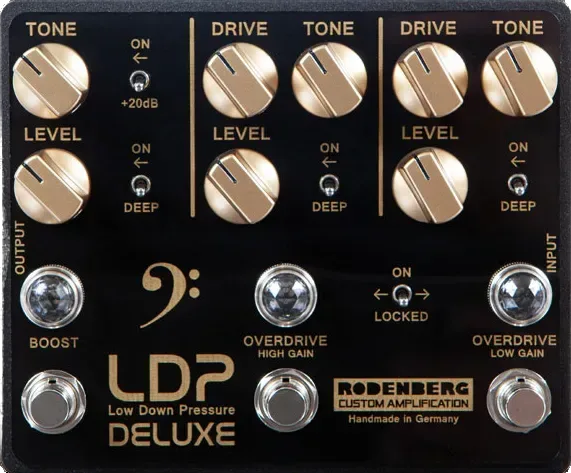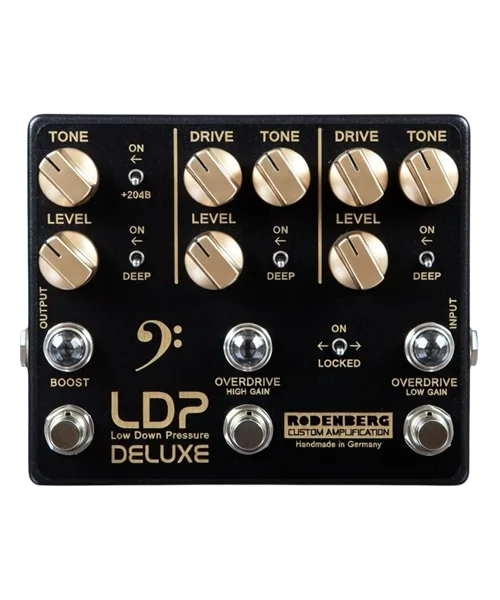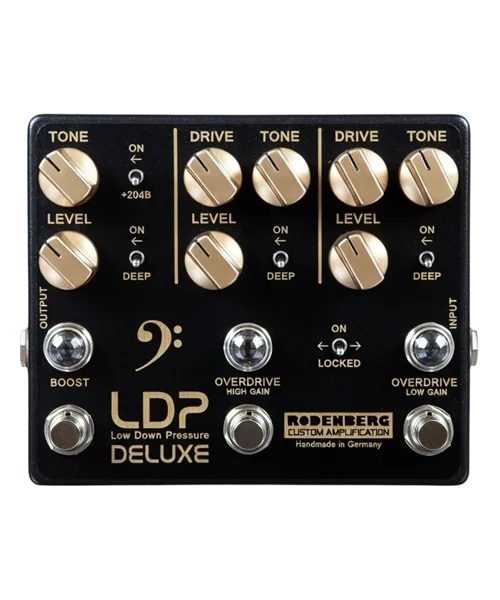


The Rodenberg LDP DELUXE is an overdrive and boost pedal for bass, built by the German maker Rodenberg. It puts three fully independent sounds in one housing: a LOW GAIN overdrive, a HIGH GAIN overdrive and a BOOST1. Rodenberg positions it not as a classic bass distortion but as a complete drive and boost platform that preserves pressure, dynamics and low end, moving from subtle tube saturation to powerful overdrive without losing the deep bass1.
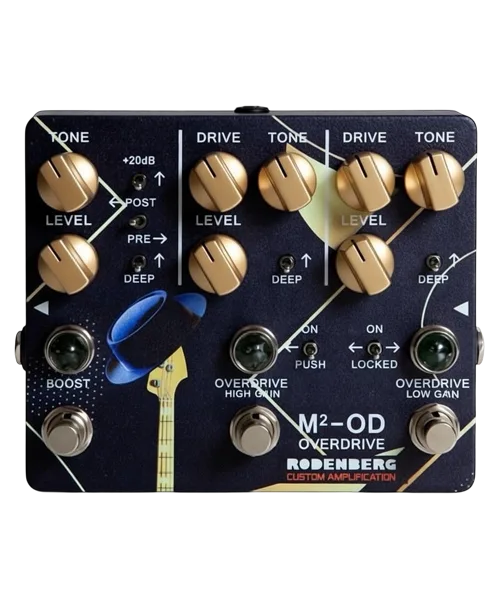
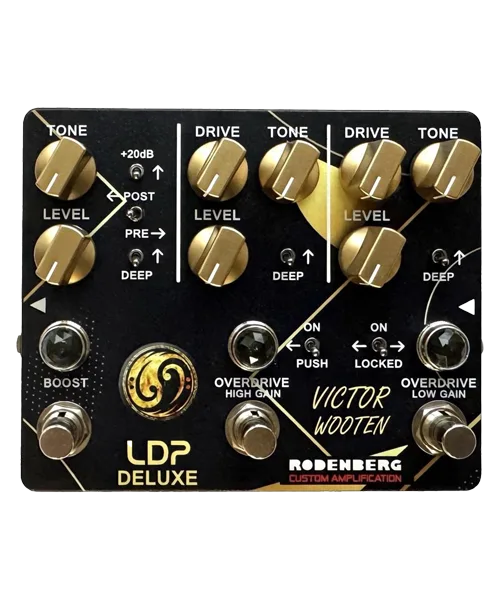
The pedal grew out of the earlier Rodenberg LDP, a combined overdrive and clean boost pedal that RockBoard's PedalPedia describes as an "OVERDRIVE BOOSTER" with three controls on the overdrive side and two on the clean boost side2. The DELUXE keeps that two-drive-plus-boost idea and adds the switching logic described below. Rodenberg also makes signature versions voiced with Marcus Miller and Victor Wooten, both built on the same three-sound layout34.
Two overdrives and a boost in one pedal
The core idea of the LDP DELUXE is that the three sections work as fully independent sounds rather than one drive with a gain knob1. For a bassist, that means a low-gain channel for edge and warmth, a high-gain channel for a stronger drive sound, and a clean boost for lifting solos or pushing an amp, all reachable without re-patching a pedalboard.
Each overdrive channel carries its own Drive control alongside Level and Tone, and the BOOST section carries Level and Tone1. The earlier LDP used the same control layout, with Level, Tone and Drive on the overdrive and Level and Tone on the boost5.
| Section | Controls | What it does |
|---|---|---|
| LOW GAIN OD | Level, Tone, Drive | Lighter overdrive, from subtle tube saturation up1 |
| HIGH GAIN OD | Level, Tone, Drive | Stronger overdrive, more drive on tap1 |
| BOOST | Level, Tone | Clean boost for level lifts1 |
On the earlier LDP, the overdrive side also had a deep boost toggle switch to push the lower frequencies without getting muddy, according to RockBoard's PedalPedia2, and the Marcus Miller version of the DELUXE carries a DEEP Boost preset toggle on its LOW GAIN overdrive section3.
The LOCKED mode
The control that sets the DELUXE apart from a simple two-pedal-in-one-box setup is the LOCKED switch. Rodenberg describes it as linking the LOW GAIN overdrive and the HIGH GAIN overdrive in a locked mode, so one footswitch press switches seamlessly between both sounds1. On the Victor Wooten version, the maker calls this ideal for fixed routing and live setups, where toggling between the two drives with a single press is faster than tapping two separate switches4.
For a player who lives on one low-gain sound most of the night and jumps to a high-gain sound for a chorus or solo, LOCKED mode turns the pedal into a two-channel drive with one switch. Run it unlocked and the three sections behave as independent effects134.
Power: 9V to 18V, up to 100mA
The LDP DELUXE runs on 9V to 18V DC and draws 60 to 100 mA, with 9V DC as the standard supply voltage and 18V DC as the maximum1. There is no battery operation1.
Rodenberg says the pedal can be run at 18V for more headroom, which prevents unwanted distortion from strong pickups and dynamic playing, a real consideration for active basses with hot outputs5.
The signature versions share the same power spec: the Marcus Miller and Victor Wooten models both list 9 to 18V DC at 60 to 100 mA34. RockBoard's PedalPedia entries for the LDP and the Victor Wooten Signature list the supply as 9V DC, center negative26, so a standard center-negative pedal supply is the baseline, with 18V as an option for headroom.
Bypass and build
Rodenberg fits a special mechanical True Bypass circuit with optimized interference suppression, which the maker says makes switching nearly click-free1. The signature versions describe the same approach as a newly developed switching concept with almost no switching noise, under the name Silent True Bypass34.
The housing is powder-coated aluminum in black1, measuring 145 x 121 x 39 mm1. Rodenberg handcrafts the pedal in Germany in small numbers1 and covers it with a 3 year warranty1.
Videos
Fabian Ratsak - Guitar Tone and Gear
dde's bass nonsense
Questions
Does the Rodenberg LDP Deluxe take a battery?
No. Rodenberg specifies no battery operation for the LDP DELUXE, so it needs an external power supply. It runs on 9V to 18V DC and draws 60 to 100 mA, which means a standard 9V pedal supply works, and an 18V supply can be used for extra headroom.
Is the Rodenberg LDP Deluxe true bypass?
Yes. Rodenberg describes a special mechanical True Bypass circuit with optimized interference suppression that makes switching nearly click-free. The maker calls this Silent True Bypass on its signature versions of the pedal.
Where is the Rodenberg LDP Deluxe made?
Rodenberg builds the LDP DELUXE by hand in Germany in small numbers. The pedal comes in a black powder-coated aluminum housing and carries a 3 year warranty from the maker.
Sources (6)
- LDP DELUXE, RODENBERG amplification
- LDP by Rodenberg, RockBoard PedalPedia, 2026
- LDP DELUXE Marcus Miller, RODENBERG amplification
- LDP DELUXE Victor Wooten, rodenberg-amplification.com
- LDP (OD/CB), RODENBERG amplification
- LDP DELUXE Victor Wooten Signature by Rodenberg, RockBoard PedalPedia, 2026