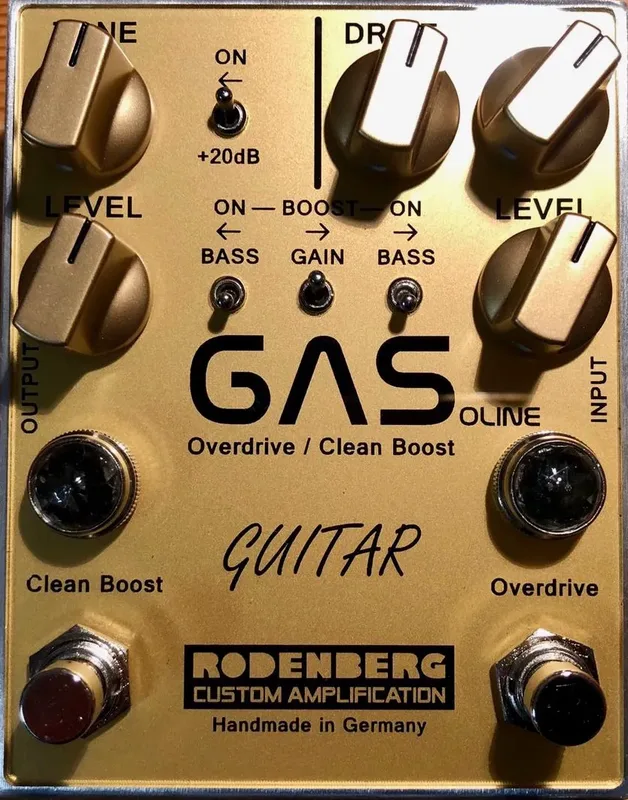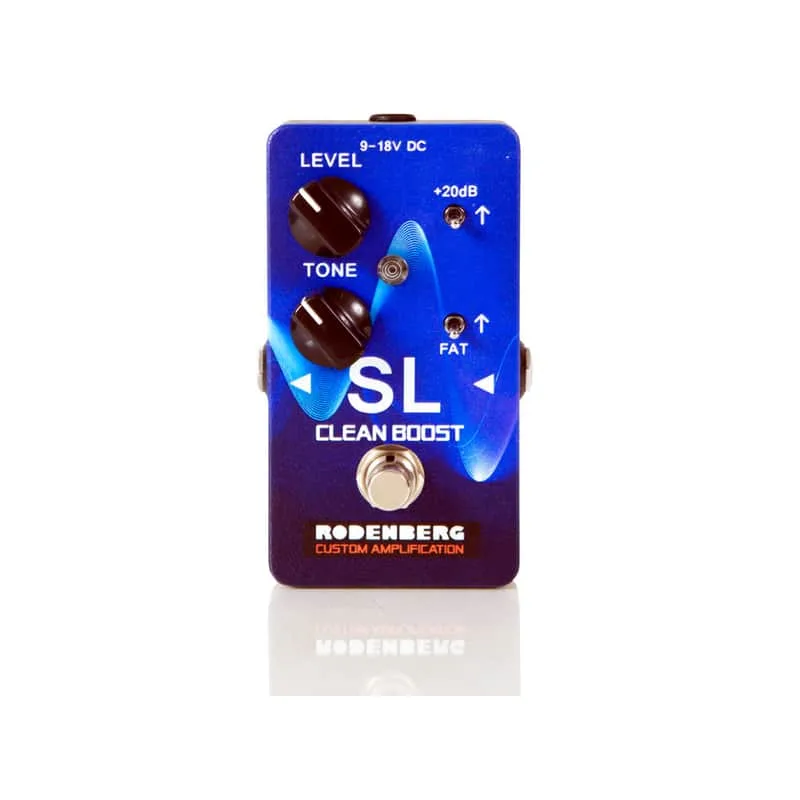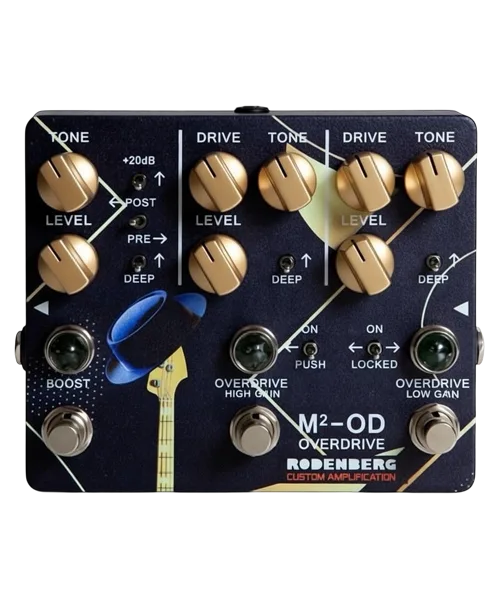


The Rodenberg LDP is an analog pedal for bass that combines two effects in one housing: an overdrive and a clean boost. Rodenberg bills it as an "OVERDRIVE BOOSTER," and its product pages describe a range that runs from slightly distorted bass with tube sound character all the way to completely distorted1. It sits in the company's line of bass-focused drive and boost pedals, alongside guitar models like the Rodenberg GAS (OD/CB) Guitar and the Rodenberg SL Clean Boost.
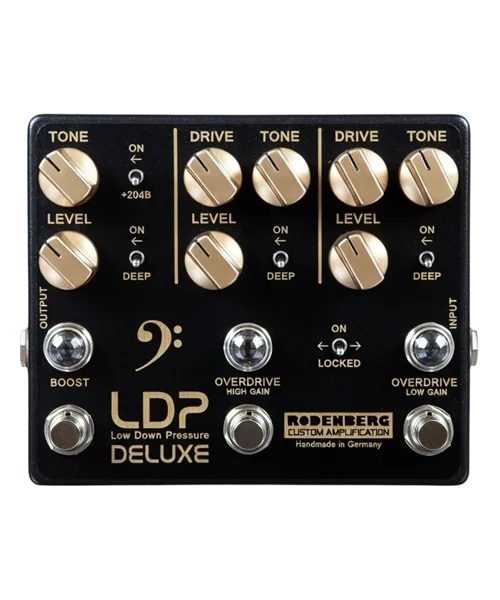
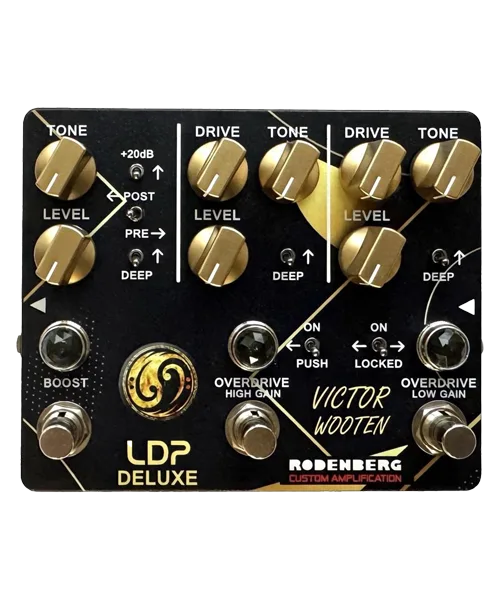
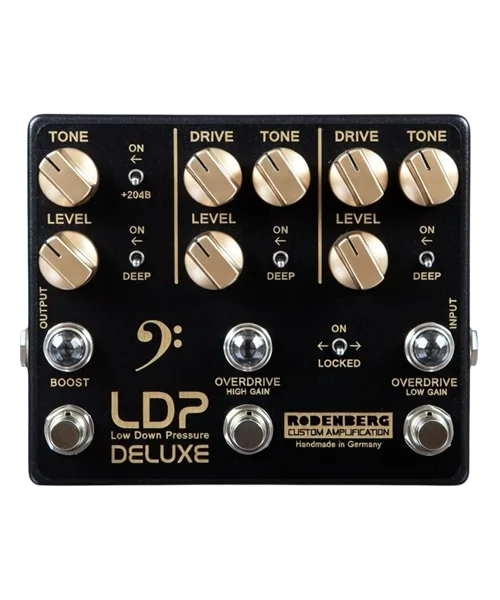
The LDP family has grown into several versions. The LDP DELUXE combines three fully independent sounds in one pedal: a LOW GAIN overdrive, a HIGH GAIN overdrive and a boost2. Rodenberg describes the DELUXE not as a classic bass distortion but as a complete drive and boost platform that preserves pressure, dynamics and low end, from subtle tube saturation to powerful overdrive without losing the deep bass2. Signature versions exist for Marcus Miller, optimized as an overdrive and boost for bass3, and for Victor Wooten, which Rodenberg says "supports expression and dynamics instead of overriding them"4.
An overdrive and a clean boost in one
The core idea of the LDP is that a bass player gets both halves of the equation without a second pedal. The overdrive section handles the dirt, and the boost section delivers what Rodenberg calls a lively level boost, almost like an exciter6. That puts the LDP across two categories at once: it competes with dedicated overdrive pedals on one side and pure boost pedals on the other, while aiming squarely at the bass pedals market where keeping the low end intact is the main challenge.
Rodenberg's own description of the sound range is broad: "From slightly distorted bass with tube sound character to completely distorted - no problem for the LDP (OD/CB)"1. The DELUXE versions refine that range by splitting the drive into two channels, LOW GAIN and HIGH GAIN, so a player can set a light saturation on one and a heavier overdrive on the other, with the boost available separately2.
The controls
The LDP keeps its control set small. Rodenberg's pages say only three controls are needed for the overdrive pedal and two for the clean boost pedal1:
| Section | Controls | What they shape |
|---|---|---|
| Overdrive | Level, Tone, Drive | The overdrive sound6 |
| Clean boost | Level, Tone | The boost sound6 |
The overdrive section also carries a GAIN BOOST preset toggle switch6, which adds a preset gain increase on top of the Drive knob's setting.
The DELUXE versions expand the layout. Each overdrive channel, LOW GAIN OD and HIGH GAIN OD, gets its own Level, Tone and Drive controls, while the BOOST section gets Level and Tone2. The Marcus Miller version adds a jewel LED in blue for the LOW GAIN overdrive section3, and the Victor Wooten version uses a red jewel LED for the HIGH GAIN overdrive section4.
The DELUXE models also add routing flexibility through a PRE/POST toggle switch on the boost section. In POST position the signal flows Bass, then LOW GAIN OD, then HIGH GAIN OD, then BOOST, then the amp; in PRE position the boost comes first, so the chain runs Bass, then BOOST, then LOW GAIN OD, then HIGH GAIN OD, then the amp3. That choice determines whether the boost pushes the amp harder or pushes the overdrive channels harder, which changes the character of the drive itself.
The deep boost switch
The deep boost switch is the LDP's answer to the problem every bass drive pedal faces: adding low end without losing clarity. It is a toggle switch on the overdrive section that pushes the lower frequencies. RockBoard's PedalPedia entry for the LDP puts it plainly: "The overdrive pedal has a deep boost (toggle switche) to push the lower frequencies without getting muddy"1.
Rodenberg's own product page for the LDP (OD/CB) describes the separate DEEP BOOST switch in similar terms, saying the low end can be boosted in a targeted way, with pressure and depth, but without mud6. The Marcus Miller DELUXE carries the same feature, with separate DEEP Boost switches doing the same job3. For a player comparing bass overdrives, this switch is the practical difference between a pedal that thins out under drive and one that keeps its foundation.
Power and versions
The standard LDP runs on 9V DC with a center negative plug and draws 50mA1. The DELUXE versions are more flexible on voltage: they accept 9 to 18V DC and draw 60 to 100mA, with 9V DC as the standard supply voltage and 18V DC as the maximum2. The Marcus Miller and Victor Wooten DELUXE models share those figures34, though RockBoard's PedalPedia entry for the Victor Wooten Signature lists 9V DC center negative with a 100mA draw7.
Rodenberg says the higher operating voltage on the LDP (OD/CB) provides a bit more headroom and prevents unwanted distortion, even with strong pickups and dynamic playing6. On the Marcus Miller version, the maker specifically recommends 18V operation for more headroom and to prevent unwanted distortion with active basses3. The DELUXE models have no battery operation2, so they need a power supply or a pedalboard power source.
The DELUXE versions accept 9 to 18V DC, but the standard LDP is specified at 9V DC center negative. Check which version you have before running higher voltage.
Videos
Bass Bonedo
MrTeijo
Questions
What power does the Rodenberg LDP need?
The LDP runs on 9V DC with a center negative plug and draws 50mA. The LDP DELUXE versions accept 9 to 18V DC, drawing 60 to 100mA, and Rodenberg says running them at 18V gives more headroom and prevents unwanted distortion with active basses. The DELUXE models have no battery operation.
How many knobs does the Rodenberg LDP have?
The standard LDP keeps it simple: three controls on the overdrive side (Level, Tone and Drive) and two on the clean boost side (Level and Tone). The LDP DELUXE follows the same layout, with Level, Tone and Drive on each of its two overdrive channels and Level and Tone on the boost.
What does the deep boost switch do on the Rodenberg LDP?
The deep boost is a toggle switch on the overdrive section that pushes the lower frequencies. Rodenberg describes it as adding pressure and depth to the low end without the sound turning muddy, so bass players can add weight while keeping the note definition.
Is the Rodenberg LDP analog or digital?
The Rodenberg LDP is an analog pedal, as is the LDP DELUXE Victor Wooten Signature version. Rodenberg lists the circuit type as analog on its product pages for both models.
How much current does the Rodenberg LDP draw?
The standard LDP draws 50mA. The LDP DELUXE draws 60 to 100mA depending on the version, and the Victor Wooten Signature is listed at 100mA on RockBoard's PedalPedia.
Sources (7)
- LDP by Rodenberg, RockBoard PedalPedia, 2026
- LDP DELUXE, RODENBERG amplification
- LDP DELUXE Marcus Miller, RODENBERG amplification
- LDP DELUXE Victor Wooten, rodenberg-amplification.com
- LDP - RODENBERG amplification, rodenberg-amplification.com
- LDP (OD/CB), RODENBERG amplification
- LDP DELUXE Victor Wooten Signature by Rodenberg, RockBoard PedalPedia, 2026