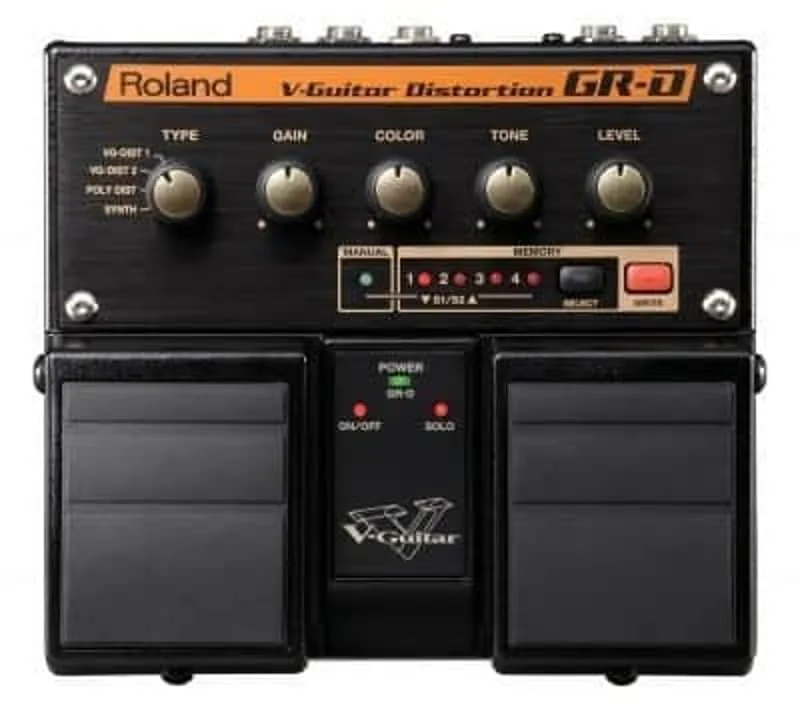


The Roland GR-D V-Guitar Distortion is a distortion pedal that offers a portion of Roland's V-Guitar technology in a Boss Twin Pedal chassis1. Roland's V-Guitar system is not exactly a budget buy, and the GR-D exists as a way into that world without committing to a full V-Guitar setup: MusicRadar's Trevor Curwen called it "a cost-effective way to buy into the V-Guitar world, with a useful range of distortion textures and a synth sound thrown" in1.
Four effect types
The GR-D offers four effects types: VG Distortion 1, VG Distortion 2, Poly Distortion and Synth1. The Poly Distortion mode has a lineage worth knowing: it is derived from the polyphonic distortion in Roland's early guitar synths1. VG Distortion 2 adds an octaver effect, but that octaver is something you only hear with a divided pickup; with a conventional pickup it is absent1.
Controls
| Control | What it does |
|---|---|
| Gain | Adjusts the amount of distortion for the distortion effects; adjusts the synth waveform for the Synth sound1 |
| Tone | Brightens the sound for the distortion effects; adjusts the synth's filter cut-off frequency for the Synth sound1 |
| Color | Does something different for each effect1 |
The gain and tone knobs offer what you would expect on the distortion effects, adjusting the amount of distortion and brightening the sound respectively; for the Synth sound their functions adjust the synth waveform and the synth's filter cut-off frequency1. The right-hand footswitch offers a useful boost to the sound for soloing1.
Using it with a normal guitar or a GK pickup
The GR-D requires the use of a guitar equipped with a divided pickup, such as Roland's GK-3, and its 13-pin connection for its full potential1. It has a divided-pickup guitar input, but also a pair of standard jack inputs, plus outputs to connect to an amp or other gear; for mono you simply connect it to the L (mono) input and use the jack outputs for either stereo or mono operation1.
What you hear depends heavily on which input you use:
- With a divided pickup: the Synth sound "sounds like a proper analogue synth, complete with filter squelch, and raises the pitch an octave with the solo switch engaged"1. VG Distortion 2's octaver comes through1.
- With a normal guitar: the Synth sound comes across as "a weird fuzzy distortion, with the solo switch simply making it louder"1, and the VG Distortion 2 octaver is not heard1.
The GR-D's most distinctive sounds, including the synth voice and the VG Distortion 2 octaver, depend on a GK divided pickup and its 13-pin connection. A conventional guitar works through the standard jack inputs, but with more limited results1.
Connections and the Guitar Out socket
When using a GK pickup, there is also a Guitar Out socket, so you can send the normal clean pickup signals of the GK-compatible guitar to another device, which MusicRadar describes as useful for a send/return scenario1.
What reviewers said
MusicRadar's review, by Trevor Curwen, frames the GR-D as an affordable door into V-Guitar processing. Its overall verdict: "A cost-effective way to buy into the V-Guitar world, with a useful range of distortion textures and a synth sound thrown" in1. The review highlights the right-hand footswitch's solo boost as a useful feature for live playing1.
If the GR-D's distortion textures are what interest you, it sits alongside other distortion options in the wider field of Distortion Pedals, and its synth voice relates to the territory covered by Synth Pedals.
Videos
Sweetwater
RolandChannel
RolandChannel
Questions
Do I need a GK pickup to use the Roland GR-D?
For the full experience, yes. MusicRadar's review notes that the GR-D requires a guitar equipped with a divided pickup, such as Roland's GK-3, and its 13-pin connection to reach its potential. With a divided pickup you get the V-Guitar features, including the octaver in VG Distortion 2 and the proper analog-style synth sound. The pedal does also accept a pair of standard jack inputs, so a conventional guitar can be connected, but the results are more limited.
What does the Color knob do on the GR-D?
The Color knob does something different for each of the four effect types, so its function changes depending on whether you are in VG Distortion 1, VG Distortion 2, Poly Distortion or Synth. Alongside it, the gain and tone knobs offer what you would expect on the distortion effects, adjusting the amount of distortion and brightening the sound, while for the Synth sound they adjust the synth waveform and the filter cut-off frequency.
Can the GR-D be used with a normal guitar?
Yes. The GR-D has a divided-pickup guitar input but also a pair of standard jack inputs, so you can plug in a conventional guitar. With a normal guitar the Synth sound comes across as a weird fuzzy distortion, with the solo switch simply making it louder, and the octaver effect in VG Distortion 2 is not heard. The pedal's more distinctive sounds need a divided pickup such as the GK-3.
How many user memories does the GR-D have?
The GR-D provides four user memories. These store and recall any sound you create, regardless of how the knobs are physically set, so you can keep your favourite settings and bring them back at the stomp of a switch even if the panel has been moved since.
What is the Guitar Out socket for?
When you are using a GK pickup, the Guitar Out socket sends the normal clean pickup signals of the GK-compatible guitar to another device. MusicRadar describes this as useful for a send/return scenario, letting you run the conventional guitar signal elsewhere while the GR-D processes the divided-pickup signal.
Sources (1)
- Roland GR-D V-Guitar Distortion review, MusicRadar, 2013-05-15