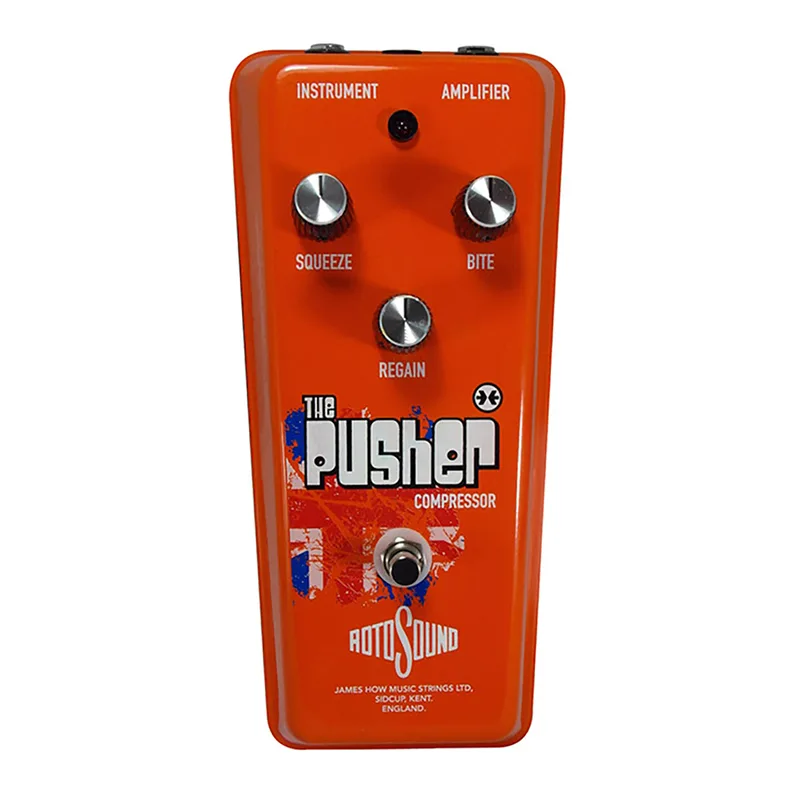
The Rotosound Pusher is a vintage-style compressor pedal, model RPU1, one of the hand-wired stompboxes Rotosound made in England. Rotosound, best known as a string maker, built it around high headroom, which in practice means the pedal can take a strong input signal before the circuit itself runs out of room and distorts. It was designed by John Oram, whom Rotosound credits with VOX and Trident history, a background in professional audio rather than guitar pedals alone1.
The Pusher is now discontinued on Rotosound's own product page1. It was followed by a reissue, The Pusher, part of Rotosound's range of 60s-style effects pedals, which is a separate product covered on its own page.
A vintage-style compressor with high headroom
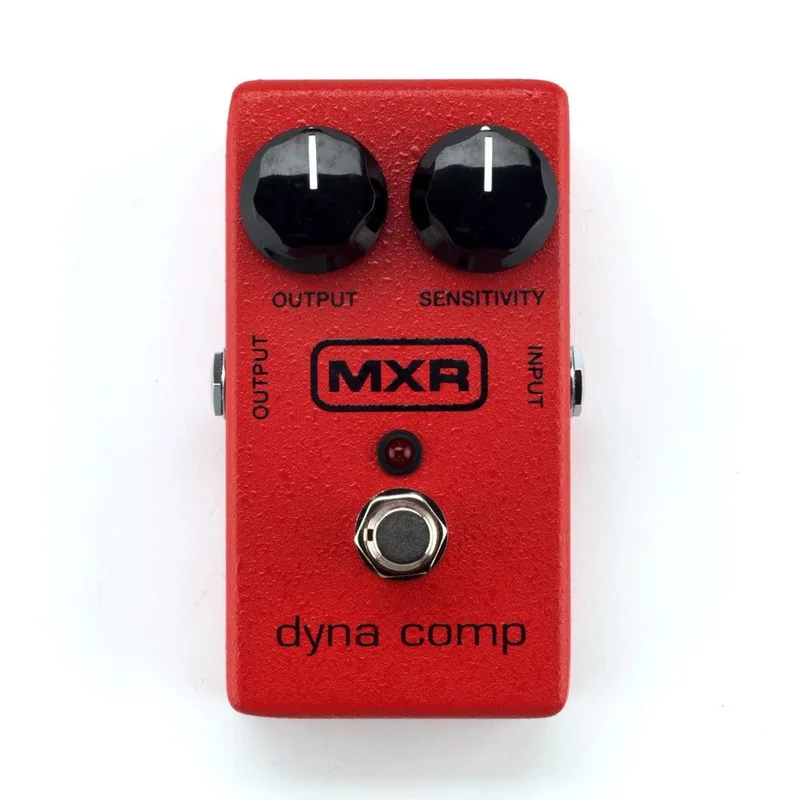
A compressor evens out the difference between a guitar's loud and quiet notes. The Pusher takes a vintage approach to this, and Rotosound's design stands apart from the common template: as MusicRadar's reviewer Trevor Curwen noted, while most guitar compressors available in recent years seem to be based on the MXR Dyna Comp or Ross design, Rotosound went its own way with The Pusher2.
The high headroom is the pedal's distinguishing electrical feature. Headroom is the amount of signal level a circuit can pass cleanly, and a compressor with plenty of it can work a hot signal hard without the circuit itself breaking up. Combined with the 9 to 18 volt internally regulated power input, this points at a pedal built to stay clean at the levels where compressors usually work hardest1.
Rotosound's earlier red Pusher compressor, introduced among the company's effects pedals in 2013, was described in Guitar Interactive Magazine as an audio dynamics controller providing noise reduction, helping toward a more transparent tone and helping increase sustain3. The same publication later listed the red Pusher among Rotosound's compressor offerings when the range was announced4.
The controls: ratio, compression and expansion
The original Pusher's control layout is unusual. Rotosound describes it as smooth, wide-range control of ratio, with compression on one control and expansion on another1.
- Ratio: how hard the pedal compresses, that is, how much a loud note is pulled down relative to a quiet one.
- Compression: the amount of squeeze applied to the signal.
- Expansion: the opposite of compression, pushing loud and quiet notes further apart, which a player can use to counteract the flattening effect or shape dynamics in the other direction.
The reissue, The Pusher, takes a different approach with controls Rotosound calls Squeeze, Bite and Regain. Guitar Pedal X describes it as a musical yet utilitarian compressor that can sweep from a 1:1 ratio, effectively no compression, to full limiting at 50:1, with a noise-suppression stage and a Bite control that mixes in a brightened parallel signal to retain attack and tone5. MusicRadar's review of The Pusher likewise notes the amount of compression is controlled with the squeeze knob2.
| Control | Original Pusher (RPU1) | Reissue The Pusher |
|---|---|---|
| Compression amount | Compression control25 | Squeeze knob2 |
| Ratio | Ratio control, wide range1 | Sweeps 1:1 to 50:1 limiting5 |
| Attack and tone | Not specified | Bite, a brightened parallel blend5 |
| Dynamics shaping | Expansion control1 | Not specified |
| Noise | Not specified | Noise-suppression stage5 |
What reviewers said
MusicRadar's review of The Pusher found the design choices paid off in use2:
"Put it all together and that means plenty of sustain and top-end bite, but no hiss - cool2!"
Trevor Curwen, MusicRadar2
That verdict, sustain and top-end bite without noise, matches what the circuit's noise-suppression stage and parallel Bite path are built to do5.
Where it sits for a player today
The original Pusher RPU1 is discontinued, so a player looking for one is searching the used market. Its successor, The Pusher, carries the compressor side of the Rotosound range forward with the Squeeze, Bite and Regain control set and the same true bypass approach15. Players comparing compressors more broadly can find the full category on the compressor pedals page.
Questions
Who designed the Rotosound Pusher?
The Pusher was designed by John Oram, the engineer Rotosound credits with VOX and Trident history. Oram's background is in studio console and audio electronics, and Rotosound describes the pedal as part of its hand-wired stompboxes made in England.
What voltage does the Rotosound Pusher run on?
The pedal takes an external power supply through an input socket rated 9 volt to 18 volt, internally regulated. That means it can run from a standard 9V supply or from higher-voltage supplies for extra headroom, with the internal regulation keeping the circuit consistent.
Is the Rotosound Pusher true bypass?
Yes. Rotosound lists true bypass switching for the Pusher, so with the pedal off the signal passes through without the circuit coloring the tone. The later reissue, The Pusher, also uses true bypass.
Is the Rotosound Pusher discontinued?
Yes. Rotosound's product page for the Pusher, model RPU1, marks it as discontinued. The company later reissued its vintage pedal range, including a compressor called The Pusher, which is a separate product.
What is the Rotosound Pusher model number?
The model number is RPU1, as given on Rotosound's product page. It identifies the original vintage-style compressor, distinct from the later reissue The Pusher.
Sources (5)
- Pusher | Compressor Guitar Effects Pedal • Rotosound Music Strings, Rotosound, 2025-02-20
- Rotosound The Pusher Compressor review, MusicRadar, 2014-06-20
- Rotosound Introduce Six New Effects Pedals, Guitar Interactive Magazine, 2013-07-08
- Six New Effects Pedals Released by Rotosound, Guitar Interactive Magazine, 2014-03-03
- Guitar Pedal X, Guitar Pedal X, 2025-02-21