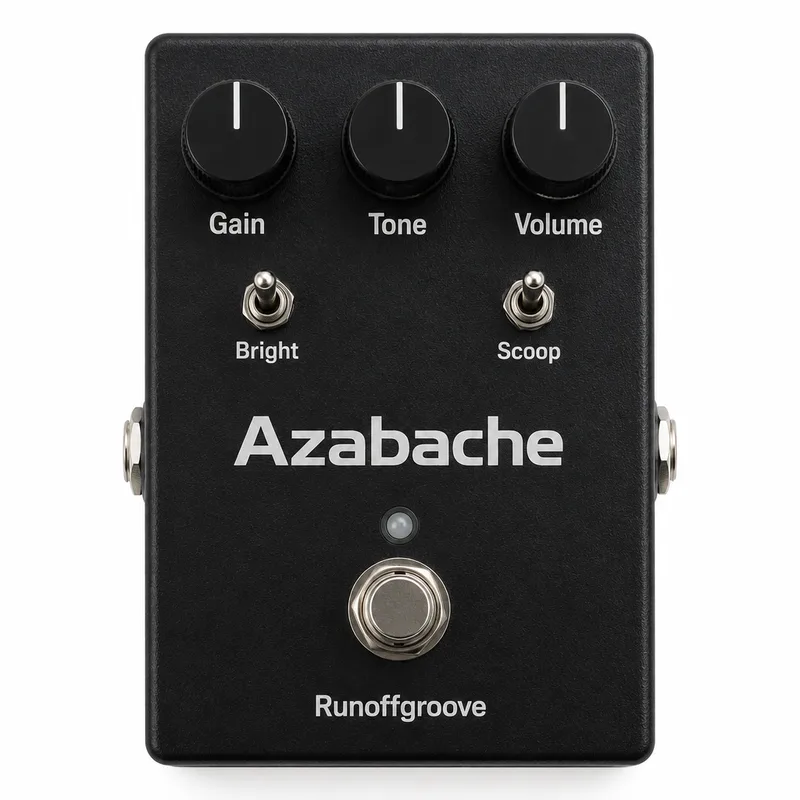


The Runoffgroove Azabache is a DIY overdrive circuit, a refined overdrive with a natural note decay that reacts well to the guitar's volume knob, according to its designer. Runoffgroove describes it as capturing a wider variety of Fender-like tones, and the name recalls the Blackface and Tweed aesthetics: Azabache is the Spanish word for "black amber"1.
It is a build-it-yourself project rather than a retail pedal, and most of what is known about how it behaves in practice comes from the builders who posted their results on Guitar FX Layouts1.
How the circuit works
Each gain stage is set up to produce a moderate amount of gain while avoiding hard clipping in the JFET itself, so the overdrive builds gradually rather than slamming into a wall1. Runoffgroove notes that the design does not correspond to any particular existing amp or pedal circuit. Two borrowed ideas do show up: a modified "Big Muff Pi" style tonestack, placed before the overdrive sections rather than after them, and final tone shaping modeled after the frequency response of a Jensen P10R speaker1.
Controls and the four modes
The Azabache has three knobs and two switches:
| Control | What it does |
|---|---|
| Gain | Adjusts the sound from almost clean, to a warmed-up light overdrive, to a medium overdrive, to a quite gainy overdrive1 |
| Tone | Varies the sound from fat and warm fully counterclockwise, to full at the center, to thin and bright at the clockwise end1 |
| Volume | Sets output level |
| Bright switch | Adds a glassy character to the sound1 |
| Scoop switch | Reduces the midrange around 400Hz for more clarity1 |
The two switches together name four modes, a nod to Fender amp eras1:
| Bright | Scoop | Mode |
|---|---|---|
| ON | ON | Black |
| ON | OFF | Brown |
| OFF | OFF | Blonde |
| OFF | ON | Silver |
What builders said
Builder reports on the Azabache split sharply on two points: how good it sounds, and how bright and noisy it is1.
- Geiri (April 2013) said it brought his Orange Dual Terror to life and that he felt like he had a proper Fender amp, and said he would recommend the build for its quality and sound1.
- Doron Barness (April 2013) called it a great pedal and a keeper on his pedalboard, saying it works great with fuzz pedals and with any pickup, and that he built it instead of the Catalinbread Formula No.5 and other Fender-like pedals1.
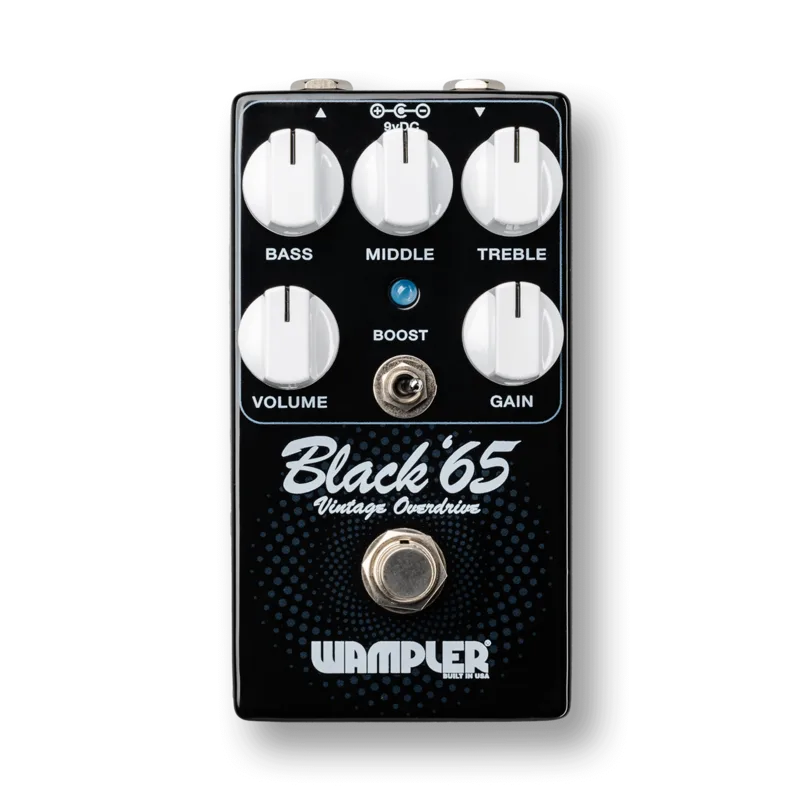
- hako (May 2013) rated it among the strongest Fender-like circuits he had tried, with only the Wampler Black '65 possibly ahead of it in his view, though he found it a bit too bright and used a 2n2 capacitor instead of the 1n1.
- Iago (January 2015) found it very bright, sounding best with the tone knob on "0", but said that with the super-bright tones dialed out the circuit sounds phenomenal and can be quite gainy1.
- Neil mcNasty (October 2013) had the opposite experience of everyone else, calling it the harshest and most extreme high frequency shrieking pedal he had ever heard, with the tone control only sounding nice rolled almost completely off1.
"This is the harshest and most extreme high frequency shrieking pedal I have ever heard."
On noise, Iago reported in May 2017 that the Azabache remained the noisiest overdrive pedal he had owned, with background hiss always present, and that he was much happier with the Black '65 for noise1. Another builder reported in June 2014 that the circuit sounds more detailed running at 18V with a charge pump1.
Brightness fixes and layout corrections
The brightness is the most common complaint, and the community settled on a fix. The excessive treble content on the tone control can be cured by lowering or shorting the 47K resistor at lug 1 of the tone pot; the layout author used 4K7 there and published a "fixed" version of the layout alongside the original1.
The original vero layout itself also had errors, corrected in the blog's comments1:
- On 3 April 2013, the 1n capacitor was corrected to go from emitter to the 39K resistor rather than directly emitter to base on the 5088, and the tone 3 cut under the trimmer was fixed1.
- On 11 April 2013, Geiri noted the corrected layout has 27 cuts, not 26, and needed a cut underneath the bottom 10K resistors; fixed and transistor labels were added1.
One builder, MAO, went further in July 2017 and added a 3-way "hiss reduction" toggle to his second build: center position is the original circuit, up adds a 1n capacitor from the gate of Q2 to ground, and down increases a low pass filter at the output1.
Azabache versus the Professor Tweed
The Azabache is a revised and improved version of Runoffgroove's earlier Professor Tweed, which the designer set out to update more than a year before the Azabache appeared1. The Professor Tweed is a Tweed amp emulation: its cleaner sounds are compressed with an edge, the overdrive increases as you wind up the Volume knob, and at full Volume it gives overdrive that keeps its dynamic feel and cleans up well2. One Professor Tweed builder, kod2nd, found its tone control the only negative point and reported that raising the capacitor from 4.7nF to 22nF helped a little2.
The Azabache differs in approach: it is not based on any particular amp, it moves a Big Muff Pi style tonestack ahead of the overdrive sections, and its Bright and Scoop switches give it four named voicings where the Professor Tweed has none1. Both share the JFET, moderate-gain-per-stage design philosophy, and both are strictly DIY circuits you build yourself.
Videos
Midway Fair
genmacguinness
viagemmental
Questions
What does Azabache mean?
Azabache is the Spanish word for black amber. Runoffgroove chose the name to recall the aesthetics of Fender's Blackface and Tweed amp eras, since the circuit is meant to capture a wide variety of Fender-like tones rather than copy one specific amp.
How do I fix the Azabache being too bright?
The fix most builders used is to lower or short the 47K resistor at lug 1 of the tone pot. The layout author at Guitar FX Layouts used 4K7 there in a fixed version of the layout. Individual builders also swapped the 1n capacitor for a 2n2 to tame the brightness, and several report running the tone knob near zero.
Is the Runoffgroove Azabache noisy?
It can be. One builder, Iago, called it the noisiest overdrive pedal he had owned, with background hiss always present, and said he was happier with a Wampler Black '65 for noise. Another builder, MAO, added a 3-way hiss reduction toggle to his build, and one builder reported the circuit sounds more detailed at 18V with a charge pump.
How is the Azabache different from the Professor Tweed?
The Azabache is a revised and improved version of Runoffgroove's earlier Professor Tweed circuit. The Professor Tweed is a Tweed-style amp emulation whose overdrive increases with the Volume knob, while the Azabache is not based on any particular amp, uses a modified Big Muff Pi style tonestack before its overdrive sections, and offers four named modes via Bright and Scoop switches.
Sources (2)
- Guitar FX Layouts: Runoffgroove Azabache, Guitar FX Layouts (tagboardeffects.blogspot.com), 2013-03-31
- Guitar FX Layouts: Runoffgroove Professor Tweed, Guitar FX Layouts (tagboardeffects.blogspot.com), 2013-03-06