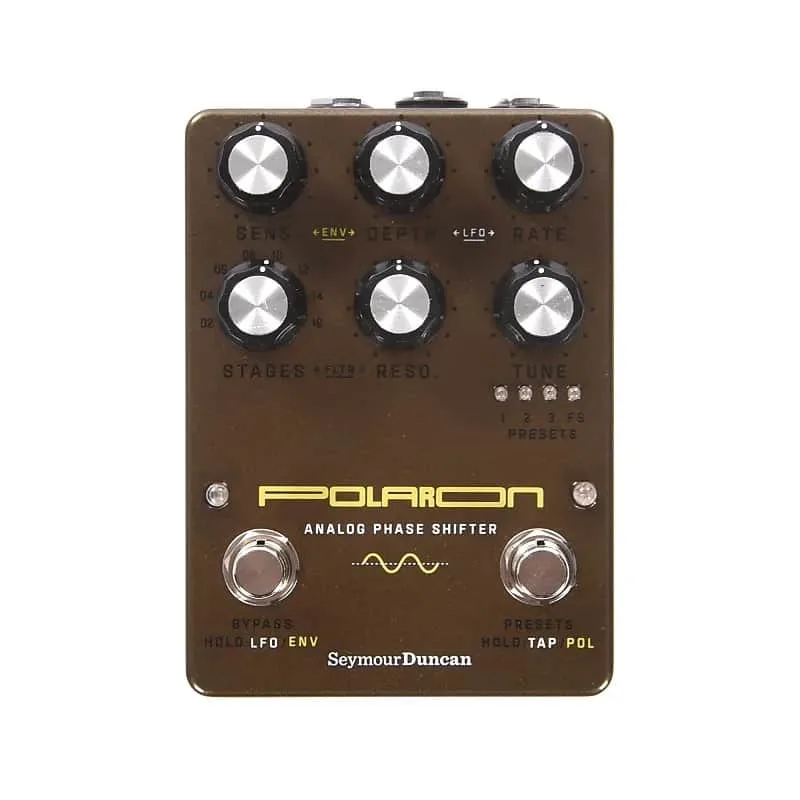


The Seymour Duncan Polaron Dual Modulated 2-16 Stage Analog Phase Shifter is an analog phaser whose core is a filter array you can set anywhere from 2 to 16 stages, in 8 steps. Where a conventional phaser fixes its stage count, the Polaron lets you move from a gentle, subtle sweep to a deep, resonant shift on the same pedal, and it adds envelope modulation alongside the usual LFO. Guitar Pedal X lists it at $229 as of January 20261.
Controls and modes
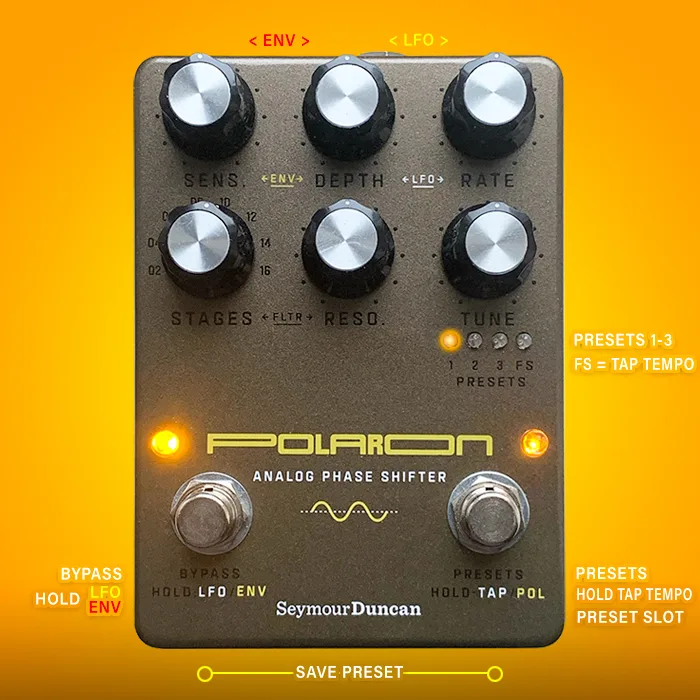
The pedal's controls split by modulation mode, so what each knob does depends on which side you are using1:
| Control | What it does |
|---|---|
| ENVELOPE Sens | Sets the envelope follower's sensitivity to your playing |
| ENVELOPE Depth | Sets how deeply the envelope drives the phase shift |
| LFO Depth | Sets the depth of the automatic LFO sweep |
| LFO Rate | Sets the speed of the LFO sweep |
| Stages | Selects 2 / 4 / 6 / 8 / 12 / 14 / 16 stages |
| Resonance | Sets resonance of the stage array (Stage + Reso = the character of the shift) |
Switching between the two modulation engines is done from the footswitches rather than a menu: holding the Bypass footswitch flips the pedal between LFO and ENV mode1. In LFO mode the sweep runs on its own at the Rate you set; in ENV mode the phase shift follows your pick attack, with the Sens control deciding how hard you have to play to open it up.
The footswitches carry the rest of the practical load. The Presets footswitch recalls the three onboard presets, and holding it engages tap tempo, so the LFO rate can be matched to a song without touching the Rate knob1.
Stages and resonance
The stage selector is the pedal's defining control. The steps run 2 / 4 / 6 / 8 / 12 / 14 / 16, and Guitar Pedal X pairs it with the Resonance control as the two halves of the pedal's character, describing the combination as "Stage + Reso = F" in its control listing1. Low stage counts give a light, quick shimmer; the higher counts, especially 12 through 16, push the sweep into deeper, more pronounced territory that smaller phasers cannot reach. Because the array is analog, the shifting happens in the analog domain, which Guitar Pedal X takes as a given in calling it "an exceptionally expansive analog phaser"1.
The Polaron's stage count and modulation options are described by Chase Bliss in its own materials; see the controls table above for what each mode does.
What reviewers said
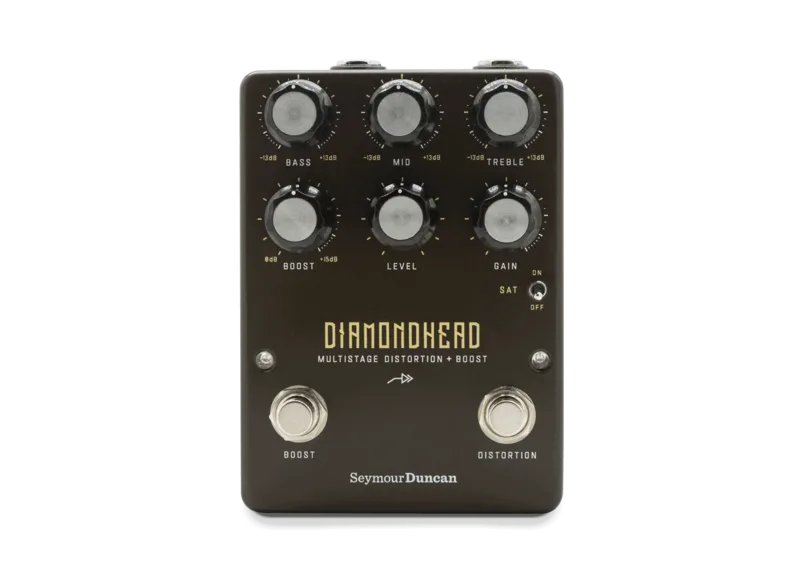
Guitar Pedal X's review, published 23 January 2026, is strongly positive. Stefan Karlsson calls the Polaron highly capable and judges it every bit as good as the Diamondhead, Seymour Duncan's multistage distortion and boost pedal from the same range, and says the two combine exceptionally well overall1. He also notes that he found the Polaron discounted at GuitarGuitar in the UK, below its £229 webstore price1.
Videos
Pete Thorn
Premier Guitar
Seymour Duncan
News
Questions
Does the Seymour Duncan Polaron have tap tempo?
Yes. Guitar Pedal X's review notes that the Polaron's Presets footswitch doubles as a tap tempo control: holding it sets the tempo. That makes it straightforward to lock the LFO modulation to a song's tempo without opening menus or reaching for an external controller.
How many presets does the Polaron have?
The Polaron carries three onboard presets, numbered 1, 2 and 3. Guitar Pedal X describes these as a further advantage of the pedal, letting you store and recall different stage counts, modulation settings and resonance positions without resetting the knobs between songs.
Is the Polaron analog?
Yes. Guitar Pedal X describes the Polaron as an analog phaser, with a selectable 2 to 16 stage analog filter array at its core. The modulation side can be driven either by an internal LFO or by an envelope follower that responds to your picking.
How do you switch the Polaron between LFO and envelope mode?
You hold the Bypass footswitch to flip the pedal between LFO and ENV mode. In envelope mode the Sens and Depth controls shape how the effect responds to your playing dynamics; in LFO mode the Depth and Rate controls set an automatic sweep.
How much does the Polaron cost?
Guitar Pedal X lists the Polaron at $229 as of January 2026, and notes it also goes for £229 on the Seymour Duncan webstore. The reviewer found it discounted at GuitarGuitar in the UK, so street prices can sit below the list figure.
Sources (1)
- Guitar Pedal X, Guitar Pedal X, 2026-01-23