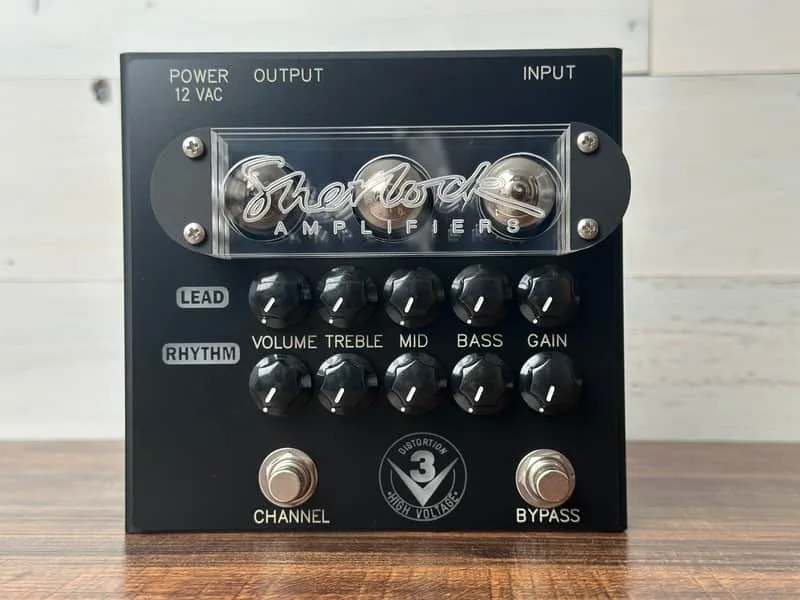


The Sherlock V3 is an all-tube distortion pedal from Sherlock Amps, a builder based in Australia1. Where most "tube" pedals run a single preamp tube at low voltage, the Sherlock V3 carries three tubes and runs at high voltage, which is why it gets warm in use1. It is built around two channels, rhythm and lead, each with a full set of controls, and it is aimed at players who want to turn a clean amp into a full three-channel rig1.
What it is and what it does
Pete Thorn, demoing the pedal on his YouTube channel in January 2018, called it a high-voltage, all-tube distortion pedal with two channels, and described it as a great option for a player with a clean amp who needs high gain1:
"it's meant to be run into a clean amp I would say and and you know kind of turn your your your single channel clean amp"1
That is the core idea: rather than stacking overdrive pedals in front of an amp that is already breaking up, the Sherlock V3 supplies the whole distorted sound itself, with a rhythm setting and a lead setting you can footswitch between1.
The controls
Each channel has its own complete control set1:
| Control | What it does |
|---|---|
| Volume | Output level for the channel |
| Treble | Highs, part of an active tone stack |
| Mid | Midrange, part of an active tone stack |
| Bass | Low end, part of an active tone stack |
| Gain | Distortion amount for the channel |
Thorn noted that the tone controls are "real powerful real active," meaning they cut and boost strongly rather than trimming gently1. Two footswitches handle the rest: one is the bypass, and the other toggles between the rhythm and lead channels1.
Dip switches and rear trim pots
Inside the pedal, four dip switches shape the gain structure of each channel, and the pedal ships with a mini screwdriver for flipping them and adjusting the trim pots1:
| Switch | Function |
|---|---|
| 1 | Gain boost bias for the lead channel, more gain and saturation when up |
| 2 | Gain reduction for the lead channel, for a more vintage type of gain |
| 3 | Gain reduction for the rhythm channel |
| 4 | Gain boost for the rhythm channel |
On the rear panel there are two recessed trim pots for high-frequency adjustment, one for the lead channel and one for the rhythm channel1. Between the dip switches and the trim pots, a player can set up two quite different gain characters and voicings before touching the knobs.
Tubes and power
The pedal uses three tubes and runs at high voltage from a 12-volt power supply1. Because real tubes are running at real voltages, the enclosure gets pretty warm during use, which Thorn pointed out as expected for a tube pedal1. Players used to 9V battery-friendly distortion pedals should plan board space and power accordingly.
What kind of high gain sound it makes
Thorn described the Sherlock V3 as a really cool sounding distortion pedal with great modern tones and a wide gain range, from mid gain up to maximum saturation using the dip switches1. Asked what the character of the high gain reminded him of, he placed it firmly in modern high-gain territory:
"it would be like Soldano or angle or you know Mesa dual rectifier or that kind of thing real kind of grindy full sound"1
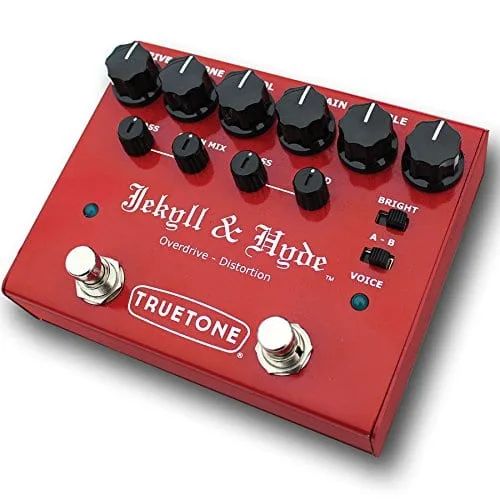
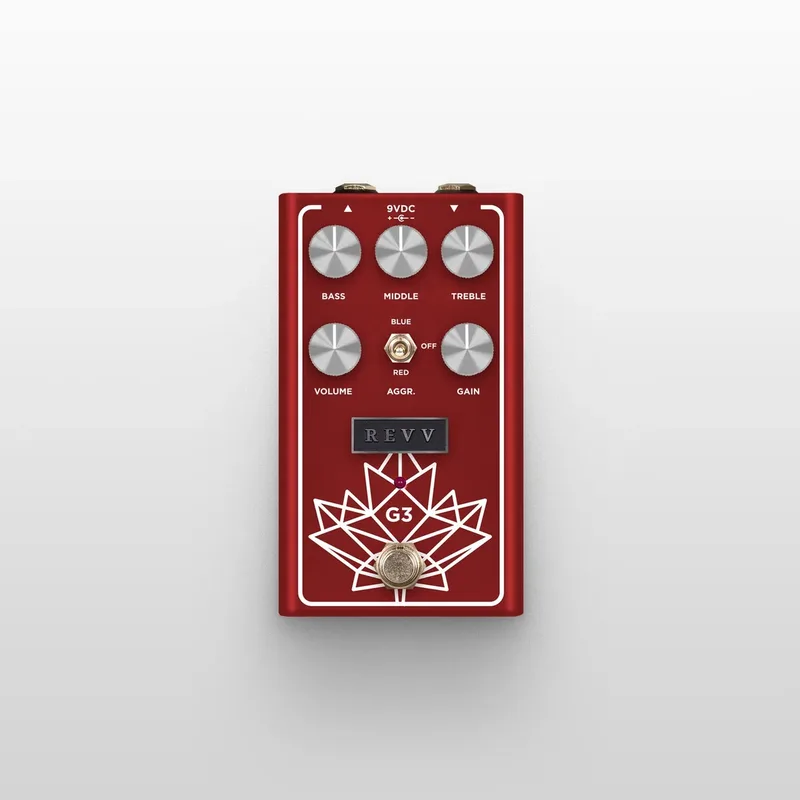
He specifically contrasted it with vintage-voiced designs like a plexi or an AC30, and noted the sound is uncompressed and full1. For players comparing it with other two-channel distortion pedals, the Truetone V3 Jekyll & Hyde takes a different approach, pairing a warm overdrive with a thick high-gain distortion in one box, while the Revv G3 V2 covers aggressive, tight-midrange high gain in a solid-state pedal.
What reviewers said
The published coverage is Pete Thorn's demo video, which is positive on both sound and concept. His overall verdict1:
"great modern tones coming out of this pedal and if you've got a clean amp and you need to get some grind this could be a"1
In the video he walks through both channels, the dip switches and the trim pots, and plays the pedal into a clean amp to show the range from mid gain to full saturation1.
Videos
R.J. Ronquillo
Ash Ravens Music
Questions
Where is the Sherlock V3 made?
The Sherlock V3 comes from Sherlock Amps, a builder based in Australia. Pete Thorn, demoing the pedal in January 2018, described it as coming from Sherlock Amplifiers, heralding from Australia.
How many tubes does the Sherlock V3 use?
Three. Pete Thorn's demo shows the three tubes inside the pedal, and the circuit runs at high voltage rather than the low voltages typical of most tube pedals.
Does the Sherlock V3 get hot?
It gets pretty warm, according to Pete Thorn's demo, because it runs real tubes at high voltage. That is normal behavior for a high-voltage tube pedal and something to plan for on a crowded pedalboard.
Does the Sherlock V3 have two channels?
Yes. It has a rhythm channel and a lead channel, each with its own full set of volume, treble, mid, bass and gain controls, plus a footswitch to toggle between them and a separate bypass switch.
What do the dip switches on the Sherlock V3 do?
There are four internal dip switches. Switch 1 is a gain boost bias for the lead channel, switch 2 is gain reduction for the lead channel for a more vintage gain, and switches 3 and 4 are gain reduction and gain boost for the rhythm channel.
What kind of high gain sound does the Sherlock V3 make?
Pete Thorn described it as a modern, grindy, full, uncompressed high gain sound, comparing it to Soldano or Mesa Dual Rectifier amps rather than a plexi or AC30. Gain ranges from mid gain up to full saturation using the dip switches.
Sources (1)
- Sherlock V3 ALL TUBE Distortion, demo by Pete Thorn, YouTube (Pete Thorn channel), 2018-01-17