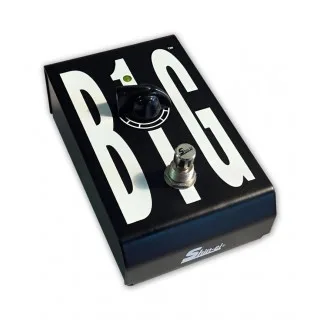


The Shin-ei B1G 1 Transparent Gain Booster is a one-knob, all-analog clean boost pedal made by Shin-ei. It does one thing: raise the level of your signal, cleanly, without changing its character. Pedal of the Day put it plainly: "Basically, it just makes your original signal sound fantastic, without adding or taking anything away from the heart of your sound"1.
Shin-ei positions it as more than a pedal, describing it as "an analog pre-amp on par with vintage and modern recording studio channel strips" and calling it a high fidelity, studio quality gain boost2. Pedal of the Day agreed, writing that it "brings true studio quality right onto your pedalboard"1.
A clean, all-analog boost of up to +30dB
The B1G 1 is a boost pedal in the classic sense: it makes your signal louder without adding overdrive, distortion or tone coloring of its own. Pedal of the Day found "an available +30dB of boost on tap"1, while Shin-ei's own page for the pedal describes "+32db of clean headroom"2. The two figures differ slightly between the maker and the press, but both describe the same reality: a large amount of clean level on tap, more than enough to drive an amplifier into breakup or simply lift a quiet instrument in a mix.
The circuit is fully analog. Shin-ei calls it a "Highest quality analog gain boost with advanced circuitry not found in any commercial gain booster effect pedal," built with what the maker says are only the finest audio components23. Pedal of the Day confirmed the analog claim from the playing side: "The B1G 1 is an all-analog gain boost with advanced circuitry packed inside"1.
Operation is deliberately simple. As the review put it, "Sometimes, you just need ONE knob to get some incredible tone out of your guitar and amp"1.
| Control | What it does |
|---|---|
| Gain knob | Sets the amount of boost, from a small level lift up to the full +30dB on tap1 |
Where to put it in your signal chain
Shin-ei offers a placement tip on the product page: "Many players like using the B1G 1 as the last pedal before their amp in their signal path"4. Running a clean boost last in the chain, right into the amp's input, is the traditional way to use one: the full boosted level hits the amp's preamp, pushing it harder than the guitar alone can.
Works with more than electric guitar
Although it is a guitar pedal, the B1G 1 is not limited to electric guitar. Pedal of the Day reported that "this steel beauty sounds incredible on electric guitar, but also on acoustic, bass, keyboards and more"1. A transparent boost is naturally suited to this: a boost that neither adds nor takes anything away from the source sound works for any instrument that needs a clean level lift.
Designer and product code
The B1G 1 was designed by Lee Jackson. Shin-ei's page credits it as "Designed by electronic guru Lee Jackson"2, and Pedal of the Day described the design as the work of "Lee Jackson, noted effects and amplifier wizard"1.
The maker lists the product code BG-1 for the B1G 1 Preamp Gain Boost2. There is also a color option, the B1G 1 Black2.
The Not So B1G 1 and the Julian Lage connection
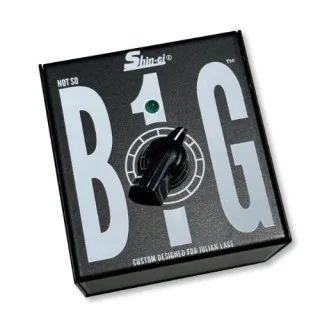
Shin-ei also builds a smaller sibling, the Not So B1G 1 Preamp Gain Boost Pedal, designed for guitarist Julian Lage "to make road traveling easier"3. Despite the smaller size, it uses "the exact same circuit board" as the B1G 1 Gain Booster4, so the two pedals deliver the same clean boost, with the maker describing the smaller version as adding "a clean boost to your tone via a massive 30+ db of pure studio quality gain"3.
| B1G 1 | Not So B1G 1 | |
|---|---|---|
| Product code | BG-12 | BGMINI-13 |
| Designer | Lee Jackson2 | Designed for Julian Lage3 |
| Circuit | Analog gain boost2 | Exact same circuit board as the B1G 14 |
| Boost | +32dB of clean headroom (maker)2 | 30+ db of pure studio quality gain (maker)3 |
| Extras | B1G 1 Black color option2 | Free Shin-ei B1G 1 T-shirt (sizes M, L, XL) included when available3 |
The Not So B1G 1 was offered on preorder, with shipping beginning November 15th4.
Build
The enclosure is 14 gauge cold rolled steel, a detail both Shin-ei2 and Pedal of the Day1 confirm. The review's take on the construction: "Made of 14 gauge cold rolled steel, the B1G 1 is not going to fall apart any time soon"1.
Videos
Shin-ei
Shin-ei
Pedal of the Day
Questions
Who designed the Shin-ei B1G 1?
The B1G 1 was designed by Lee Jackson, whom Shin-ei calls an electronic guru and whom Pedal of the Day described as a noted effects and amplifier wizard. Jackson's design work is behind the pedal's analog preamp circuit, which Shin-ei compares to vintage and modern recording studio channel strips.
Is the Shin-ei B1G 1 analog or digital?
It is fully analog. Shin-ei describes it as a highest quality analog gain boost with advanced circuitry not found in any commercial gain booster effect pedal, and Pedal of the Day confirms it is an all-analog gain boost with advanced circuitry packed inside. There is no digital processing in the signal path.
Can the Shin-ei B1G 1 be used with bass and keyboards?
Yes. Pedal of the Day found it sounds incredible on electric guitar, but also on acoustic, bass, keyboards and more. Because it is a transparent boost that does not add or take anything away from the core of your sound, it works for any instrument that needs a clean level lift.
How much boost does the Shin-ei B1G 1 give?
Pedal of the Day measured an available +30dB of boost on tap, and Shin-ei describes the pedal as offering +32dB of clean headroom. Either way, that is far more level than most players ever need, enough to push an amp hard or lift a quiet instrument.
What is the Shin-ei BG-1?
BG-1 is the product code Shin-ei lists for the B1G 1 Preamp Gain Boost, the maker's own name for the transparent gain booster pedal. A smaller version, the Not So B1G 1 designed for guitarist Julian Lage, carries the product code BGMINI-1 and uses the exact same circuit board.
Sources (4)
- Shin-ei B1G 1 Transparent Gain Booster, Pedal of the Day, 2018-07-06
- B1G 1 Preamp Gain Boost Pedal, shin-ei.com
- Not So B1G 1 Preamp Gain Boost Pedal, Shin-ei
- Not So B1G 1 Preamp Gain Boost Pedal, Shin-ei