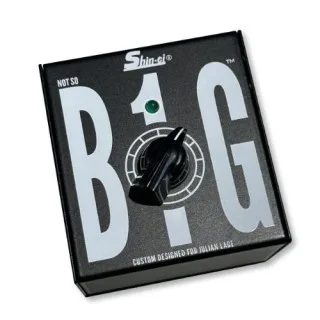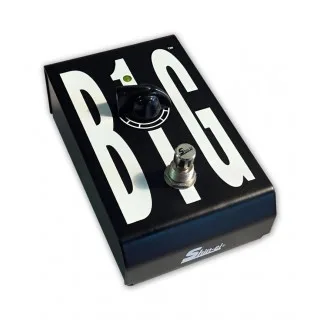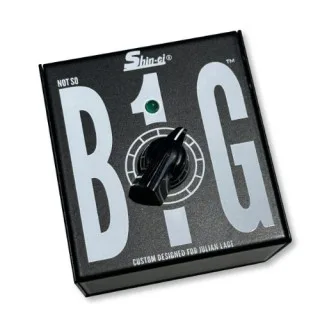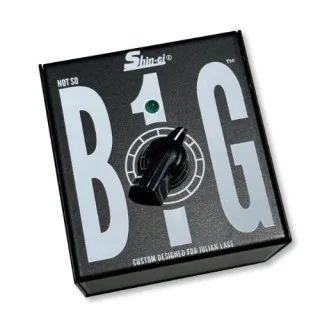


The Shin-ei Not So B1G 1 Preamp Gain Boost Pedal is a compact boost pedal from Shin-ei, designed for guitarist Julian Lage to make road traveling easier. It is a custom, smaller version of the Shin-ei B1G 1 Preamp Gain Boost, built on the exact same circuit board, and it adds a clean boost to your tone via what the maker describes as a massive 30+ dB of pure studio quality gain1.
Because Lage never turns his B1G 1 off, the Not So B1G 1 has no footswitch at all: it is meant to sit in your signal chain permanently on. Shin-ei describes it as a highest quality analog gain boost with advanced circuitry not found in any commercial gain booster effect pedal, using only the finest audio components1.
A clean preamp boost with 30+ dB of gain
The Not So B1G 1 is a clean boost, not an overdrive or distortion. Shin-ei says it adds a clean boost to your tone via a massive 30+ dB of pure studio quality gain, and describes the underlying B1G 1 as a high fidelity, studio quality gain boost, in effect an analog preamp on par with vintage and modern recording studio channel strips21.
That framing matters for how you use it. A clean boost with this much gain on tap can push an amp harder into breakup, or simply raise the level of a quiet guitar or a low-output pickup without changing its character. Pedal of the Day, reviewing the B1G 1 circuit in 2018, noted "an available +30dB of boost on tap" and that the pedal "has been designed by and electronics guru, and brings true studio quality right onto your pedalboard"3.
The maker's own description of the sound:
"Highest quality analog gain boost with advanced circuitry not found in any commercial gain booster effect pedal. Only the finest audio components were used."1
The circuit is fully analog, and the Not So B1G 1 uses the exact same circuit board as the B1G 1 Gain Booster, so the two pedals are electronically identical1.
How it differs from the B1G 1
The differences between the Not So B1G 1 and the standard B1G 1 are physical, not sonic14:
| B1G 1 | Not So B1G 1 | |
|---|---|---|
| Circuit board | Same | Same1 |
| Body | Larger, heavier | Smaller (3.00 x 3.25 inches, 82mm x 76mm) and lighter1 |
| Footswitch | Yes | No footswitch1 |
| Designed for | General players | Julian Lage, for touring1 |
| Enclosure | 14 gauge cold rolled steel2 | Smaller, lighter body1 |
The standard B1G 1 is made of 14 gauge cold rolled steel and carries product code BG-1; the Not So B1G 1 carries product code BGMINI-121. Both are offered in a Black color option12.
Made for Julian Lage
Shin-ei is explicit about the origin of this model: it was designed for guitarist Julian Lage, to make road traveling easier. The maker explains the custom model's features plainly1:
"this custom model features a smaller, lighter body with no foot switch as Julian never turns off his B1G 1!"1
For a player who leaves a boost on all the time, a footswitch is dead weight and a failure point, so removing it lets the enclosure shrink. The trade-off is simple: if you want to switch the boost in and out during a set, the standard B1G 1 is the one with the footswitch1.
The B1G 1 family was designed by electronic guru Lee Jackson2. Both the B1G 1 and the Not So B1G 1 were listed by Shin-ei as taking preorders with shipping beginning November 15th21.
Power: 9V DC, 100mA
The Not So B1G 1 can be powered by a nine volt battery or a nine volt external power source rated at 100mA minimum, but Shin-ei says it performs best with a 9 volt DC external power supply1.
A 9V battery works, but Shin-ei says battery power will not last more than a couple of hours. The maker includes it only as a backup for when external power is unavailable, so plan on running this pedal from a power supply1.
Where it goes in a signal chain
Shin-ei's own usage tip for the B1G 1 family: many players like using the B1G 1 as the last pedal before their amp in their signal path2. Placed there, the boost drives the amp's input directly rather than feeding other pedals, which is the usual spot for a clean boost meant to push the front end of an amplifier.
Warranty
Shin-ei LLC offers a two year warranty on the Not So B1G 1 Pre Amp Gain Booster to the original purchaser of the device. There is no warranty on preowned units sold on the secondary market1.
Videos
Shin-ei
Pedal of the Day
Ramon Goose
Questions
Does the Not So B1G 1 have a footswitch?
No. The Not So B1G 1 has no footswitch at all. Shin-ei built it that way deliberately for Julian Lage, because he never turns his B1G 1 off, so the pedal is designed to stay on permanently in a signal chain rather than be switched in and out.
Can the Not So B1G 1 run on a battery?
Yes, it accepts a nine volt battery, but Shin-ei says battery power will not last more than a couple of hours, so the battery is really a backup for when external power fails. The maker states the unit performs best with a 9 volt DC external power supply rated at 100mA minimum.
What is the difference between the B1G 1 and the Not So B1G 1?
The Not So B1G 1 uses the exact same circuit board as the B1G 1 Gain Booster, so the sound is the same. The differences are physical: the Not So B1G 1 has a smaller, lighter body, measuring 3.00 x 3.25 inches (82mm x 76mm), and it has no footswitch, since it was designed for Julian Lage, who never turns his B1G 1 off.
Where should the Shin-ei B1G 1 go in a signal chain?
Shin-ei says many players like using the B1G 1 as the last pedal before the amp in their signal path. That placement lets the boost drive the amp input directly, pushing the front end of the amplifier rather than the pedals in front of it.
Sources (4)
- Not So B1G 1 Preamp Gain Boost Pedal, Shin-ei
- B1G 1 Preamp Gain Boost Pedal, shin-ei.com
- Shin-ei B1G 1 Transparent Gain Booster, Pedal of the Day, 2018-07-06
- Not So B1G 1 Preamp Gain Boost Pedal, Shin-ei