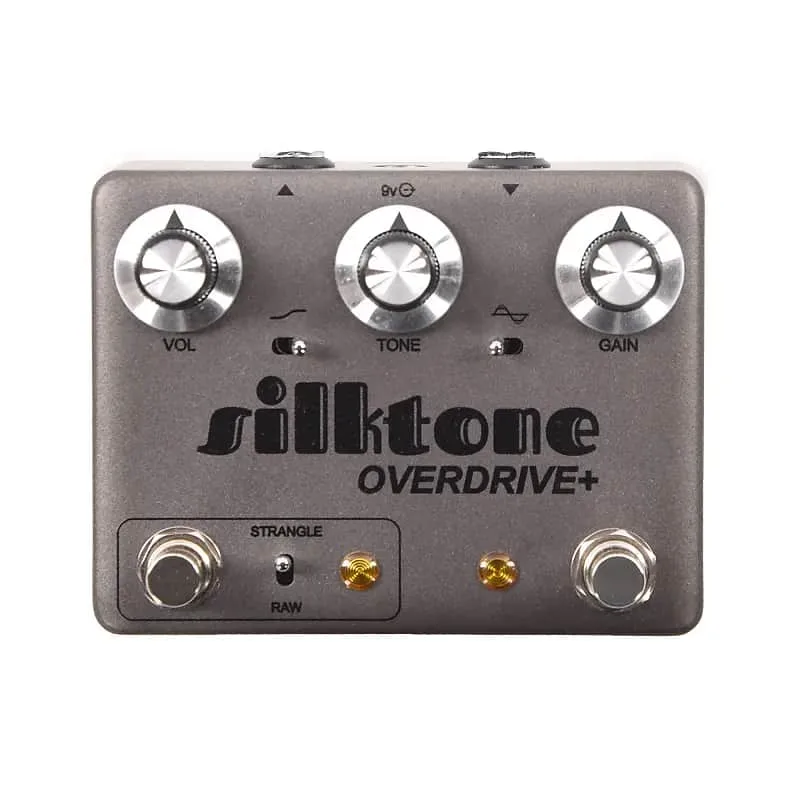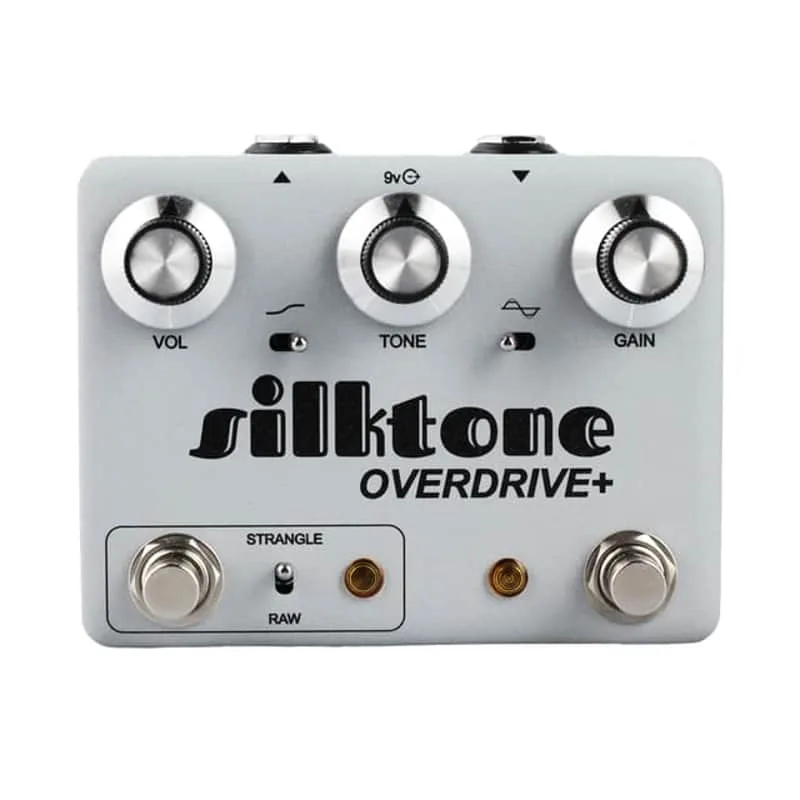
The Silktone Overdrive+ is an overdrive pedal from Silktone, an American boutique amp maker, and it is the brand's first drive pedal1. Guitar Pedal X calls it a "universal full-range dynamic overdrive"2, meaning it is voiced to work across the whole frequency range rather than cutting bass or honing in on one midrange band the way many classic overdrives do. The enclosure shares the high-end aesthetics of Silktone's amp lineup3.
What sets it apart from most overdrives at this price is the control set: alongside the usual three knobs there is a bass cut switch, a clipping mode toggle, and a second footswitch that engages a boost section4. guitar.com's reviewer found it delivers "a superbly midrange-rich amp-like tonality" with "tons of available output level and a stratospherically wide yet usable gain range"1.
A full-range overdrive with an amp-like voice
The Overdrive+ covers a wide spread of drive sounds. Set low with soft symmetrical clipping, guitar.com's Ed Oleszko found it "perfect as an always-on sweetening pedal," while turning up the gain and switching to asymmetrical clipping revealed "a raw cooking tweed amp-like [overdrive] with plenty" of tight attack and excellent string separation1. He concluded that "it's no mere clone, it has its own unique voice and wonderfully responsive amp-like feel"1.
Premier Guitar's reviewer went further on versatility, writing that the design "covers miles of sonic territory and gives you the power to effectively turn a single-channel amp into a three-channel wonder"4. For players who run a simple amp and want one pedal to cover clean-ish edge, crunch and lead, that is the use case the reviewers point to.
The boost section has its own character. In strangle mode, Premier Guitar found "you get a pile of harmonics that (depending on your amp setup) generates rich, controllable, and musical feedback"4. guitar.com described the boost as "tonally rich in second-order harmonics with sustain for weeks," with a strangle-mode midrange that sits almost like a treble booster, suited to a lead boost1.
The controls: knobs, mini switches and two footswitches
The control setup is built around three standard knobs plus a set of switches and two footswitches46.
| Control | What it does |
|---|---|
| Volume | Sets the output level5 |
| Tone | Shapes the overall brightness5 |
| Gain | Sets the amount of drive5 |
| Bass Cut switch | Trims low end from the signal4 |
| Clipping toggle | Selects symmetrical or asymmetrical clipping567 |
| On/off footswitch | Standard true bypass-style on/off6 |
| Boost footswitch | Engages the boost section4 |
The boost footswitch is a non-independent lead gain boost, meaning it adds gain on top of whatever the main circuit is doing rather than acting as a separate clean boost1. GuitarPlayer notes it carries its own filter-mode switch and status light, and is "intended to add further gain to the signal while enhancing second-order harmonic distortion"6.
Inside the circuit: JFETs, op-amps and diodes
According to designer Charles Henry, the Overdrive+ is an original circuit that uses a collection of JFETs, op-amps, and diodes to create a wide variety of drive sounds4. Pedal of the Day and Delicious Audio describe the same topology: a combination of JFETs, op-amps and a few diodes, with all clipping handled by the JFETs or the diodes75.
The op-amp's role is worth noting for anyone who stacks drives. Pedal of the Day explains that the op-amp is used for gain and buffering and is raised to around 30 volts so it never clips, even when another pedal is stacked in front of it7. Delicious Audio frames the result as "a pedal with, literally, infinite headroom, even when fed very high levels, thanks to its 30v buffering dealt by the op-amp"5. In practice, that means you can put a hot pedal or a loud boost ahead of it without the input stage itself adding unwanted distortion.
Clipping modes and stacking
The clipping toggle is where much of the pedal's range lives. GuitarPlayer describes it as "a clipping mode switch to select between Asymmetrical (left) and Symmetrical (right)"6.
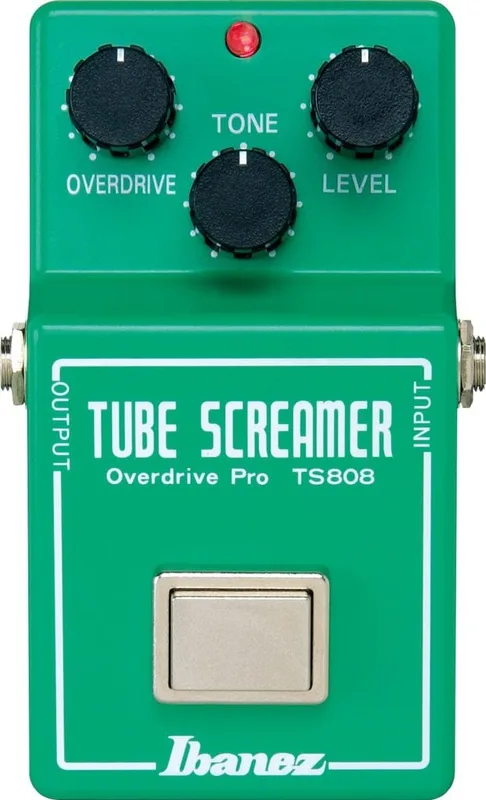
- Symmetrical: akin to the clipping scheme used in an Ibanez Tube Screamer, among others; described as smoother4
- Asymmetrical: in the fashion of a Boss SD-1; described as more natural and textured4
The comparison is a familiar one for players who know the Boss SD-1 vs Ibanez TS9 divide: symmetrical clipping rounds the wave evenly for a smoother voice, while asymmetrical clipping lets one half of the waveform behave differently, adding even-order content for a more open, textured feel. On the Overdrive+ you get both in one pedal, switchable on the fly874.
Combined with the high-headroom op-amp front end, the pedal is built to stack. The 30-volt buffering means the input will not fold when another boost or drive pedal feeds it hard75, and the bass cut switch lets you tighten the low end when it sits later in a chain of distortion or fuzz pedals.
What reviewers said
The published reviews were positive across the board, with a consistent theme: this is not a clone of anything61.
"it's no mere clone, it has its own unique voice and wonderfully responsive amp-like feel"1
Ed Oleszko, guitar.com1
GuitarPlayer's Dave Hunter wrote that "the circuit and features are different from any previous OD I know of, and the results put this pedal in a place all its" own6. On value, guitar.com's reviewer took the view that "The price may be steep, but a versatile overdrive is an investment and you get a lot of scope for your money here"1.
The Overdrive+ keeps its headroom by design: Silktone says the op-amp used for gain and buffering is raised to around 30 volts so it never clips, even when another pedal is stacked in front7.
Questions
What is the difference between symmetrical and asymmetrical clipping on the Overdrive+?
The clipping toggle selects between two clipping styles. Symmetrical clipping, akin to the scheme used in an Ibanez Tube Screamer, is described as smoother. Asymmetrical clipping, in the fashion of a Boss SD-1, is described as more natural and textured, and at higher gain settings it gives a raw, tweed amp-like overdrive with tight attack and good string separation.
What does the bass cut switch do?
The Bass Cut switch trims low end from the signal before it is driven. Rolling back bass content keeps the overdrive tight when the gain is up, which helps the pedal stay articulate on the low strings and sit well in front of an amp that is already breaking up.
Is the Silktone Overdrive+ based on an existing circuit?
No. According to designer Charles Henry, the Overdrive+ is an original circuit built from JFETs, op-amps and a few diodes. GuitarPlayer's Dave Hunter found the circuit and features different from any previous overdrive he knows of, and guitar.com's reviewer called it no mere clone, with its own unique voice.
How much does the Silktone Overdrive+ cost?
The Overdrive+ lists at $269 street in the US, and £279 in the UK as reported by guitar.com in June 2024. Guitar.com's reviewer felt the price may be steep but called it a fair price for something different from the crowd, with a lot of scope for the money.
Can the Overdrive+ be stacked with other drive pedals?
Yes. The op-amp handles gain and buffering and is raised to around 30 volts, so it does not clip even when another pedal is stacked in front of it. Delicious Audio describes the result as a pedal with effectively infinite headroom even when fed very high levels.
Sources (8)
- Silktone Overdrive+ review: unique drive sound in a world of clones, guitar.com, 2024-06-03
- Guitar Pedal X, Guitar Pedal X, 2024-02-08
- “Didn't want to re-invent the wheel, just wanted to make a wheel that could sound beautiful... or rip faces off”: Silktone unveils the Overdrive+, a drive/boost twofer that plays naughty or nice, Guitar World, 2024-02-08
- Silktone Overdrive+ Pedal Review, Premier Guitar, 2024-05-20
- Silktone Overdrive+, Delicious Audio, 2025-01-10
- “If an overdrive designed by a self-proclaimed hater of drive pedals sounds like something you wouldn't even want to plug into, think again”: Silktone Overdrive+ review, GuitarPlayer, 2024-08-19
- Silktone Amps overdrive+, Pedal of the Day, 2024-04-14
- Silktone Introduces Overdrive+ Pedal - Premier Guitar, Premier Guitar, 2024-03-20