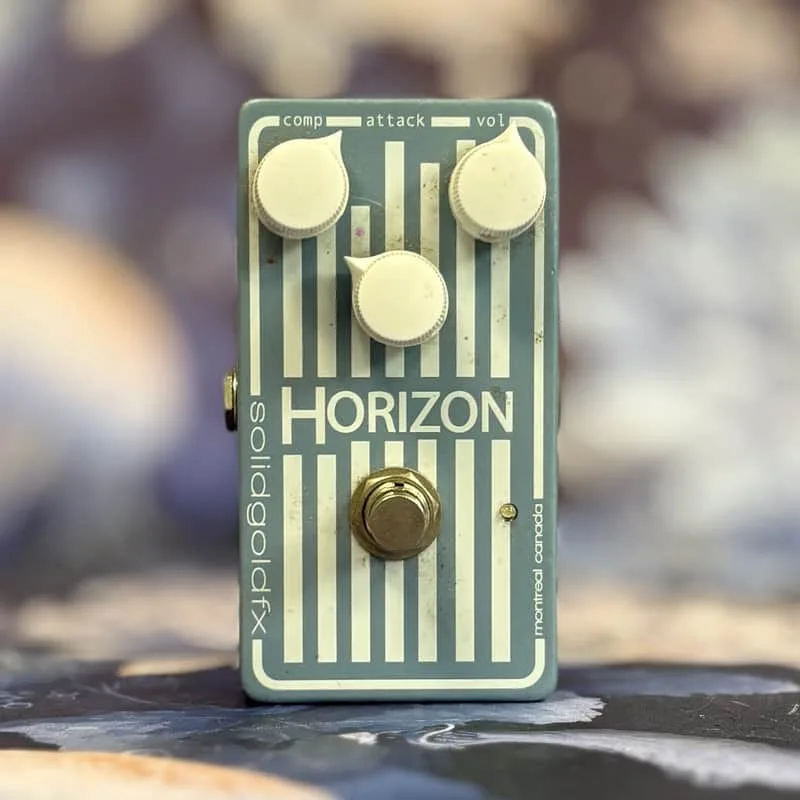


The SolidGoldFX Horizon is a retro-style optical compressor pedal for guitar and bass, released in November 2015. It is an analog design built around a photocell and LED, and SolidGoldFX designed it, in the words of the original announcement, to deliver "silky smooth compression with a blossoming release"1. Where many compressors aim to be transparent and surgical, the Horizon leans the other way: its slow, blooming release is the point, and reviewers found it colorful and interactive rather than subtle.
The pedal keeps things simple on the outside, with three knobs, true bypass switching, and a compact enclosure measuring 4.39" x 2.34" x 1.06" (112 x 60 x 27mm)2. Street price was $175 at release2, and the Premier Guitar review of 2023 still listed it at $175 street3.
An optical compressor with a blooming release
Optical compression works differently from the VCA or OTA circuits in many compressor pedals. As Guitar Interactive's Jonathan Graham explained at the release, "An optical compressor relies on a photocell and LED or light source to control the dynamic range of the input signal"1. The Horizon's circuit uses a lamp and a light-sensitive receptor to represent gain changes, and Premier Guitar's reviewer noted that the design "leverages these quirks" of the optical approach rather than fighting them3. The result is the soft, liquid bloom that optical compressors are known for, which the reviewer found "quite pronounced, but seamlessly integrated" with the complete tone3.
Inside, the Horizon uses a buffered JFET input, low-noise transistors and IC, and a selected optocoupler1. That JFET buffer sits at the input even though the bypass switching itself is true bypass2.
Controls
The control surface is minimal, and the two controls that matter most are attack and compression32:
| Control | What it does |
|---|---|
| Compression | Sets the amount of compression applied to the signal3 |
| Attack | Dials in the attack time; higher settings push the pedal toward volume-swell and reverse-tape-like textures3 |
The attack knob is where the Horizon's character lives. Premier Guitar's reviewer called it "the real key to piling on that fluid, flowering quality," and found that higher attack settings could suggest volume swells, bowing effects, and tape manipulation3. Slower attack settings, mated to heavy compression, gave "quacky, out-of-phase Stratocaster tones a little extra snap and sustain"3.
With fuzz and distortion
The Horizon interacts noticeably with gain pedals placed around it. The Premier Guitar reviewer found it "also works in very cool ways with fuzz and distortion, adding a really nice smoothing quality on the downstream side," while placing it in front of fuzz enabled splintered, radical fuzz tones at low volume3. If you run a fuzz or distortion pedal, both placements are worth trying, because they produce very different results.
What reviewers said
Premier Guitar reviewed the Horizon in July 2023 and came away positive, with some caveats. The reviewer's pros and cons3:
- Pros: "Great range. Tons of unique sounds. Cool interactivity between controls."3
- Cons: "May be too vague or colorful for players that like to fine-tune subtle comp tones."3
That con is worth taking seriously if you are shopping for a compressor. Players who want a clean, studio-style squeeze with precise control over ratio and threshold may find the Horizon too impressionistic. Players who want a compressor that shapes the voice of the guitar will find more to like3.
The reviewer also tested the pedal with different guitars. Humbuckers "react beautifully to the Horizon's ability to maintain clarity and harmonic complexity" while keeping bossier overtones in check3. Rickenbackers with "toaster" and Hi-Gain pickups were "a heavenly match," especially through big, clean 6L6-powered amplifiers3.
On build quality, the reviewer found the pedal "looks and feels like a no-nonsense, locked-down, and elegant piece of construction," with stout controls that move with smooth, satisfying resistance3. Inside, the circuit board is flipped, obscuring the individual components, but the solder joints were "immaculate and robust"3. There is also room for a 9V battery if you are AC-power averse3.
The verdict summed up the pedal's appeal:
"It's a quick and easy-to-use means of enlivening otherwise staid tones."
Videos
SolidGoldFX | Diamond Pedals
SolidGoldFX | Diamond Pedals
Mike Hermans
Questions
Does the SolidGoldFX Horizon take a battery?
Yes. The Horizon runs from a 9V DC input, and there is room inside for a 9V battery if you would rather not use AC power. Battery operation was listed as an option when the pedal was released, and the reviewer's unit had space for one.
Is the SolidGoldFX Horizon true bypass?
Yes. The Horizon uses true bypass switching, so when the pedal is off your signal passes through without the circuit in the path. When it is on, the input is buffered by a JFET stage, which is part of how the pedal keeps noise low.
Should a compressor go before or after fuzz?
Both placements work, but they do different things. The Premier Guitar reviewer found the Horizon placed in front of fuzz enabled splintered, radical fuzz tones at low volume, while running it after fuzz and distortion added a smoothing quality downstream. Try both orders and let your ears decide.
How does an optical compressor work?
An optical compressor uses a light source, an LED or lamp, and a light-sensitive receptor such as a photocell to control gain. As your input signal gets louder, the light gets brighter, the receptor reacts, and gain is reduced. The receptor's natural response gives optical compressors their characteristic soft, liquid bloom.
Sources (3)
- SolidGoldFX Release the Horizon Compressor, Guitar Interactive Magazine, 2015-11-11
- SolidGoldFX Releases the Horizon Compressor, Premier Guitar, 2015-11-06
- SolidGoldFX Horizon Compressor Review, Premier Guitar, 2016-06-15