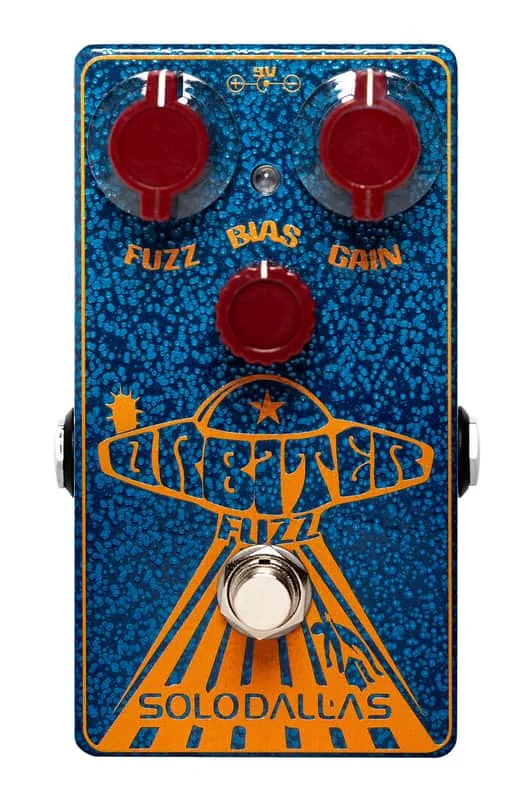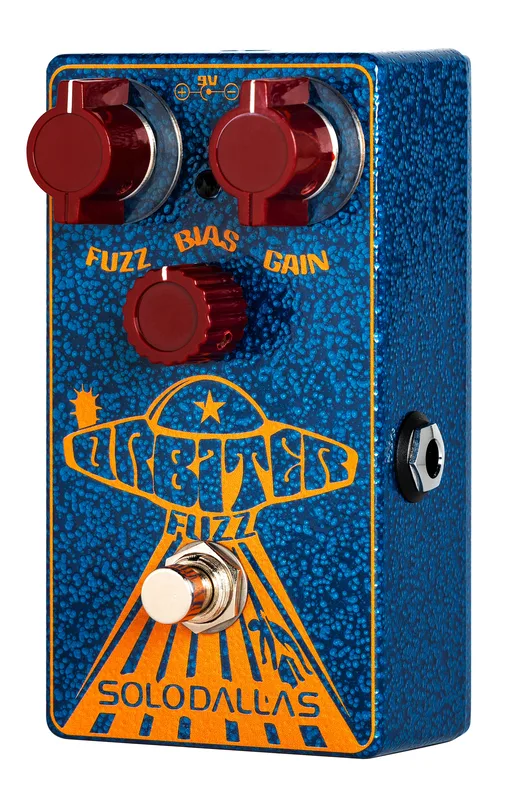


The SoloDallas Orbiter Fuzz is a fuzz pedal from SoloDallas, built in what the maker describes as a durable reinforced steel enclosure with a vintage metallic blue hammered finish1. An internal power circuit converts modern wall power to emulate the draw of a vintage carbon zinc battery, an approach aimed at players chasing vintage fuzz behavior from a modern supply2. The pedal became available for purchase exclusively at SoloDallas.com starting September 1, 20241, at a regular price of £205.00, on sale at £189.002.
The Orbiter is optimized for pedalboard space and easy integration with any standard pedal, as the maker puts it, sitting in a compact 4.75" x 2.50" x 1.5" enclosure weighing 0.8 lbs23. It sits alongside the company's other fuzz offering, the SoloDallas fuzz pedal.
What it does: fuzz into an overdrive stage
The Orbiter's core idea is the two-stage signal path. The F-Face style fuzz circuit generates the fuzz, and that signal then feeds a smooth overdrive circuit, which SoloDallas says can be pushed into harmonic clipping for what it calls ultra-smooth fuzz tones2. For a player, that means the fuzz has a second stage shaping it after the fact, rather than a fuzz knob alone doing all the work.
Premier Guitar's gear coverage later name-checked the Orbiter as a fuzz that "balances fuzz with core-signal clarity," a useful shorthand for what the overdrive stage contributes: the fuzz sits on top of a clear core signal instead of burying it4.
The enclosure is a durable reinforced steel box with a vintage metallic blue hammered finish1, and Bass Magazine noted it is crafted for reliability to withstand rigorous touring conditions, with a compact design optimized for pedalboard space3.
The controls: Fuzz, Gain and Bias
Three knobs sit on the outside, and two trim pots live inside, accessed by removing the back cover52.
| Control | What it does |
|---|---|
| FUZZ | Sets the overall amount of fuzz by shifting the signal's waveform from triangular to square as you turn it clockwise2 |
| GAIN | Increases the signal entering the overdrive circuit, pushing it into harmonic clipping for ultra-smooth fuzz tones2 |
| BIAS | Increases voltage to the matched pair of silicon transistors, sweeping a wide range of vintage fuzz tones2 |
The Bias knob is where much of the pedal's character lives. SoloDallas describes its range in terms of two reference points: "Lower voltages produce spitty Black Keys responses, whereas higher voltages generate smooth American Woman tone"2. Bass Magazine's launch coverage repeated the same description of the Bias sweep3. Turning Bias down starves the transistors the way a dying battery would, for a spittier, gating character; turning it up gives the transistors full voltage for a smoother, sustaining fuzz.
Two internal mini pots round out the control set:
- Drag Control: adjusts the attack from slow to fast as it is turned clockwise2
- Sweet Spot Control: adjusts the input signal to match pickup impedance2
The Sweet Spot control pairs with the 500 kOhm input impedance: rather than a switch for different pickup types, you trim the input to suit your guitar once and leave it2.
Power: 9V, 200 mA, with vintage battery emulation
The Orbiter runs on 9 vDC, center negative, drawing 200 mA, and it is PSU power only: there is no battery operation, and the power supply is sold separately2.
At 200 mA the Orbiter draws more current than a typical analog fuzz, and it cannot run on a battery. Plan for a dedicated 9V output on your power supply rather than a daisy chain shared with low-draw analog pedals.
The reason for that draw is the feature SoloDallas highlights most: Vintage Power Emulation. As the company puts it, "Our unique power circuit internally converts modern wall power to emulate the draw of a vintage carbon zinc battery"1. Classic fuzz circuits were designed around carbon zinc batteries, and their sound changed as those batteries sagged under load. The Orbiter recreates that draw and sag internally2, which is also what makes the Bias knob's voltage sweep meaningful: you get the dying-battery and fresh-battery ends of the fuzz range from a modern power supply.
What reviewers said
Pedal of the Day reviewed the Orbiter in December 2024 and came away impressed by how much range the three-knob format delivered, writing5:
"It's extremely musical and holds together the way you've always wished a fuzz would"5
Pedal of the Day5
The same review described the pedal as a modern take on the 1966 Arbiter Fuzz circuit with vintage battery emulation and an internal impedance trim pot5. Premier Guitar's later gear coverage, listing the Orbiter among fuzzes worth attention, characterized it as balancing fuzz with core-signal clarity4.
Videos
SoloDallas
SoloDallas
SoloDallas
News
Questions
Can the SoloDallas Orbiter run on a battery?
No. SoloDallas specifies 9 vDC, center negative, 200 mA, PSU power only, with no battery operation. Instead of a battery, an internal power circuit converts modern wall power to emulate the draw and sag of a vintage carbon zinc battery, which is part of how the Bias knob shapes the fuzz character. The power supply is sold separately.
Is the Orbiter Fuzz true bypass?
Yes. SoloDallas lists the Orbiter Fuzz as true bypass, so when the pedal is off the signal passes through without the circuit in the path. Input impedance is 500 kOhm and output impedance is 10 kOhm.
How do you get Black Keys and American Woman fuzz tones from the Orbiter?
Through the Bias knob. SoloDallas says lower voltages on the Bias control produce spitty Black Keys responses, while higher voltages generate smooth American Woman tone. Bias increases voltage to the matched pair of silicon transistors as you turn it clockwise, so sweeping it moves between those two characters.
What is the input impedance of the Orbiter Fuzz?
The input impedance is 500 kOhm and the output impedance is 10 kOhm, as listed by SoloDallas. There is also an internal Sweet Spot control, a mini pot accessed by removing the back cover, that adjusts the input signal to match your pickup impedance.
Is the Orbiter based on the Dallas Arbiter Fuzz Face?
SoloDallas describes the Orbiter as an extremely musical F-Face style circuit fed into a smooth overdrive, and says its take on the vintage circuit follows the pure lineage of Arbiter to Diaz to SoloDallas. Press coverage calls it a modern take on the 1966 Arbiter Fuzz circuit.
Sources (5)
- Introducing the Orbiter Fuzz Pedal from SoloDallas, Premier Guitar, 2024-09-01
- Orbiter Fuzz, SoloDallas LLC
- SoloDallas Releases the Orbiter Fuzz Pedal, Bass Magazine, 2024-09-02
- The Fuzz Boxes That Fuel PG Staff’s Meanest Musical Moments, Premier Guitar, 2025-05-12
- SoloDallas Orbiter Fuzz, Pedal of the Day, 2024-12-21