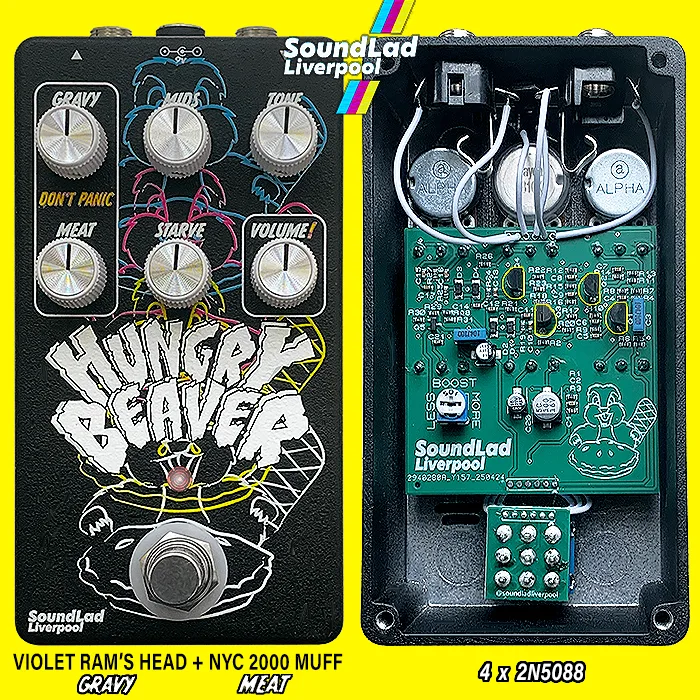
The Hungry Beaver Multi-Muff is a compact Big Muff style fuzz from SoundLad Liverpool, a small UK builder. It carries two stacked gain voices drawn from different points in the Big Muff's history, a Tone control taken from the Big Muff dual filter tone stack, a Mids sweep, and a Starve control that starves the circuit of voltage for sounds well beyond a standard Muff. Guitar Pedal X filed it under Big Muff style fuzz, distortion, fuzz-drive and fuzzstortion, silicon fuzz1.
MusicRadar's reviewer describes it as designed to "slam the front end of an amp harder than you could ever think possible", and is clear that it is not a mere Big Muff clone but a Muff-influenced design pulled through what he calls a voltage-starved, boostable twilight zone2.
The controls
| Control | What it does |
|---|---|
| GRAVY (Gain 1) | Mids focused; based on a 1973 Violet Ram's Head Muff1 |
| MEAT (Gain 2) | Thick and chunky; based on the NYC 2000 Muff1 |
| Mids sweep | Midrange shaping across the fuzz voice1 |
| Tone | Big Muff dual filter tone stack1 |
| Starve | Voltage starvation; harmonic octave character around 11 o'clock1 |
| Volume | Output level, used to compensate for the Starve setting1 |
The two gain controls are stacked, so they shape each other. MusicRadar sums up the split: "Meat is thick and chunky like a modern Russian/New York sound whereas Gravy is less so with more mids, like a classic" version2. Guitar Pedal X's MK2 listing of the pedal repeats the same pairing: GRAVY as mids focused, MEAT as thick and chunky, alongside the Mids sweep, Tone, Starve and Volume3.
The Starve control and the internal Boost trimmer
Starve is the pedal's signature control. It lowers the voltage reaching the circuit, and its character moves across the dial1:
- Around 11 o'clock, Guitar Pedal X reports an "incredible Super-Fuzz-like Harmonic Octave Fuzz", and the MK2 control legend lists Starve as Harmonic Octave at 11 o'clock13.
- Above 2 o'clock, it gates out the pedal's output entirely1.
- An internal Boost trimmer makes the final Starve range usable1.
Guitar Pedal X's reviewer explains how to reach that upper range: "Crank Meat and Gravy right up, turn the internal Boost to max and the second half of the 'starve dial' starts to be useable too!"1
The Volume knob is a relatively recent addition to the circuit. Guitar Pedal X believes this is at least the second iteration of the design, and the Volume control exists largely to compensate for Starve: the more you turn up Starve, the more you need to raise Volume1.
Where it came from and what reviewers said
Guitar Pedal X reviewed the pedal on 6 June 2025, pricing it at £129 and calling it superb value1. The reviewer's verdict:
"This is instantly one of my favourite Big Muffs, particularly in compact enclosure format - it has such a vast range onboard."
In Guitar Pedal X's end-of-year roundup, the MK2 appeared as a "Killer expanded range Big Muff - combining Violet Ram's Head and NYC 2000 flavour"3.
MusicRadar adds a note on the builder's pricing: when the cost of components went up, something the reviewer notes is being heard across the industry, SoundLad did not pass the rise on to customers, and aluminum knob alternatives were offered at the previous £99 price2.
Questions
What is the Starve control on the Hungry Beaver Multi-Muff?
Starve reduces the pedal's internal voltage, and its behavior changes across the dial. Guitar Pedal X notes that around 11 o'clock it produces what the reviewer calls an incredible Super-Fuzz-like harmonic octave fuzz, and the MK2 control legend lists Starve as Harmonic Octave at 11 o'clock. Turned above 2 o'clock, it gates out the pedal's output entirely, so the top of the range is a deliberate dead zone unless you use the internal Boost trimmer to open it up.
What does the internal Boost trimmer do?
It is a trimmer inside the pedal that makes the final part of the Starve range usable. Guitar Pedal X's reviewer describes the method: crank the Meat and Gravy gain controls right up, turn the internal Boost to maximum, and the second half of the Starve dial starts to become usable too. Without it, the upper Starve range gates the output out entirely.
What is the difference between the Gravy and Meat gain circuits?
They are two different Big Muff lineages. GRAVY, the first gain control, is based on a 1973 Violet Ram's Head Muff and is described as mids focused. MEAT, the second, is based on the NYC 2000 Muff and is described as thick and chunky. MusicRadar puts it as Meat being thick and chunky like a modern Russian/New York sound, while Gravy is less so with more mids, like a classic version.
Does the Hungry Beaver have a Volume knob?
Yes, though Guitar Pedal X believes it is a relatively recent addition to the circuit, which the reviewer takes to be at least its second iteration. The Volume knob exists to compensate for the Starve setting: the more you turn up Starve, the more you need to raise Volume to compensate.
Which Big Muff versions is the Hungry Beaver based on?
Its two gain circuits draw on a 1973 Violet Ram's Head Muff (Gravy) and the NYC 2000 Muff (Meat). MusicRadar is careful to say it is not a mere Big Muff clone, but a Muff-influenced design pulled through a voltage-starved, boostable twilight zone. Guitar Pedal X's MK2 listing calls it a killer expanded range Big Muff combining Violet Ram's Head and NYC 2000 flavour.
Sources (3)
- Guitar Pedal X, Guitar Pedal X, 2025-06-06
- SoundLad Liverpool Hungry Beaver Voltage Starved Power Fuzz / Boost pedal review, MusicRadar, 2022-08-15
- Guitar Pedal X, Guitar Pedal X, 2025-12-08