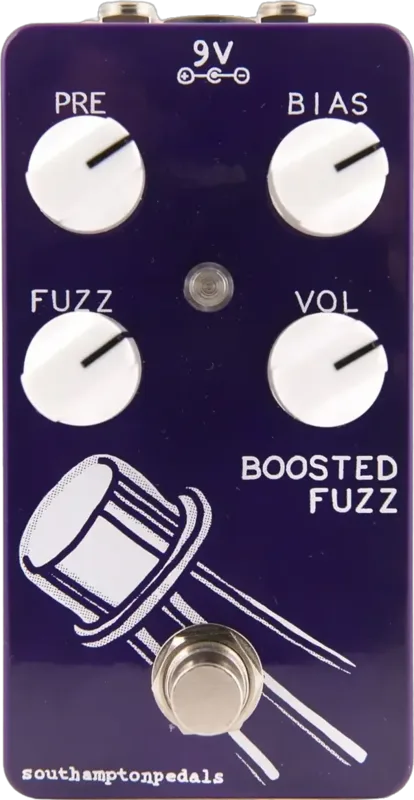

The Southampton Pedals Boosted Fuzz is an analog fuzz pedal built on one of the classic pedal combinations: a Rangemaster-style booster circuit acting as the front end of a Fuzz Face. RockBoard's PedalPedia describes the result as a versatile fuzz that can go from a full spectrum fuzz that saturates easily with tons of bass, with the Pre knob on full, to a mellower, bass-rolled-off voice when Pre is rolled back1. It sits in the broader family of fuzz pedals, with the boost stage doing the work that a separate unit from boost pedals would otherwise handle.
Circuit and transistors
The design pairs two well-known circuits. A Rangemaster-style circuit, a treble-boosting design, sits in front of a Fuzz Face, and the maker presents this as Southampton Pedals' take on that classic combination1.
Rather than germanium transistors, the Boosted Fuzz uses low-gain silicon transistors. according to RockBoard's PedalPedia, this lets the pedal retain a lot of the sonic characteristics of germanium fuzzes1.
Controls
| Control | What it does |
|---|---|
| Bias | Starves the circuit fully off for a velcroey fuzz at one end; over-saturates the pedal fully on at the other; can typically be used to kill the noise between notes1 |
| Pre | On full, a full spectrum fuzz that saturates easily with tons of bass; rolled off, removes bass and mellows out the fuzz1 |
Noise and oscillation
The maker states that, as with many versatile fuzzes, oscillation and noise will occur at some settings. The Bias knob can typically be used to kill the noise between notes1.
Power
The Boosted Fuzz runs on 9V DC, center negative, and draws 10mA1.
Videos
Mike Hermans
Questions
What power supply does the Southampton Pedals Boosted Fuzz need?
The Boosted Fuzz runs on a 9V DC power supply with a center negative plug, the standard arrangement for most pedalboard power supplies. It draws 10mA, which is a light load that any typical supply can handle. The maker's listing does not mention battery operation, so plan on a DC supply.
Does the Boosted Fuzz use germanium or silicon transistors?
It uses low-gain silicon transistors. According to the maker, this choice lets the pedal retain a lot of the sonic characteristics of germanium fuzzes while avoiding some of the quirks that come with germanium parts. The circuit itself is a Rangemaster-style booster feeding a Fuzz Face.
Why does the Boosted Fuzz oscillate or make noise?
The maker notes that, as with many versatile fuzzes, oscillation and noise will occur at some settings. This is part of the circuit's character rather than a fault. The Bias knob can typically be used to kill the noise between notes, so adjusting bias is the first thing to try if the pedal gets unruly.
What does the Bias knob do on the Boosted Fuzz?
The Bias knob starves the circuit fully off at one end, creating a velcroey fuzz, and over-saturates the pedal fully on at the other. It can also typically be used to kill the noise between notes, which helps when the pedal oscillates at certain settings.
How much current does the Boosted Fuzz draw?
The Boosted Fuzz draws 10mA at 9V DC, center negative. That is a modest current draw, well within what any standard pedalboard power supply output provides.
Sources (1)
- Boosted Fuzz by Southampton Pedals, RockBoard PedalPedia, 2026