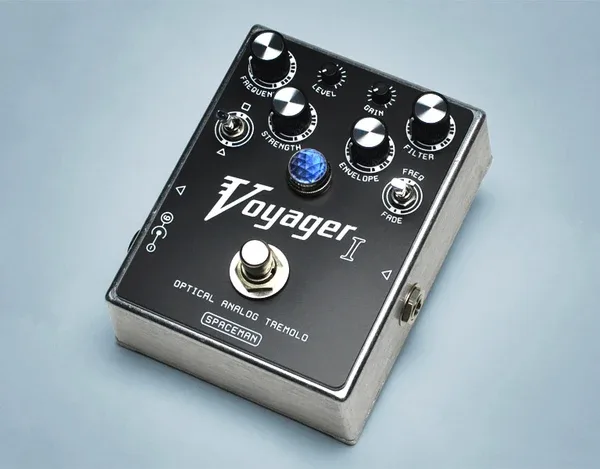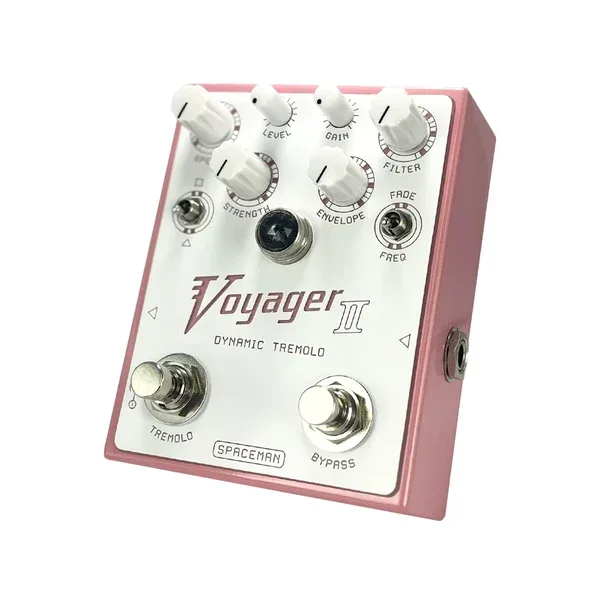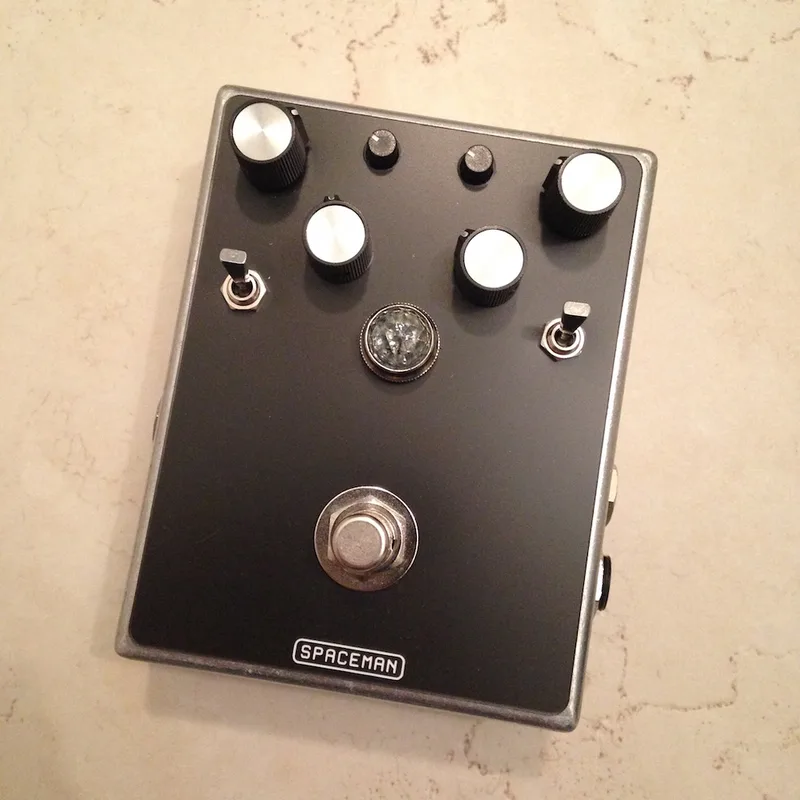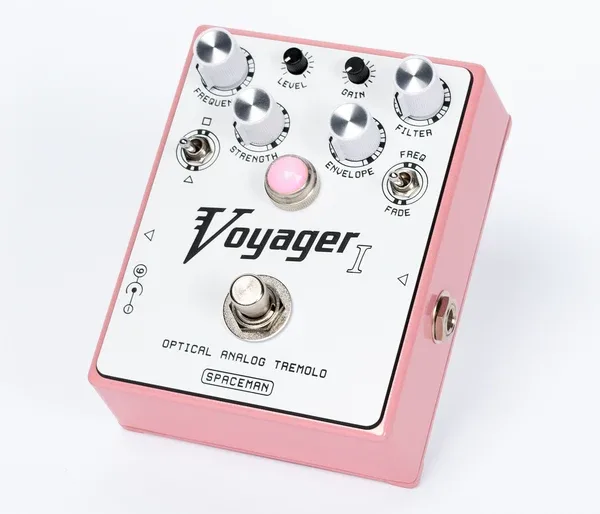


The Spaceman Effects Voyager I is an optical analog tremolo pedal: an all-analog, light-based circuit that raises and lowers your volume in a repeating wave, the way the tremolo circuits in vintage amplifiers did. What sets it apart from a standard tremolo is an envelope section that listens to how hard you play and changes the effect in response, so the pedal reacts to your picking dynamics rather than simply cycling at a fixed rate1.
Spaceman describes the design in its own words:
"The all analog, light-based (optical) design of the Voyager 1 gives it vintage tone and feel, while its unique control options set it apart from the old standards."1
The Voyager I is no longer available: Spaceman's product pages list it as sold out12.
How the envelope section works
The core of the Voyager I is what Spaceman calls an optional envelope control section that changes parameters based on your playing dynamics1. A selector switch chooses between two envelope modes, Freq and Fade, and an Envelope control dials in the sensitivity of the envelope section so the pedal responds to your touch the way you want1.
The two modes work in opposite directions:
| Mode | What happens as you play |
|---|---|
| Freq | The LFO speed increases with louder dynamics and slows back down when playing with a lighter touch1 |
| Fade | A heavy hand fades out the tremolo effect; the tremolo fades back in with light playing or sustained phrases1 |
In Freq mode, digging in makes the tremolo pulse faster and easing off lets it relax, which suits players who want the intensity of the effect to track their attack. In Fade mode, hard playing pushes the tremolo out of the way entirely and it returns as you soften up or hold notes, effectively using your dynamics as an on/off control for the effect1.
The other controls
Alongside the envelope section, the Voyager I carries the controls a tremolo player expects, plus a tonal shaping option12:
| Control | What it does |
|---|---|
| Envelope | Dials the sensitivity of the envelope section1 |
| Envelope selector | Chooses between the Freq and Fade envelope modes1 |
| Wave shape switch | Selects between Triangle or Square wave shapes for a smooth or choppier feel2 |
| Filter | Shifts between sparkle and warmth, adding tonal flavor to the tremolo2 |
The wave shape switch is the classic tremolo choice: a triangle wave gives the smooth, rounded swell associated with amplifier tremolo, while a square wave chops the signal on and off more abruptly. The Filter control is less common on tremolo pedals, letting you voice the effect brighter or warmer to sit with the rest of your rig2.
Finishes and the Pink Edition
The Voyager I appeared in a range of finishes across its run, shown on Spaceman's product page as Silver, Black, Brass, White, Navy Blue, Chrome, and Copper2. Pricing varied by finish, from $349.00 to $499.002. Guitar Pedal X reports that on the original Voyager I "the price tag went as high as $499 for the shiny copper edition!"3.
The final version was a one-of-a-kind Pink Edition:
- Pink powder-coated enclosure with a heavy duty white and black engraved faceplate1
- Signed and numbered on the inside, with a 1-of-1 hand-hammered number tag on the enclosure1
- A white jewel indicator with a soft pink LED1
- Listed at $499.001
The Voyager II reissue
Spaceman later reissued the dynamic optical tremolo as the Voyager II3. The circuit concept carries over, but the reissue makes several changes:
- The Voyager I's all analog, light-based (optical) design gives it what Spaceman describes as vintage tone and feel, while its unique control options set it apart from the old standards12
- In the Freq setting, the LFO speed increases with louder dynamics and slows back down when playing with a lighter touch1
- A one-of-a-kind Pink Edition appeared in a pink powder-coated enclosure with a heavy duty white and black engraved faceplate, signed and numbered on the inside, with a 1-of-1 hand-hammered number tag on the enclosure1
For a player weighing the two, the Voyager I is the original handmade run, an all analog, light-based (optical) tremolo whose unique control options set it apart from the old standards12, while the Voyager II is the current version of the same dynamic optical tremolo design.
Videos
Knobs
Premier Guitar
Zachary Rizer
Questions
Is the Spaceman Voyager I analog?
Yes. Spaceman Effects describes the Voyager I as an all analog, light-based optical tremolo, a design the maker says gives it vintage tone and feel. The pedal was fully handmade and hand-soldered, built on the original run circuit.
What is the difference between the Voyager I and the Voyager II?
The Voyager II is a reissue of the same dynamic optical tremolo. Spaceman relabeled the Frequency control as Speed and the Freq / Fade envelope switch as Fade / Freq, and added a separate Overdrive Bypass footswitch. It was released as a Through-Hole Components Release expected to return to the webstore for $399.
What did the Spaceman Voyager I cost?
Spaceman's product page listed the Voyager I at $349.00 to $499.00 depending on the finish. The one-of-a-kind Pink Edition was listed at $499.00, and Guitar Pedal X reports the original copper edition also carried a $499 price tag.
Is the Spaceman Voyager I still made?
No. Both of Spaceman's Voyager I product pages, including the Pink Edition, show the pedal as sold out. The design lives on in the Voyager II reissue, which Spaceman released as a Through-Hole Components Release.
Sources (3)
- Voyager I: Optical Analog Tremolo, Spaceman Effects
- Voyager I: Optical Analog Tremolo, Spaceman Effects
- Guitar Pedal X, Guitar Pedal X, 2024-12-11