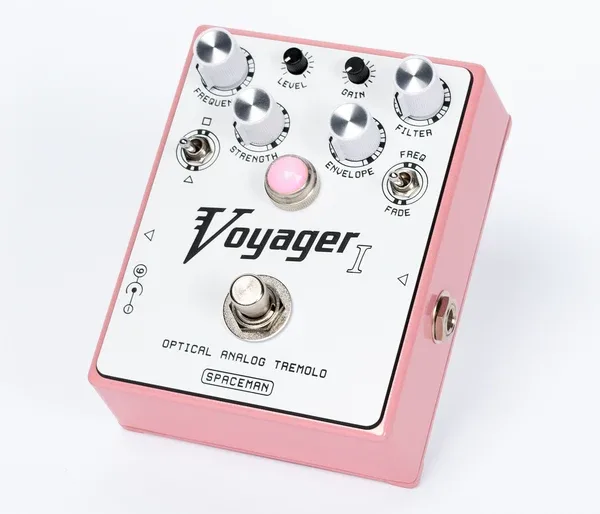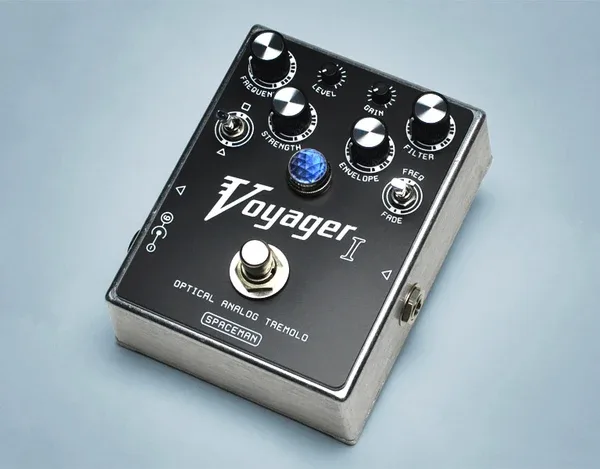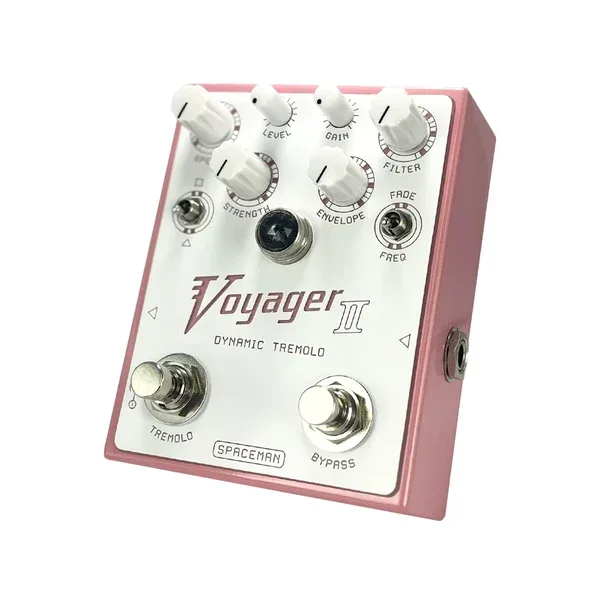


The Spaceman Effects Voyager II is a fully analog, optical tremolo pedal with a twist: it responds to your playing. A dynamic envelope control tracks your attack and alters the tremolo's speed or depth in real time, so the effect shifts with how hard or softly you play rather than running at one fixed setting1. On top of the tremolo, it carries a preamp and overdrive section with Gain and Level controls, and two footswitches so the drive and the tremolo can be used independently2.
Spaceman builds the Voyager II in limited, signed and numbered runs, and the batches offered so far are sold out2. It lists at $399.00 to $429.00 USD depending on the edition2.
An optical tremolo that follows your playing
Most tremolo pedals cycle at whatever speed you dial in and stay there. The Voyager II instead uses dynamic envelope control, reading your picking dynamics and changing the tremolo's speed or depth as you play1. Spaceman offers this in two modes, selected by a switch2.
- Freq mode: the tremolo speed ramps up as you play and slows back down with a softer touch2.
- Fade mode: the tremolo depth fades out the harder you play, then fades back in with a gentle attack or at the end of a phrase2.
The Fade behavior carries over from the original Voyager I, where Spaceman described it the same way: a heavy hand fades out the tremolo effect, with the tremolo fading back in during light playing or sustained phrases3. The practical difference between the modes is which parameter moves: Freq changes how fast the pulse runs, while Fade changes how deep it is.
The tremolo itself is optical, meaning the signal is controlled by a light-dependent element rather than a transistor chopping the audio, and the LFO driving it is analog with a choice of waveshapes21.
The controls and footswitches
The Voyager II's control panel covers both the tremolo and the drive side of the pedal2.
| Control or switch | What it does |
|---|---|
| Speed | Sets tremolo speed; wide-range control for fine-tuning2 |
| Strength | Wide-range control for fine-tuning the tremolo depth2 |
| Gain | Sets the preamp/overdrive amount, from transparent unity gain to overdrive2 |
| Level | Sets the output level, from unity gain to a boost2 |
| Wave shape switch | Selects Triangle (smooth) or Square (choppy) LFO shapes2 |
| Mode switch | Selects Freq or Fade dynamic behavior2 |
| Tremolo footswitch | Stops and starts the LFO on command2 |
| Overdrive Bypass footswitch | Bypasses the drive section independently4 |
The two waveshapes give distinct characters. Spaceman describes the Triangle wave as "a wonderfully smooth tremolo" and the Square wave as producing "a choppier effect"2.
The second footswitch exists because Spaceman considers the overdrive section a pedal in its own right. As the maker puts it2:
"We think this overdrive is so special that we've included a secondary footswitch to stop/start the tremolo, so you can use it independently."2
With the tremolo stopped, the Voyager II works as a preamp/overdrive with Gain and Level, covering everything from clean unity gain to a boost to overdrive2. With the tremolo running, the drive colors the signal before the pulsing optical stage.
History: from the Dynamic Optical Tremolo to Voyager II
The Voyager II is a reissue of Spaceman's earlier Dynamic Optical Tremolo, the Voyager I4. When Spaceman announced the Voyager II in December 2024, Guitar Pedal X described it as a return of that circuit with a few changes: the control formerly labeled Frequency was relabeled as Speed, the Freq/Fade mode switch was flipped to Fade/Freq, and a separate Overdrive Bypass footswitch was added4.
The Voyager I itself remains listed by Spaceman as an Optical Analog Tremolo, with editions such as the Pink Edition shown as sold out3. The Voyager II was launched as a Through-Hole Components Release rather than a Standard Series pedal, meaning it uses full-size through-hole components instead of the smaller parts found in Spaceman's more affordable machine-made lines4.
The Voyager II has been offered only in limited runs. Spaceman released three signed and numbered First Editions in Blue, White and Black, then a second limited batch of the first edition in the same three colors in a numbered open edition format; both are sold out. Guitar Pedal X reported in December 2024 that further colorways were expected24.
Guitar Pedal X's Stefan Karlsson, writing at the December 2024 announcement, called it "a really cool Tremolo pedal for sure" and noted it as a viable wishlist target, adding that while he personally favors harmonic tremolos, he likes dynamic envelope follower tremolo types overall4.
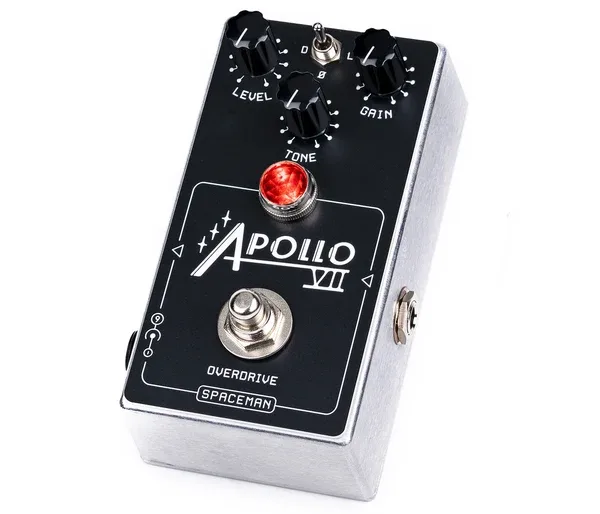
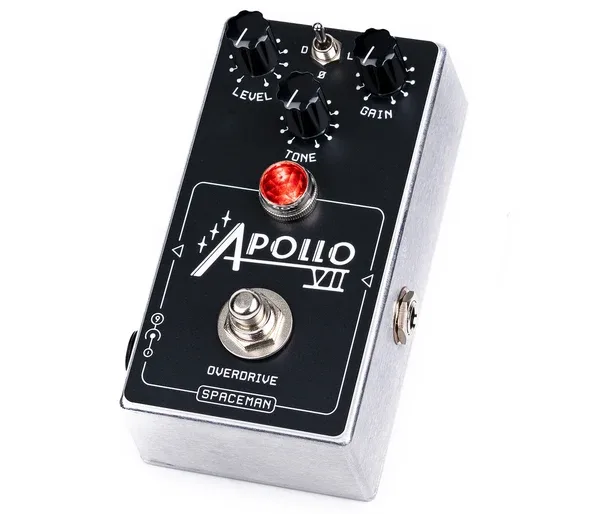
The Voyager I's preamp also lives on elsewhere in the Spaceman range: the Apollo VIIb Voyager preamp/overdrive pedal is derived from the Voyager tremolo's preamp circuit.
Videos
SpiralCasterPlaysPedals
Harp Lady
Demos In The Dark
Questions
How much current does the Spaceman Voyager II draw?
Spaceman lists an engaged current draw of 18 mA. It runs on 9V DC, negative center, through a 2.1mm jack, and can also be powered by a 9V battery, so it is easy on most pedalboard power supplies.
Is the Spaceman Voyager II analog?
Yes. Spaceman describes the Voyager II as a fully analog, optical tremolo. The tremolo uses an optical circuit, the LFO is analog with triangle and square waveshapes, and the preamp and overdrive section is analog as well.
What waveshapes does the Voyager II have?
The analog LFO offers two wave shapes: Triangle, which Spaceman describes as a wonderfully smooth tremolo, and Square, which gives a choppier effect. The wave shape is selected alongside the Freq and Fade dynamic modes.
How much does the Spaceman Voyager II cost?
Spaceman's product page lists the Voyager II at $399.00 to $429.00 USD, depending on the edition. When the pedal was announced in December 2024, Guitar Pedal X reported an expected webstore price of $399.
Is the Spaceman Voyager II still available?
The listed batch is sold out. Spaceman offered the Voyager II as signed and numbered First Editions in Blue, White and Black, followed by a second limited batch in the same three colors, and both sold out. Further colorways were expected as of December 2024.
Sources (4)
- Voyager II by Spaceman Effects, RockBoard PedalPedia, 2026
- Voyager II: Dynamic Analog Tremolo, Spaceman Effects
- Voyager I: Optical Analog Tremolo, Spaceman Effects
- Guitar Pedal X, Guitar Pedal X, 2024-12-11