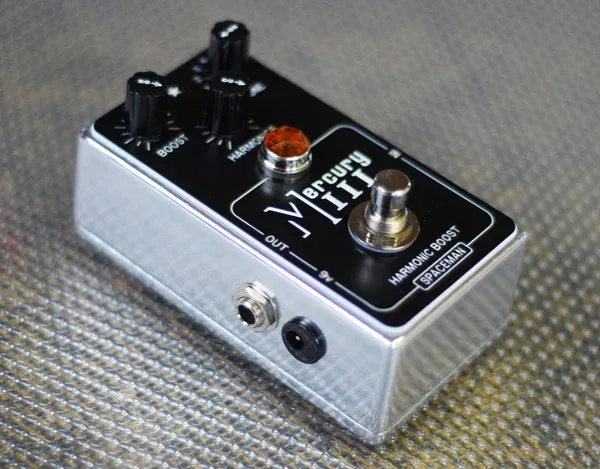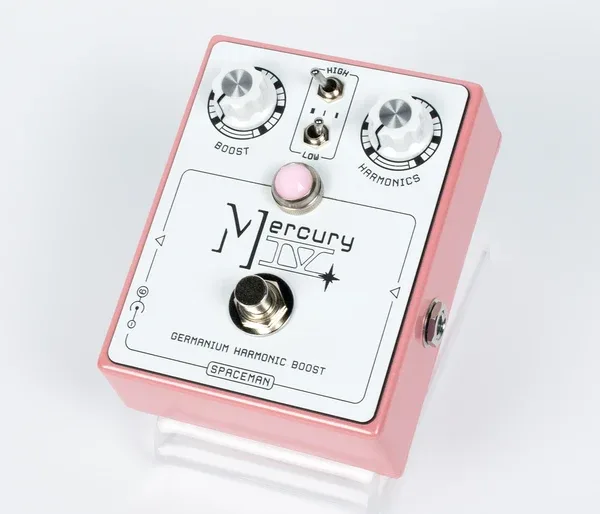


The Spaceman Mercury IV is a germanium harmonic boost pedal from Spaceman Effects, a small builder working out of Portland, Oregon. Spaceman describes it as "a dynamic tone enhancer, created to bring out additional harmonic character from instruments and amplifiers"1. It is a discrete analog circuit built around a meticulously selected vintage germanium transistor, and it launched in March 2018 as an update to the Mercury III circuit from eight years earlier1,2.
The idea is simple: a Boost knob gives you up to 35 dB of clean volume to push a tube amp, while a separate Harmonics knob blends in light, tube-like distortion. Because those even-order harmonics are generated independently of the boost, you control how much of each goes into the signal chain1,3.
Every edition of the Mercury IV listed by Spaceman Effects, including the limited Pink and Olive Drab runs, is marked sold out on the maker's product pages5,1,6. Pedal of the Day suggested in 2019 that players "try and find yourself one of these beauts on the used, black or 3rd party markets"7. Expect to buy used.
What it does: a germanium harmonic boost
Spaceman positions the Mercury IV as a boost first, but with a harmonic character that sets it apart from a plain volume pedal. The even-order harmonics the circuit generates are described by Delicious Audio as having "a sound and response like hot tubes on the edge of breakup, with subtle sparkle, complex textures, and octave-like overtones"4. Those harmonics are generated independently of the boost level, so you can add warmth and dimension at low volume or stack it with a full 35 dB push into an amplifier already near breakup1,4.
The Harmonics knob is the heart of the pedal. RockBoard's PedalPedia entry describes it as blending in "light, tube-like harmonic distortion, even adding octave-like overtones to your solos and unique textures to chords"3. Pedal of the Day's reviewer noted that the knob "is very reactive to your playing, instrument and pickup choices, and reacts strictly to the input signal," which means the same setting behaves differently with different guitars7.
"The real magic however, resides in the Harmonics control; bringing more dimension and life to ones' tone."
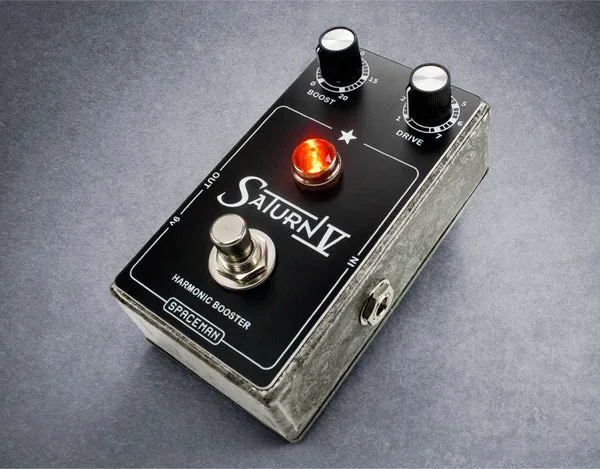
The pedal sits in a family of Spaceman harmonic boosters. Pedal of the Day describes the Mercury IV as "rooted firmly in the Boost department, but with a couple more options" than the earlier Saturn V Harmonic Boost7. The Mercury IV is itself an updated version of the Mercury III circuit, and the first run of White, Brass Metallic, Chrome and Copper editions used germanium transistors from the same vintage stock as the original Mercury III first run editions1.
The controls
The control set is deliberately small: two knobs and two toggle switches.
| Control | What it does |
|---|---|
| Boost | Sets how much of the available 35 dB of gain goes into the signal chain, from a gentle nudge to an aggressive amp push1,3 |
| Harmonics | Blends in light, tube-like harmonic distortion, from clean boost to octave-like overtones; reacts to your playing, instrument and pickups3,7 |
| Two toggle switches | Provide nine (9) tone-shaping options in combination, letting you dial the character of the boost1,4 |
The nine tone-shaping options from the two toggles are what separate the Mercury IV from a simpler booster like the Saturn V Harmonic Boost, which Pedal of the Day describes as having fewer options7.
Power and connections
Signal enters and leaves through quality open-frame Switchcraft jacks, and the pedal uses true-bypass switching through what Spaceman calls the heaviest duty mechanical footswitch available1,4. Input resistance is 1 Meg Ohm, so it presents a normal load to passive pickups1.
Build, editions and history
Spaceman builds the Mercury IV entirely in Portland, Oregon, describing it as "completely hand-soldered and handmade in Portland Oregon to the highest degree of quality possible"1. The construction details include an immaculate hand-soldered PCB, detailed military-spec wiring, and a cast aluminum enclosure with a durable, engraved vinyl faceplate and jewel indicator light1,4.
The pedal launched in March 2018 in five signed and numbered limited editions: Chrome, White, Brass, Black and Silver, with the Silver Edition priced at $2992. Guitar.com reported the release as a Mach 4 version of the builder's boost pedal, priced from $299 to $3498. Later runs included a Pink Edition, a 1-of-1 with a hand-hammered number tag that Spaceman matched to a limited run of pink Sputnik III pedals, and an Olive Drab Edition limited to a batch of four, with the maker noting "We wanted to make more than just four, but are currently limited by available parts"56,6. Each pedal number is hand-hammered on the nameplate, and each unit is signed and numbered on the inside1.
What reviewers said
Published coverage of the Mercury IV has been positive. Delicious Audio called the Harmonics control the pedal's "real magic"4. Pedal of the Day's 2019 review highlighted the Harmonics knob's reactivity to playing and pickup choices, and pointed used-market buyers toward third-party listings7. Writing at Guitar Pedal X in 2022, Stefan Karlsson, who uses the Mercury IV in his own chain to further sculpt and enhance tone, called it "my ultimate Harmonics multiplier" for a long time9.
Videos
Premier Guitar
Premier Guitar
SpacemanEffects
Questions
How much gain does the Spaceman Mercury IV have?
The Boost control offers up to 35 dB of gain, which Spaceman describes as enough to gently or aggressively push a tube amplifier into breakup. The Harmonics control is separate, so the amount of boost and the amount of harmonic coloration are set independently.
Is the Spaceman Mercury IV discontinued?
Every edition listed by Spaceman Effects, including the standard run and the limited Pink and Olive Drab batches, is marked sold out on the maker's product pages. Pedal of the Day suggested in 2019 that players look for one on the used or third-party markets.
What is the difference between the Mercury III and Mercury IV?
The Mercury IV is an updated version of the Mercury III circuit, which Spaceman introduced eight years before the new pedal. The first run of White, Brass Metallic, Chrome and Copper editions used germanium transistors from the same vintage stock as the original Mercury III first run editions.
Does the Mercury IV take a battery?
Yes. The pedal is built with a custom Spaceman heavy-duty battery connector alongside its 9V DC power input, so it can run on an internal battery rather than a power supply.
Where is the Spaceman Mercury IV made?
Spacman Effects builds the Mercury IV entirely in Portland, Oregon. The maker describes it as completely hand-soldered and handmade, with a hand-soldered PCB, military-spec wiring and open-frame Switchcraft jacks.
Sources (9)
- Mercury IV: Germanium Harmonic Boost, Spaceman Effects
- Mercury IV Boost: Spaceman's New Germanium Harmonic, Premier Guitar, 2018-03-01
- Mercury IV by Spaceman Effects, RockBoard PedalPedia, 2026
- Spaceman Mercury IV Germanium Harmonic Boost, Delicious Audio, 2018-11-26
- Mercury IV: Pink Edition, Spaceman Effects
- Mercury IV: Olive Drab Edition, Spaceman Effects
- Spaceman Effects Mercury IV Germanium Harmonic Boost, Pedal of the Day, 2019-09-12
- Spaceman Effects launches the Mercury IV boost pedal, Guitar.com, 2018-03-05
- Guitar Pedal X, Guitar Pedal X, 2022-05-06