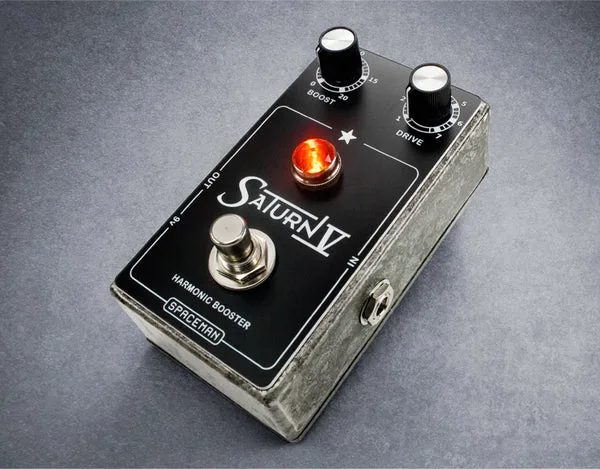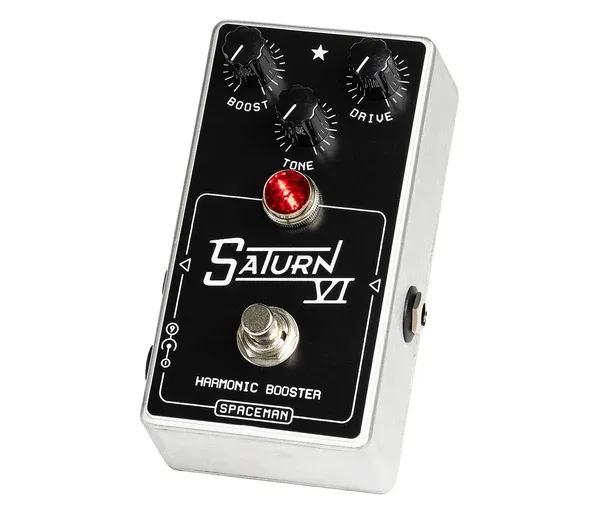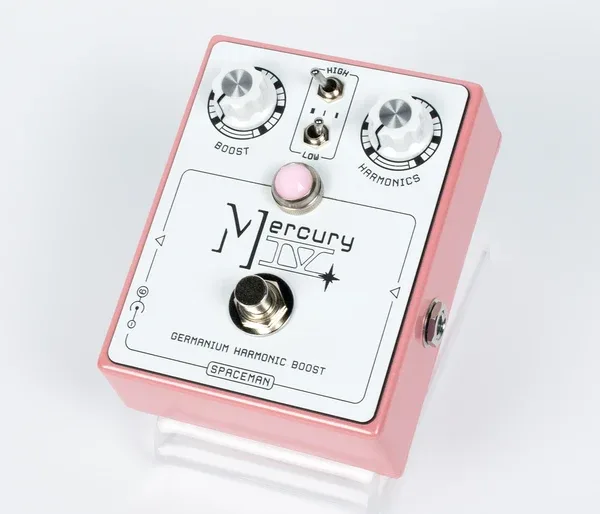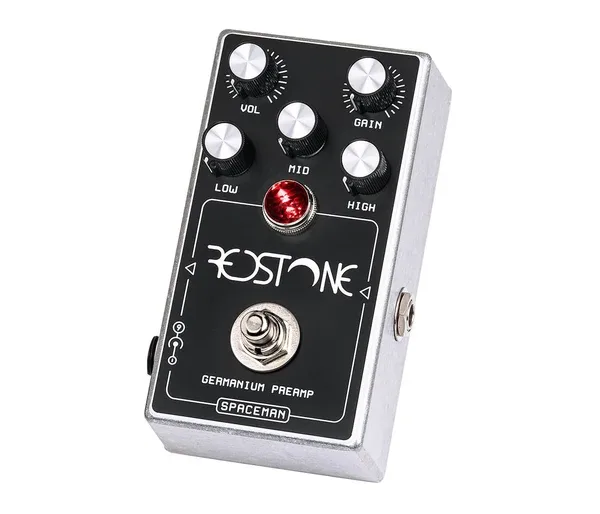

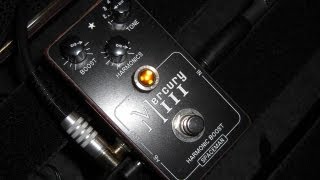
The Spaceman Effects Mercury III is a harmonic boost pedal: a germanium-powered boost that does more than simply make you louder. Spaceman describes it as a tone enhancer that blurs the line between boost and overdrive, generating tube-like even-order harmonics that are mixed back in with your original instrument signal to bring more dimension and life to your tone1. It belongs to the same family of harmonic boosters as the Saturn V and Saturn VI, and sits in the wider world of boost pedals.
The Mercury III is sold out. It was offered in three limited editions, so availability depends on the secondhand market.
What it does to your sound
The core of the pedal is a clean boost of up to 11 G's of gain, enough on its own to drive a tube amp from light breakup to distortion1. On top of that, the Mercury III generates even-order harmonics, the harmonics associated with tube amplification, and lets you mix them in with your dry signal1. That blending is what makes it a harmonic boost rather than a straight volume pedal: at low harmonic settings it behaves like a clean boost, and as you add more it moves toward overdrive territory, the ground also covered by overdrive pedals and distortion pedals.
The circuit is all discrete, with no ICs in the tone path, and each pedal includes a NOS 1966 germanium transistor, which Spaceman credits for its "wonderful vintage sparkle"1.
Controls
| Control | What it does |
|---|---|
| Boost | Sets the amount of clean gain, up to 11 G's1 |
| Harmonic | Sets how much even-order harmonic content is mixed with your signal1 |
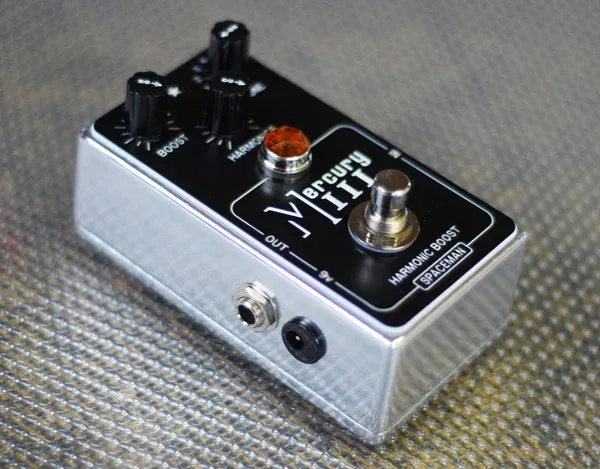
| Tone | Six tone selections, interactive with the Boost and Harmonic controls, enabling Full boost, Treble boost, Bass boost and Mid boost1 |
The tone control's six positions are not fixed EQ curves in isolation: Spaceman notes they are interactive with the Boost and Harmonic controls, so the character of each selection changes with the other two settings1.
Versions and finishes
Three limited versions were offered, each with its own look1:
| Edition | Limit | Indicator light |
|---|---|---|
| Copper Plated | Units 1 to 10 | Vintage NASA surplus dimmable amber light, "hazard" style display1 |
| White Powdercoat | Units 1 to 30 | Vintage NASA surplus dimmable amber light, standard display1 |
| Raw Silver | Units 1 to 80 | Jeweled indicator1 |
The NASA surplus indicator lights appear on the Copper and White versions only, and are dimmable1.
Build, power and warranty
The Mercury III is housed in a super-duty USA-cast aluminum enclosure topped with a durable engraved faceplate, and is handmade in Portland, Oregon1. Switching is true bypass, provided by what Spaceman calls the heaviest-duty mechanical footswitch available1.
Power is 9V DC, drawing 7.5 mA bypassed and 13.5 mA engaged1. Input resistance is 1 Meg Ohm1.
The pedal ships with a transferable three year warranty plus a lifetime discount repair plan1.
Where it sits in Spaceman's range
The Mercury III sits in Spaceman's range as a germanium gain pedal, listed at $229.00 to $299.00 and currently sold out1. Spaceman describes it as a pedal that "generates tube-like even-order harmonics, which can then be mixed in with your original instrument signal, bringing more dimension and life to your tone"1. Its circuit is built around an all discrete tone path with no ICs, a design choice Spaceman highlights on the product page1.
Videos
musictoyznetwork rasch
missfitzpdx
Dennis Kayzer
Questions
What does a harmonic boost do?
A harmonic boost does more than raise your volume. Alongside clean gain, it generates even-order harmonics, the kind associated with tube amps, and mixes them back in with your original signal. Spaceman describes the Mercury III as a tone enhancer that blurs the line between boost and overdrive, adding dimension and life rather than just level.
Does the Spaceman Mercury III use a germanium transistor?
Yes. Each Mercury III includes a NOS, meaning new old stock, germanium transistor from 1966. Spaceman credits that transistor for what it calls the pedal's wonderful vintage sparkle, and the whole tone path is discrete, with no integrated circuits.
Is the Mercury III true bypass?
Yes. The Mercury III uses true bypass switching, handled by what Spaceman describes as the heaviest-duty mechanical footswitch available. Input resistance is 1 Meg Ohm.
Does the Mercury III have a warranty?
It comes with a transferable three year warranty, plus a lifetime discount repair plan. The pedal is built into a super-duty USA-cast aluminum enclosure topped with a durable engraved faceplate.
How many Mercury III pedals were made in each finish?
Three versions were offered, each limited: Copper Plated was limited to units 1 through 10, White Powdercoat to units 1 through 30, and Raw Silver to units 1 through 80. The Copper and White versions carry vintage NASA surplus dimmable amber indicator lights, while the Silver edition uses a jeweled indicator.
Sources (1)
- Mercury III: Harmonic Boost, Spaceman Effects