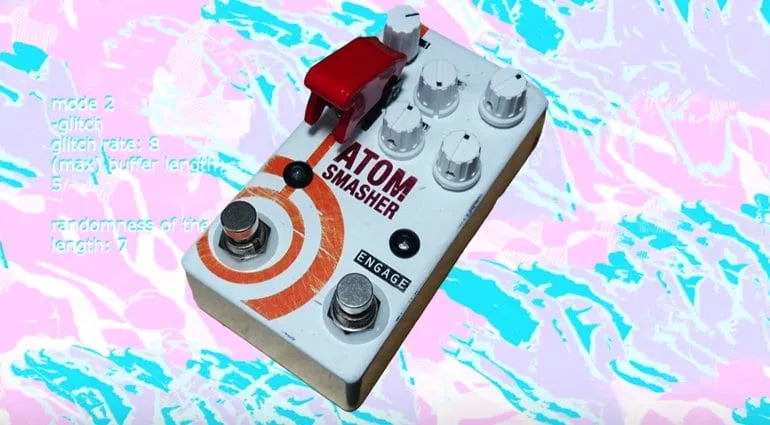


The Atom Smasher is a glitch delay pedal designed and built by Alex Lynham of SSD Devices in Manchester, UK, announced in July 2017. gearnews.com described it as "a digital delay pedal, reverb pedal and micro-sampler in one," built around code that has, in the writer's words, "essentially been built hacked and torn apart" to create "a delay that just wants to smash it up."1 It sits in the wider family of delay pedals, with one foot in reverb and pitch territory as well.
What it does
The Atom Smasher is built for mangling rather than tidy repeats. Its eight patches cover Stutter, Glitch, Reverse Ramp Delay, Dual Pitch Delay, Pitch Shift, Glitch Reverb, Pitch Shift Reverb and Reverse Reverb, so the same box can act as a delay, a reverb or a pitch-shifting texture unit depending on where the rotary selector is set.1
Controls
| Control | What it does |
|---|---|
| Rotary patch selector | Accesses the eight patches1 |
| Three control parameters | Adjust the settings for the selected patch1 |
| Mix control | Blends the effect with your dry signal1 |
| VAR1 footswitch | Momentarily maxes out the VAR1 parameter on command1 |
The momentary VAR1 footswitch is the performance hook: it lets you push one parameter to its limit while you play, which is where the stutter and glitch effects come from.1
The FV-1 chip inside
The circuit is based on the SpinSemi FV-1, an SMD chip used in digital delays and other effects that need a delay line.1 The FV-1 was designed by Keith Barr; Premier Guitar called it "the brainchild of the late Keith Barr."2 As a part, it is a self-contained DSP: Jeds Peds describes it as "a complete reverb solution in a single IC," and because it has integrated stereo ADC and DACs, it "can be treated like any other analog component in your products signal path."34 For a player, that means a small, low-parts-count digital pedal that behaves simply in a chain.
Power and bypass
The Atom Smasher is 9V negative tip and powered by a PSU only, with no battery option.1 It is also true bypass, so the effect is out of the signal path when off.1
There is no battery compartment: the pedal needs a 9V center-negative supply at all times.1
Availability and price
At its July 2017 announcement the pedal was in pre-order, with a waiting list the gearnews.com writer put at "around six months or so." The RRP was set at GBP 180, with an optional UPLINK expansion pedal at GBP 25.1
What reviewers said
The gearnews.com writer, Jef, was positive about the value: "I do think he is offering something that is desirable and for a very reasonable price, considering all the hard work and imagination."1 MusicRadar's Alex Lynham, the pedal's designer, later noted that it "briefly went viral" on release.5
Videos
POSTGUITAR
Simone Provencher
Questions
Does the Atom Smasher take a battery?
No. The Atom Smasher is powered by a power supply only, with no battery option. It runs on 9V with a negative tip, so a standard center-negative pedal supply will run it, but you cannot power it from a battery and it will not sit happily on a daisy chain with other pedals if you do not have a spare isolated output.
Is the Atom Smasher true bypass?
Yes. Writing at gearnews.com in 2017, Jef noted that the pedal is true bypass, so when it is switched off your guitar signal passes through without the delay circuit loading it down.
What power supply does the Atom Smasher need?
The Atom Smasher needs a 9V power supply with a negative tip, the same polarity as most modern pedals. It is PSU-only, meaning there is no battery compartment, so plan for a dedicated supply output on your board.
Who designed the Atom Smasher?
The Atom Smasher was designed and built by Alex Lynham of SSD Devices in Manchester, UK. It was announced in July 2017 and briefly went viral as a glitch delay pedal, according to MusicRadar.
Sources (5)
- The Atom Smasher hacks the digital delay guitar pedal, gearnews.com, 2017-07-26
- 5 High-End Reverb Voices at an Affordable Price, Premier Guitar, 2020-02-11
- Game Changer, Jeds Peds (jedspeds.co.uk)
- Spin FV-1 IC (Pre-Soldered), PedalPCB.com
- Zoom G1X Four review, MusicRadar, 2019-05-01