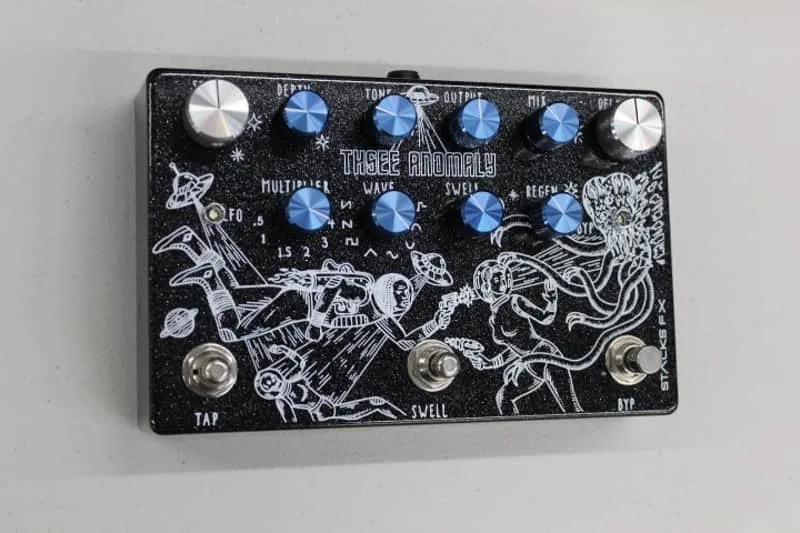


The Stacks FX Thsee Anomaly is a large-format delay pedal from Stacks FX, a boutique builder based in Long Beach, California1. The company's first delay pedal2, it does something unusual with a very common circuit: instead of a potentiometer setting the delay time, it uses light, with a photo-coupler cell paired to an LED light source23.
The core processor is the PT2399, an inexpensive delay chip that has been used in countless DIY projects1. On its own, the PT2399 provides smooth delay effects with a maximum delay time of approximately 600 milliseconds, with possible subtle artifacts at maximum that vary with each chip's tolerance4. The Thsee Anomaly pushes the chip well past that territory, reaching a maximum delay time of 1.5 seconds, and rather than hiding the degraded, artifact-laden character that shows up at long settings, it treats those artifacts as a feature13.
How the optical delay control works
Where a conventional delay pedal uses a potentiometer to control delay time, the Thsee Anomaly uses a photo-coupler cell paired with an LED light source2. The LED is fed power from the LFO section, specifically the Depth pot3.
With the depth control down, there is no LFO movement and the light stays constant, so the cell behaves like a fixed resistance feeding the delay control. As you adjust the depth, the voltage to the LED changes, which changes the resistance fed to the delay control3. In practice, this means the modulation section and the delay time control are intertwined: the same light source that sets your delay time also carries the LFO's waveform.
Controls and the modulation section
The delay controls themselves are relatively straightforward: delay time, feedback, and mix, plus a low-pass tone control that darkens the wet signal and de-emphasizes the "space dust" noise the circuit produces1.
The modulation section is where the pedal gets deep. Delicious Audio described it as a fully featured LFO section with tap tempo, six multipliers and 8 different waveforms to choose from, including a random wave3.
| Control or switch | What it does |
|---|---|
| Delay time knob | Sets the delay time1 |
| Feedback knob | Sets delay feedback (regeneration)1 |
| Mix knob | Sets the wet/dry balance1 |
| Tone knob | Low-pass filter that darkens the wet signal and de-emphasizes noise1 |
| Waveform selector | 8 positions, from smooth sine waves to chaotic sample-and-hold sequences1 |
| Multiplier | Interprets quarter-note foot taps as anything from half-notes to 16th notes1 |
| Tap-tempo switch | Sets the LFO speed; does not control delay time1 |
| Swell knob | Secondary feedback control setting how high regeneration leaps when the swell footswitch is pressed1 |
| Swell footswitch | Momentary; while held, the wet signal leaps to a high regeneration setting1 |
| Expression jack | Accepts an expression pedal for manipulating delay time32 |
The swell control is a secondary feedback circuit with its own knob and a momentary footswitch: the knob sets how high regeneration leaps while the switch is held down1.
The LFO allows for a wide range of pitch-swinging delay sounds, from lush chorus and vibrato to wild rising swells and falling star-like tones3.
History: the first Stacks FX delay
Stacks FX released the Thsee Anomaly as its first delay pedal3. The design puts a photo-coupler cell paired with an LED light source in place of the potentiometer a conventional delay circuit would use to set delay time2.
The pedal comes from the company's base in Long Beach, California35. At launch, the suggested retail price was $3993, with Delicious Audio reporting a retail price of $399.993; Premier Guitar listed the street price at $399 in its review1.
What reviewers said
Premier Guitar reviewed the pedal in August 2021 and summed up its character this way:
"It revels in its digital-ness, with an emphasis on glitches, noise, and other, um … anomalies."
The reviewer's verdict listed the pedal's pros as "Demented delay for days. Tap-tempo modulation. Real-time control. Excellent build quality," against the cons of a high price and no tap-tempo for the delay time itself1.
Videos
Premier Guitar
Stacks FX
Stacks FX
Questions
Does the Stacks FX Thsee Anomaly have tap tempo for delay time?
No. The tap-tempo switch sets the speed of the LFO, which drives the modulation section, but it does not control the delay time itself. Delay time is set with the delay time knob or an expression pedal plugged into the expression jack.
Can the Thsee Anomaly run on a battery?
No. There is no battery option. The pedal runs on a conventional 9V power supply, which is not included, so you need a 9V DC supply on your board to power it.
What is the maximum delay time on the Thsee Anomaly?
The Thsee Anomaly reaches a high maximum delay time of 1.5 seconds. That is well beyond the roughly 600 milliseconds a stock PT2399 circuit delivers, and the pedal embraces the degraded, artifact-laden character that appears at those long settings.
Is the Thsee Anomaly analog or digital?
It is digital. The core processor is the PT2399, an inexpensive delay chip used in countless DIY projects. Rather than hide the chip's character, the pedal emphasizes glitches, noise and other digital artifacts as part of its sound.
Where is the Stacks FX Thsee Anomaly made?
It is designed and built at Stacks FX's base of operations in Long Beach, California, and is entirely hand wired and hand built. Stacks FX is a boutique pedal maker based there.
Sources (5)
- Stacks FX Thsee Anomaly Review, Premier Guitar, 2018-09-03
- Stacks FX’s first delay pedal harnesses the power of light, Guitar.com, 2018-05-09
- Stacks FX Anomaly Delay With LFO, Delicious Audio, 2018-05-24
- NostalgiTone-Space-Modulator, GuitarPCB, 2024-09
- Stacks FX Unveils the Thsee Anomaly Delay, Premier Guitar, 2018-05-08