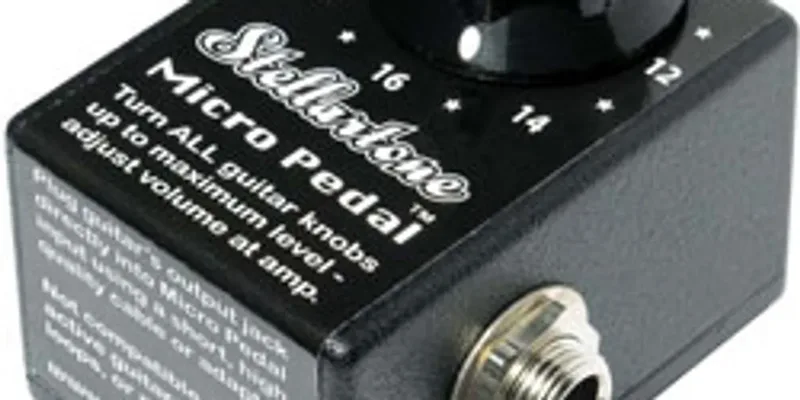
The Stellartone Micro Pedal is a passive EQ contour selector: a small stompbox that offers 15 discrete EQ contours plus a true bypass position, selected with a single 16-position rotary knob. Premier Guitar describes it as "essentially a ToneStyler tone control in an external housing," which is the simplest way to picture it. Stellartone already made the ToneStyler, a 16-position tone circuit, and the Micro Pedal packages that same circuit as a pedal you can put on a board1.
Because it is passive, it needs no battery and no power supply, and there is no digital processing involved. As Premier Guitar put it, "This is not digital modeling, but rather pure analog sound"1. At approximately 2-1/16" x 1-7/16" x 1-1/4", it is a genuinely tiny enclosure, and the review notes its weighty construction and full-length rubber rails on the bottom keep it from sliding around the floor1.
What it does to your sound
The 15 contours are not one tone control swept from dark to bright. They are spread across different frequency areas, and the reviewer found each range did something distinct. The lower settings produce focused bass sounds, working from clean jazz tones through creamy distortion, and settings 1 through 6 pushed a lead channel with what the reviewer called "Fripp-like fatness." The middle numbers, 8 through 12, operate more on the upper mids, often making it sound as if the amp itself had been swapped. Settings 12 through 15 give fine gradations of highs and upper mids, which the reviewer compared to instantly swapping between similar model pickups1.
| Knob positions | Where they work | What the reviewer heard |
|---|---|---|
| 1 to 6 | Low end | Focused bass, from clean jazz tones to creamy distortion; "Fripp-like fatness" on a lead channel1 |
| 8 to 12 | Upper mids | Often sounded like a switched amp1 |
| 12 to 15 | Highs and upper mids | Fine gradations, like swapping similar pickups1 |
| 16 | None | True bypass1 |
The overall impression was of natural results rather than an obvious tone control. In the reviewer's words1:
"I was knocked out by how natural sounding all the settings were; the Micro Pedal never sounds like a 'tone control.'"1
Premier Guitar review, September 20261
The review also notes the pedal can make one guitar sound like different models, or make the amp sound like a different amp, which is the practical payoff of having 15 contours instead of a single sweep1.
The 16-position switching knob
The single control is a large plastic 16-position rotary switching knob, and Stellartone includes a rubber sheath for it to help give your fingers traction when turning it1. There are no other controls: no level, no gain, no EQ sliders. The knob is the whole interface, which keeps the enclosure small and the operation simple.
One requirement matters for how you use it. The pedal needs a strong pickup signal to work as designed, so your guitar's Volume and Tone knobs must always be set to 10. Rolling either down changes what the passive circuit has to work with1.
Keep your guitar's Volume and Tone knobs on 10 when using the Micro Pedal. The passive circuit depends on a strong pickup signal, and the review states both controls must always be fully open1.
For connections, the review found no discernable difference in functionality between the included double male jack (plugging a cable straight in) and using a cable jack versus a cable input, so either way of hooking it up works the same1.
Where it came from: the ToneStyler connection
The Micro Pedal exists because of the ToneStyler. Stellartone's ToneStyler is a 16-position tone circuit, which Premier Guitar compared to the Varitone switch on old Gibson 345s, noting that "where the Varitone contained only six settings, the ToneStyler offers 16." The ToneStyler lives inside the guitar as a replacement tone control, and apparently enough players wanted that circuit without the wiring job that Stellartone built it into a box. As the review puts it, "Apparently others had the same issue, leading Stellartone to introduce the Micro Pedal: a ToneStyler in a box"1.
The practical difference for a player is placement. The ToneStyler is a tone control built into the guitar, while the Micro Pedal is that same control in an external housing, so it sits on a pedalboard and can be used with any instrument, moved between rigs, or pulled from the chain entirely by turning the knob to position 16, which engages true bypass1.
Versions of the Stellartone pedals
Alongside the standard Micro Pedal, Stellartone offers two other versions1:
- Jazz model: the EQ range is extended one octave lower, and it is touted as effective for taming bright single-coil pickups1
- Bass model: a version voiced for bass1
The jazz model is the one to look at if the standard version's contours sit too high for a darker, rounder target sound, since its range reaches a full octave further down1.
What the reviewer found
Premier Guitar's review, published September 2026, tested the Micro Pedal with a 1965 Fender Stratocaster loaded with DiMarzio Virtual Vintage pickups and a Stromberg Monterey with DiMarzio Eric Johnson pickups, running into an Egnater Rebel-30 amp1. The verdict was positive on the naturalness of the contours, the amp-like and pickup-like changes available across the knob's range, and the physical build, with the weighty construction and rubber rails keeping the small box planted on the floor1. The street price at the time of the review was $1291.
Questions
Is the Stellartone Micro Pedal true bypass?
Yes. Position 16 on the switching knob is true bypass, so with the knob turned there the guitar signal passes through untouched. The other 15 positions are passive EQ contours, and because the pedal is passive there is no circuitry adding color when it is engaged either.
Does the Stellartone Micro Pedal need a battery or power supply?
No. The Micro Pedal is a passive EQ contour selector, not an active circuit, so it runs on nothing but your guitar's own signal. There is no battery compartment and no power jack to worry about on a pedalboard.
How many EQ settings does the Stellartone Micro Pedal have?
It has 15 discrete EQ contours plus a true bypass position, for 16 positions in total on the rotary switching knob. The contours range from focused bass-heavy settings through upper-mid shaping to fine high-end gradations, so one knob covers a wide spread of tones.
How is the Micro Pedal different from the Stellartone ToneStyler?
The Micro Pedal is essentially the ToneStyler tone control moved into an external pedal housing. The ToneStyler is a 16-position tone circuit, and the Micro Pedal packages that same idea as a stompbox you can put on a pedalboard or use with any guitar, no wiring work required.
How much does the Stellartone Micro Pedal cost?
The street price is $129, as reported in Premier Guitar's review. Stellartone also offers a jazz model with the EQ range extended one octave lower and a bass model, and those versions may be priced differently.
Sources (1)
- Stellartone Micro Pedal Review, Premier Guitar, 2010-01-14