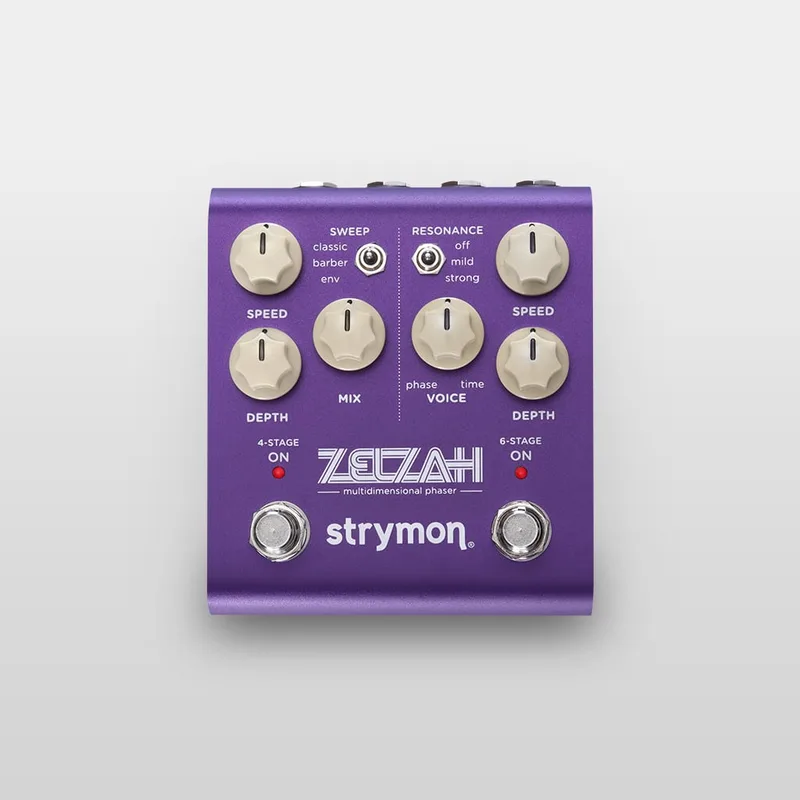


The Strymon Zelzah is a dual modulation pedal with two independent stereo phaser effects: a vintage-style 4-stage phaser on the left and a 6-stage phaser on the right, each with its own footswitch so you can run one, the other, or both at once1. Strymon describes the experience plainly: "Step on Zelzah, play one chord, and you're instantly taken back to a world of classic phaser tones as they were always meant to sound, perfectly voiced, with tons of vibe"2. It was Strymon's debut phaser pedal, announced in August 2021 at a US street price of $3493.00 as of August 20262.
What the Zelzah does: a 4-stage and a 6-stage phaser in one pedal
The two sides of the pedal behave differently. The 4-stage side is a vintage phaser with Speed, Mix and Depth knobs plus a three-way Sweep toggle offering classic, barber and envelope modes8. Recording Magazine's reviewer called it "your classic 70s-style pedal phaser, think guitar and electric piano"9. The 6-stage side has its own Speed, Mix and Depth knobs plus a Voice knob that simultaneously controls over 30 different parameters2.
| Control | What it does |
|---|---|
| 4-Stage Speed | Sets the LFO speed of the 4-stage phaser |
| 4-Stage Depth | Adjusts the LFO range; deeper phasing as you turn clockwise2 |
| 4-Stage Mix | Balances dry and phase-shifted signal, from mild phasing to 100% wet; strongest effect at 12 o'clock2 |
| 4-Stage Sweep toggle | classic: traditional rising and falling LFO; barber: continuously rising or falling LFO, direction set by a live edit function; env: touch-sensitive envelope phasing with range set by Speed and sensitivity set by Depth2 |
| 6-Stage Depth | Adjusts the LFO range of the 6-stage phaser; higher settings give more dramatic phase and/or time modulations as set by the Voice knob2 |
| 6-Stage Voice | Sweeps from pure phaser voicings on the left to flanger tones past 12 o'clock and chorus tones on the right2 |
The barber setting on the 4-stage side is unusual: Recording Magazine reports that it uses three 4-stage phasers running concurrently to produce the barber-pole sound9. On the 6-stage side, Strymon developed an architecture containing a modified all-pass filter as the basis of the phaser, which the company describes as expanding the time response of the cascading all-pass filters seamlessly and continuously210.
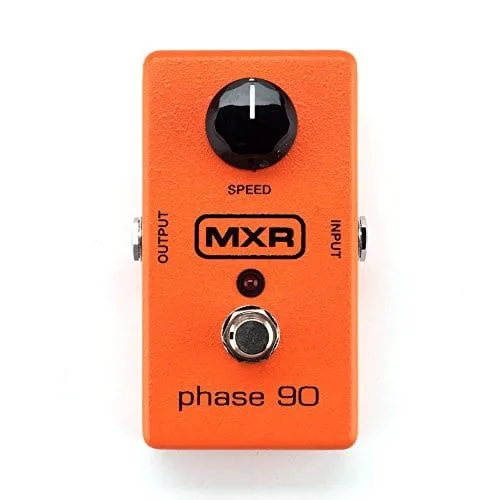
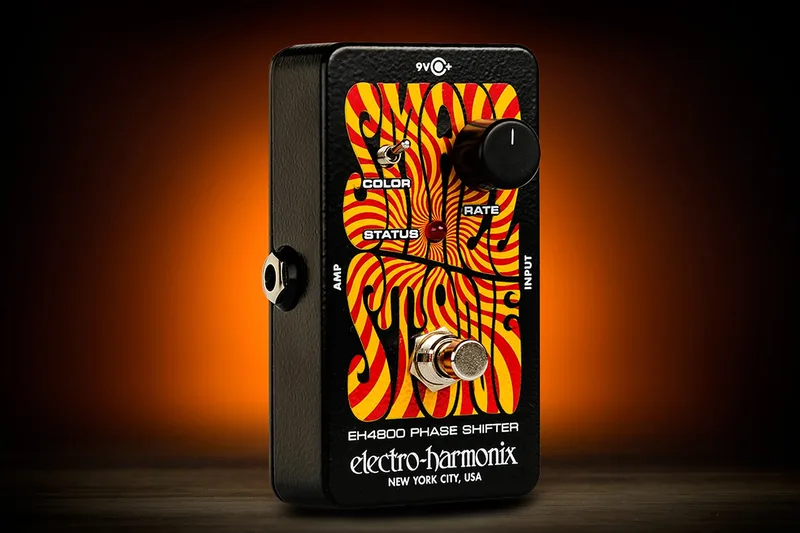
Guitar World's reviewer, Trevor Curwen, found the 4-stage side could stand in for the classics: a Depth setting of about 10 o'clock matched a script logo MXR Phase 90, and around one o'clock matched an Electro-Harmonix Small Stone. He also noted the 6-stage resonance is like engaging the Color switch on a Small Stone112.
Routing: series, parallel and split stereo
The two phasers can be configured three ways, set from a routing menu12:
- Series (GREEN, default): the 6-stage phaser's output feeds into the 4-stage phaser when both sides are engaged12.
- Parallel (BLUE): the outputs of both phasers are mixed to the outputs while maintaining stereo independence of the left and right signals12.
- Split: each phaser is routed to its own output when used in stereo1.
The input has a Mono/Stereo switch: with a mono input signal the output is stereo, and with a stereo input the output is stereo2. Use Out L alone for mono output, or Out L and Out R together for stereo2.
Power and connections
The Zelzah runs on 9V DC center negative with a minimum of 300mA, and a 9V power adapter is included79. Strymon warns that subjecting the pedal to any voltage above 9V will damage it and void the warranty7.
The 300mA current requirement means the Zelzah needs a power supply with adequate headroom, not a low-current daisy chain tap. Strymon recommends a supply providing 9V DC center negative with a minimum 300mA7.
Other connections on the back panel: a TRS stereo input, stereo outputs, an EXP/MIDI jack and a USB C jack for computer-based MIDI control and firmware updates29. Hardware specs from Strymon include 1 Meg Ohm input impedance, 100 Ohm output impedance, +10dBu maximum input level, 109 dB typical signal-to-noise, and dimensions of 4.5″ deep x 4″ wide x 1.75″ tall (11.4 cm deep x 10.2 cm wide x 4.4 cm tall)5. The enclosure is an anodized dark purple aluminum chassis2.
The input level can be set for instrument or line level sources, such as a keyboard or synthesizer, with the Line setting adding 10dB of headroom. To change it, press and hold the 6-Stage ON footswitch while connecting power, turn the 4-Stage Speed knob to choose the mode, then press either footswitch to store it. Input Level is a global setting, persistent across power cycles and not saved per preset13. Strymon notes the 6-Stage phaser has a bit less headroom than the 4-Stage phaser by the nature of the signal path, so a hotter-than-instrument input can saturate the 6-Stage side; this saturation is normal, and switching to Line level avoids it13.
Presets, MIDI and expression
The Zelzah holds 300 presets, with MIDI control providing access to them through the EXP/MIDI jack1. The same jack accepts a standard TRS expression pedal for continuous control over any of the knobs1. Incoming MIDI clock controls the LFO speed, and when synced the Speed knobs act as a multiplier or divider of the incoming clock tempo14. A secondary function determines whether the pedal responds to CC 100, which controls the designated expression pedal controls via MIDI14.
For preset access without a full MIDI setup, Strymon's MiniSwitch gives access to one favorite preset and the MultiSwitch Plus gives access to three presets11. There is no built-in tap tempo: Premier Guitar's reviewer noted you will need an external switch if you rely on tap tempo15.
What reviewers said
Reviews were positive across the board. MusicRadar called it "a MIDI-compatible stompbox with 300 presets" with selectable true or buffered bypass, and concluded that "it makes a persuasive case as an all-purpose modulation pedal"8. Guitar World's verdict was simply "Two great-sounding phasers in one box"11, a phrase MusicRadar also listed among its reasons to buy8. Recording Magazine's Paul Vnuk Jr. recommended it as a high-order modulation multi-effect9.
Strymon itself has published a guide to recreating favorite phaser sounds on the Zelzah, covering tones in the vein of Mild High Club's modern indie chorus, Rush's flanger, the Isley Brothers' phaser-with-fuzz, Smashing Pumpkins, Van Halen, Billy Joel and Khruangbin16.
Videos
Andertons Music Co
Pete Thorn
Sweetwater
News
Questions
Is the Strymon Zelzah analog or digital?
It is digital. Strymon builds the Zelzah around a 480MHz ARM Superscalar processor with 24-bit 96kHz A/D and D/A converters. The 6-stage side uses a modified all-pass filter architecture that Strymon developed for this pedal, and the barber setting on the 4-stage side runs three 4-stage phasers concurrently.
Does the Strymon Zelzah have tap tempo?
There is no built-in tap tempo switch. Premier Guitar's reviewer noted that you need an external switch if you rely on tap tempo. The pedal does sync to incoming MIDI clock, and when synced the Speed knobs act as a multiplier or divider of the incoming clock tempo.
Can the Zelzah do flanger and chorus sounds?
Yes, on the 6-stage side. The Voice knob sweeps from pure phaser voicings on the left to flanger tones past 12 o'clock and chorus tones on the right. MusicRadar's reviewer found this helped it make a persuasive case as an all-purpose modulation pedal.
Is the Zelzah true bypass or buffered?
Both are available. From the factory it ships in True Bypass, using electromechanical relay switching, and it can be set to Buffered Bypass, which Strymon says preserves high frequency response through long cable runs. Bypass mode is a global setting, not saved per preset.
How many presets does the Strymon Zelzah have?
It holds 300 presets, accessible through MIDI control via the EXP/MIDI jack. Strymon's MiniSwitch footswitch gives access to one favorite preset, and the MultiSwitch Plus gives access to three presets.
Sources (16)
- What is Zelzah?, www.strymon.net
- Zelzah Phaser & Modulation, Strymon (www.strymon.net), 2026-08-12
- Strymon Unveils the Zelzah Multidimensional Phaser, Premier Guitar, 2021-08-25
- Strymon confirms new Zelzah, a purple Multidimensional Phaser, gearnews.com, 2021-08-24
- What are the hardware specs on Zelzah?, Strymon
- How do I change the bypass mode on Zelzah?, Strymon
- What are the power supply requirements for Zelzah?, Strymon
- Strymon Zelzah Multidimensional Phaser review, MusicRadar, 2022-04-19
- July 2023: Strymon Zelzah, Recording Magazine (recordingmag.com), 2023-07
- Strymon Zelzah Stereo Dual Phaser, Delicious Audio, 2024-05-17
- Strymon Zelzah review, Guitar World, 2022-01-04
- How do I adjust the signal routing of the 4-Stage and 6-Stage phasers on Zelzah?, Strymon
- How do I set the Input Level on Zelzah?, Strymon, 2021-09-08
- Secondary Functions: Zelzah Multidimensional Phaser, Strymon, 2021-09-23
- Strymon Zelzah Review, Premier Guitar, 2022-04-04
- Ask Strymon: Recreating Our Favorite Phaser Sounds on Zelzah, Strymon, 2021-09-09