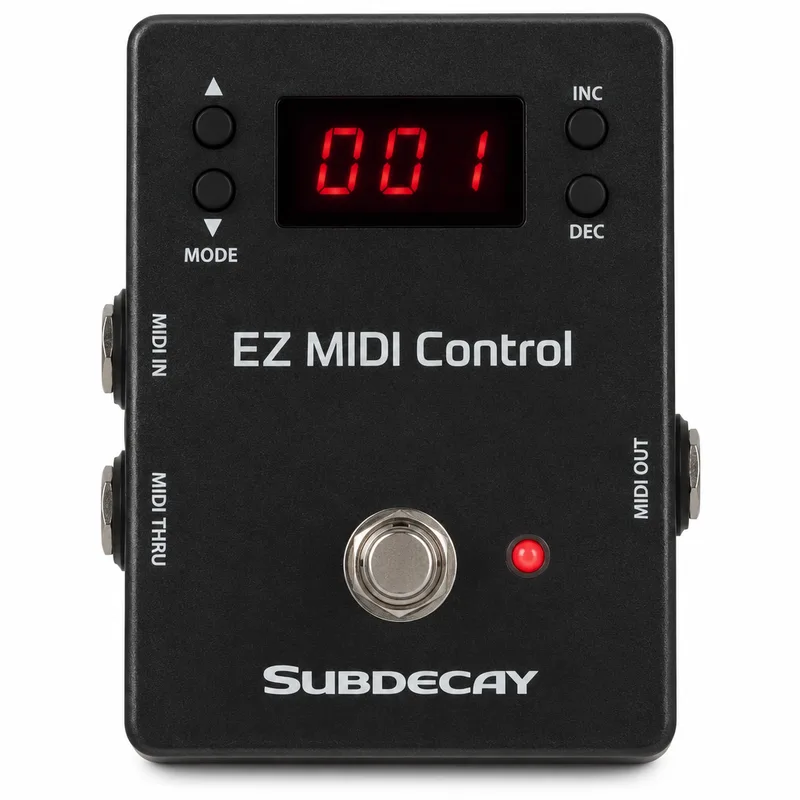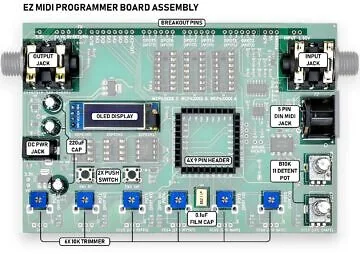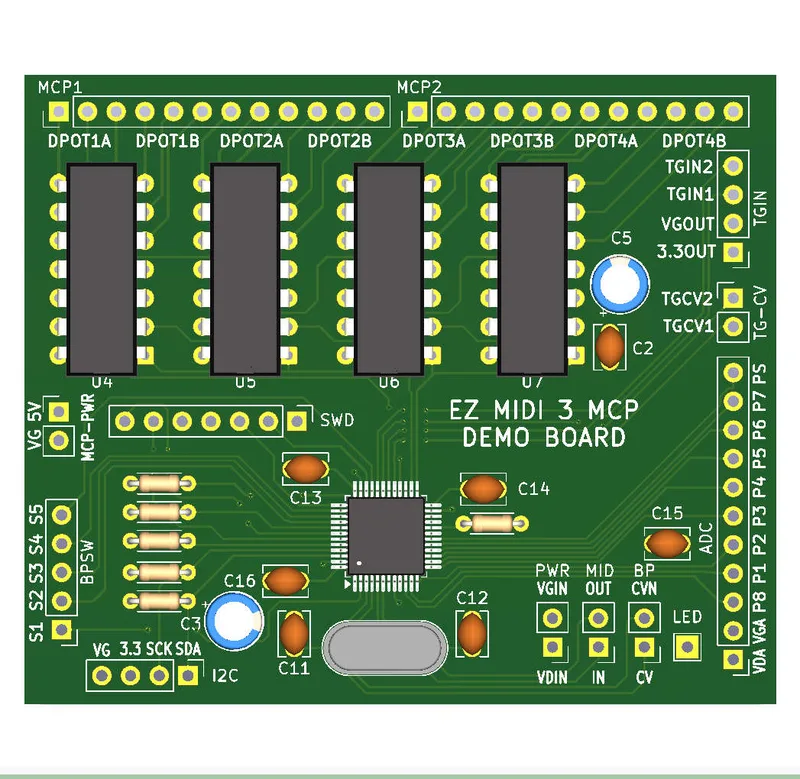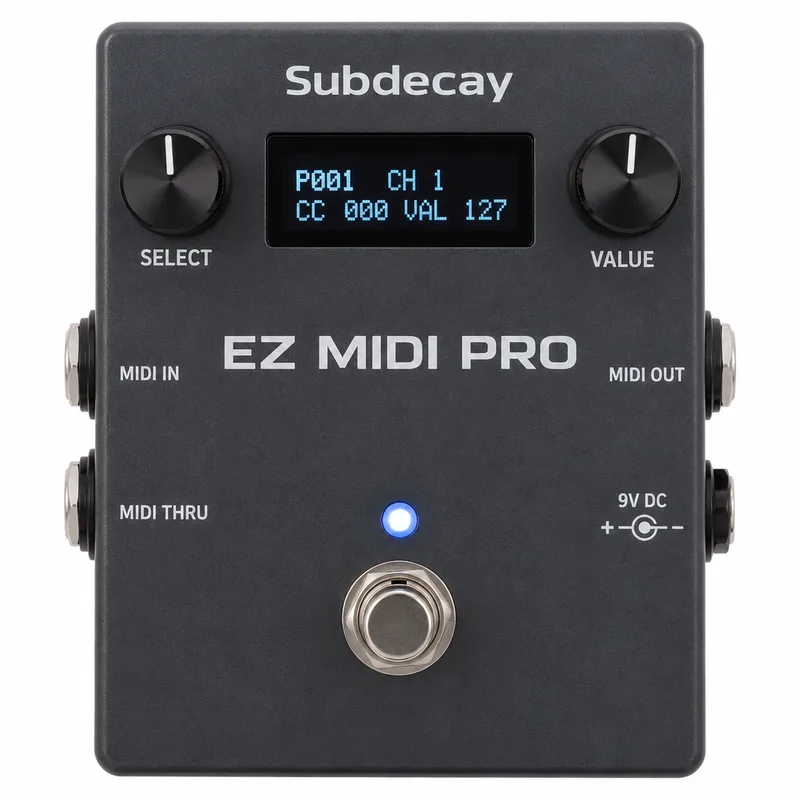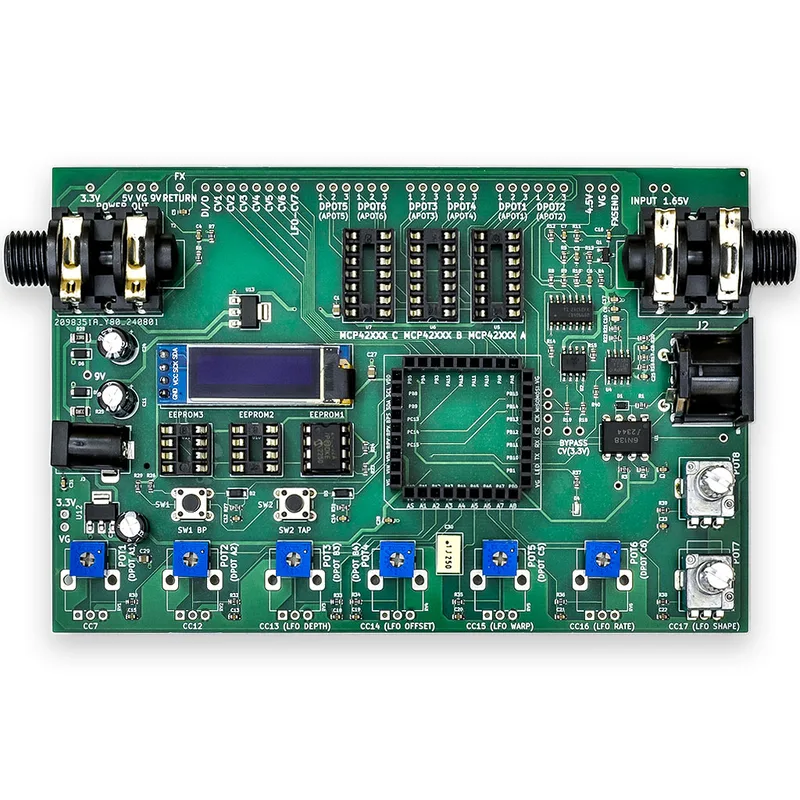
The Subdecay EZ Wizard is a programmer board for prototyping guitar effects with MIDI control, built around Subdecay's EZ MIDI system. It plugs directly into a breadboard, and Subdecay recommends either a double or triple breadboard for the work. The board is aimed at pedal builders and designers who want MIDI control over an effect circuit without writing code: Subdecay describes it as unlocking advanced features of EZ MIDI control with no coding required1.
What it is and what it does
The EZ Wizard is the programmer board in Subdecay's EZ MIDI family: it is used for programming EZ MIDI Control boards and for prototyping effect circuits that those boards will run23.
In default operation, Pot1 controls PWM/CV1 and digital pot 1, Pot2 controls PWM/CV2 and digital pot 2, and so on. All parameters are also available via MIDI2.
What's on the board
The EZ MIDI Control board and MCP42xxx digital pots are included. A set of parts ships with the board but is not assembled3:
- Breakout pins (single sided: solder to the top for quick connect wires, or to the bottom to plug into a breadboard)2
- OLED display
- One 24LC32 EEPROM
- Input and output jacks, plus a MIDI jack
- Two 9mm 11 detent B10K pots for pot 7 and 8
- Six 6mm B10K trimmers
- Power jack
Four 9 pin headers are included to accommodate an EZ MIDI Control board, which is required for operation and must be ordered separately23.
The EZ MIDI Control board is required for the EZ Wizard to operate and is not included assembled with the board's own parts. Order it separately3.
Bypass and signal connections
The EZ Wizard has an onboard bypass system based on a CD4066 analog switch IC, with effects send and return connections. Subdecay's Brian Marshall notes that EZ MIDI also supports latching relay bypass, but that it is not included on the EZ Wizard board23. The board also provides an Alt Input connection, which is the same connection as the input jack, and a DI/O pin that is currently only used for EZ MIDI PRO2.
Power: 9V, 5V and 3.3V outputs
The power pins are 9V OUT, 3.3V OUT, 5V OUT and GROUND. The board includes regulated on board 3.3V and 5V sources and filtered 9V, with filtering via the three 220u capacitors2.
Two additional bias outputs are available:
- 4.5V Out: bias voltage for the input buffer and CD4066 bypass, and it can also be used as a bias voltage for your effect circuit2
- 1.65V Out: buffered bias voltage for EZ MIDI Control's envelope detector, which can also be used on your effect circuit2
When using the EZ Wizard for prototyping, always draw power from the power pins. Subdecay warns that using multiple power sources can create unwanted noise2.
Control outputs and digital pots
The PWM/CV pins output a pulse width modulation signal, which Subdecay notes is easily converted to a 0 to 3.3V control voltage via an RC filter. PWM/CV7 is the LFO output2. The board connects directly to digital pots: sockets for MCP42xxx digital pot ICs are on the board, three sockets for those dual digital pots and three sockets for 24LC32 EEPROMs23.
Questions
Does the Subdecay EZ Wizard work without an EZ MIDI control board?
No. Subdecay states that an EZ MIDI Control board is required for operation and must be ordered separately. Four 9 pin headers are included on the EZ Wizard to accommodate the control board, which carries the microcontroller and handles the MIDI side of the system.
Does the EZ Wizard support relay bypass?
Not on the board itself. Subdecay's Brian Marshall notes that EZ MIDI supports latching relay bypass, but it is not included on the EZ Wizard board. Instead, the EZ Wizard has an onboard bypass system based on a CD4066 analog switch IC, with effects send and return connections.
Which digital pot chips fit the EZ Wizard sockets?
The board has sockets for MCP42xxx dual digital pot ICs, with three sockets for those chips and three sockets for 24LC32 EEPROMs. MCP42xxx digital pots are included with the board, and the digital pots are wired by direct connection on the board.
Why should all power come from the EZ Wizard power pins?
Subdecay advises that when prototyping with the EZ Wizard you should always draw power from its power pins. Using multiple power sources can create unwanted noise, so the board's own 9V, 5V and 3.3V outputs are the intended supply for everything on the breadboard.
Sources (3)
- EZ MIDI Modules and customization, Subdecay, 2026-10-04
- EZ MIDI Programmer assembly and use, Subdecay, 2024-08-15
- EZ WIZARD Programmer board, Subdecay, 2024-08-16