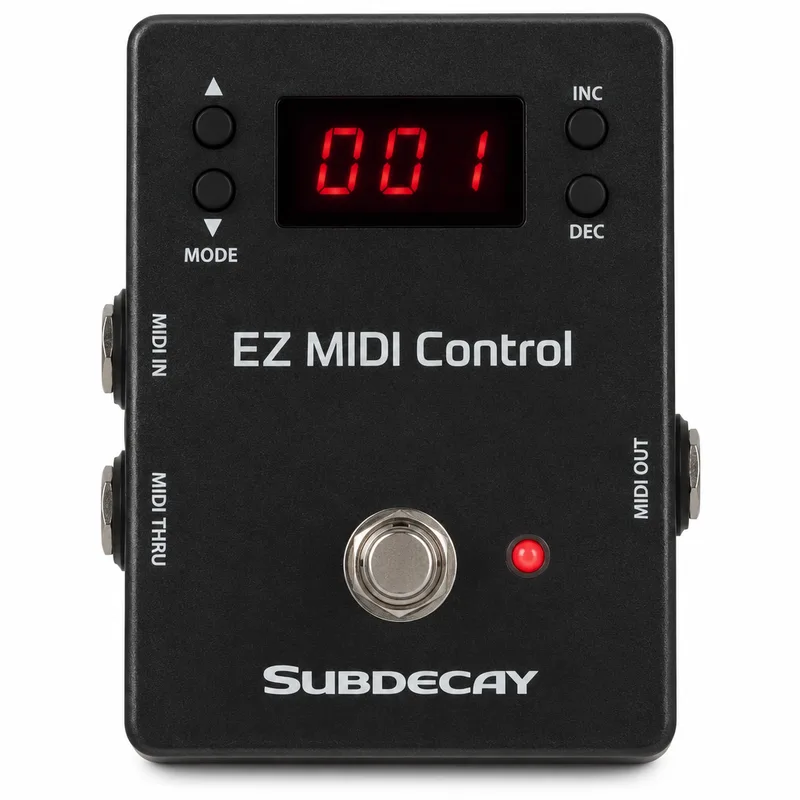

The Subdecay EZ MIDI Control is a circuit board module for pedal builders: a small board you build into an effect design to give it MIDI, savable presets and tap tempo without engineering the digital control yourself. Subdecay describes it as "a fast and easy way to add MIDI, savable presets and tap tempo to most effects designs"1. It is aimed at builders making their own pedals, or modifying existing analog circuits, rather than at players looking for a stompbox to plug into.
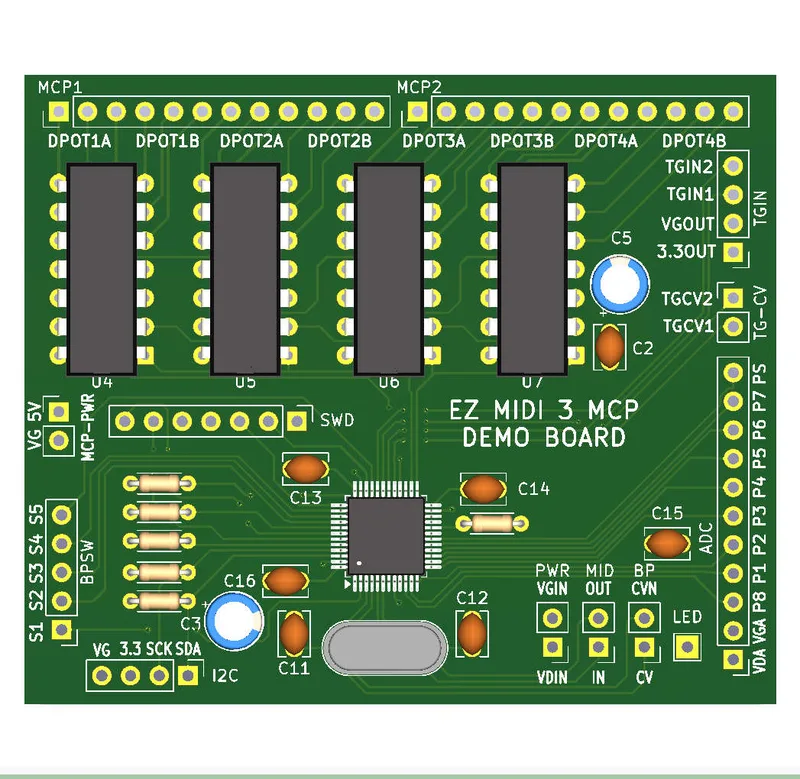
The board itself is tiny. Subdecay calls it "this 1-square-inch circuit board with 36 breakout pins," designed for integration into a builder's own project1. Those breakout pins carry the connections for its control outputs, MIDI input and the rest of the interface between the module and the host circuit.
What it does for a pedal design
The core idea is digital control of analog circuits. The board's 7 PWM / control voltage outputs can be wired to control points in an effect, so that a MIDI message or a saved preset changes the sound the way a knob or switch would1. That covers the three things Subdecay highlights: MIDI control, presets you can save and recall, and tap tempo for time-based parameters1.
EZ MIDI Control, EZ MIDI 2 and EZ MIDI PRO
The EZ MIDI family has grown into several related products, and the differences matter to a builder choosing between them.
| Board | What it is | Key differences |
|---|---|---|
| EZ MIDI Control | The base module | 7 PWM / CV outputs, 36 breakout pins, $25.991 |
| EZ MIDI 2 | DIY board and web-based MIDI editor | Serves as both the brain for an effect pedal and a programming interface via a web-based MIDI editor2 |
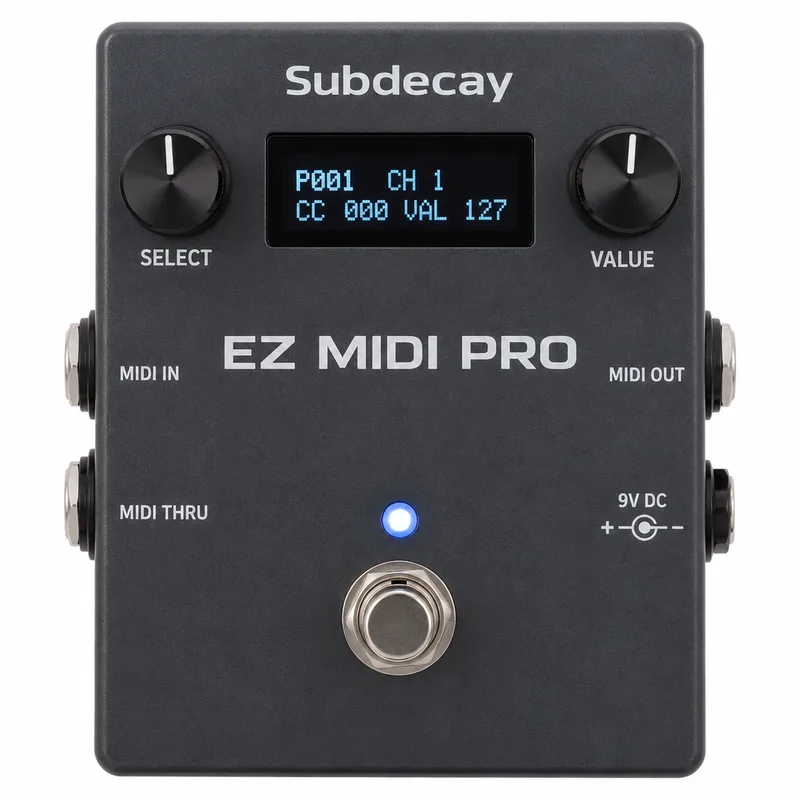
| EZ MIDI PRO | Customized, supported version of the Control board | Change MIDI CC assignments, 11-detent pot, OLED display3 |
EZ MIDI 2 is the most developed of the three. Subdecay says the board "serves as both the brain for your effect pedal and a programming interface via a web-based MIDI editor"2. Its modes include a Control Voltage Array for overdrives, fuzzes and switching, plus Warp and Non-Warp LFOs, and in Control Voltage Array mode you use Pot 7 to select a row from a stored array of CV values, mapping columns to the PWM outputs to control analog switches and tone-shaping circuits2. It also has a MIDI input with full control of all parameters, two bypass control pins (relay or analog), and a signal input for envelope-based modulation using a 1.65V-biased input signal2. A demo firmware version runs full-featured for about 90 minutes on an STM32F103C8 "Blue Pill" board without the programmer board2.
The EZ MIDI Web editor works with EZ MIDI 2 only, not with the original EZ MIDI Control board3.
EZ MIDI PRO, in turn, "is based on our EZ MIDI Control board, but offers more customization and support"3. Over the standard board it adds the ability to change MIDI CC assignments, an 11-detent pot for selecting presets and LFOs, and an OLED display for programming customizations3. For pedal builders, Subdecay can provide a customized version of the Control board or loose LQFP48 48-pin ICs, with a 64-pin IC available if more inputs or outputs are needed; MIDI out is also possible by contacting the company3. Pricing for PRO work is, in Subdecay's words, "competitive, but also is dependent on microcontroller cost/availability and level of customization"3.
Using the programmer board
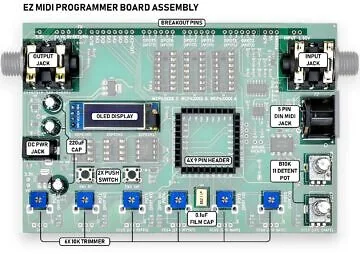
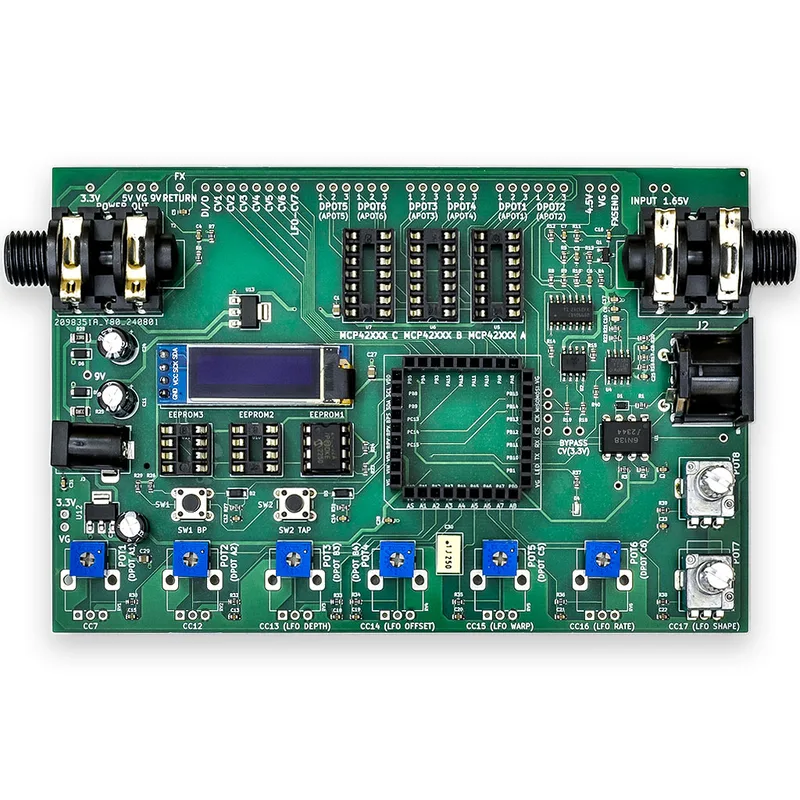
Configuring an effect is done through the EZ MIDI programmer board. To set up an effect with EZ MIDI 2, you insert a 24LC32 EEPROM into the EEPROM 3 socket on the programmer board2. When inserting the EZ MIDI board itself, orientation is the one thing to get right:
"When inserting the EZ MIDI board be sure the corner notch is lined up with the outline on the programmer board."
The demo version of EZ MIDI 2 requires a parts list download and the STM32cube programmer software to load code on the Blue Pill board, which is available for Windows, Mac and Linux2.
Manual and documentation
Subdecay publishes a downloadable PDF user guide for the EZ MIDI Control board, covering setup and use of the module1. For anything beyond the standard board, such as MIDI out or a customized version, Subdecay handles it through direct contact3.
Videos
Subdecay
Questions
What is the Subdecay EZ MIDI Control board?
It is a 1-square-inch circuit board module with 36 breakout pins, made by Subdecay for pedal builders. It provides a fast and easy way to add MIDI, savable presets and tap tempo to most effects designs, replacing the digital control work a builder would otherwise have to engineer from scratch.
How many control voltage outputs does it have?
The EZ MIDI Control board has 7 PWM / control voltage outputs. These outputs can drive analog control points in a circuit, such as tone-shaping stages or analog switches, so presets and MIDI messages can control the sound of an otherwise analog pedal.
Can the EZ MIDI board add tap tempo and saved presets?
Yes. Subdecay describes the board as a fast and easy way to add MIDI, savable presets and tap tempo to most effects designs. Presets are stored on the board and recalled from MIDI or the pedal's own controls.
How do I insert the board into the programmer?
When inserting the EZ MIDI board into the programmer, line the corner notch on the board up with the outline printed on the programmer board. Correct orientation matters, since the notch is the alignment guide Subdecay gives for the socket.
What does EZ MIDI PRO add over the standard board?
EZ MIDI PRO is based on the EZ MIDI Control board but offers more customization and support, including the ability to change MIDI CC assignments, an 11-detent pot for selecting presets and LFOs, and an OLED display for programming customizations. Subdecay can also supply customized boards or loose 48-pin ICs for pedal builders.
Is there a manual for EZ MIDI Control?
Yes. Subdecay publishes a downloadable user guide (PDF) for the EZ MIDI Control board on the product page, covering setup and use of the module.
Sources (4)
- EZ MIDI Control, Subdecay, 2024-09-27
- EZ MIDI 2 web editor, Subdecay, 2026-10-04
- EZ MIDI PRO, Subdecay, 2025-08-06
- EZ MIDI Programmer assembly and use, Subdecay, 2024-08-15