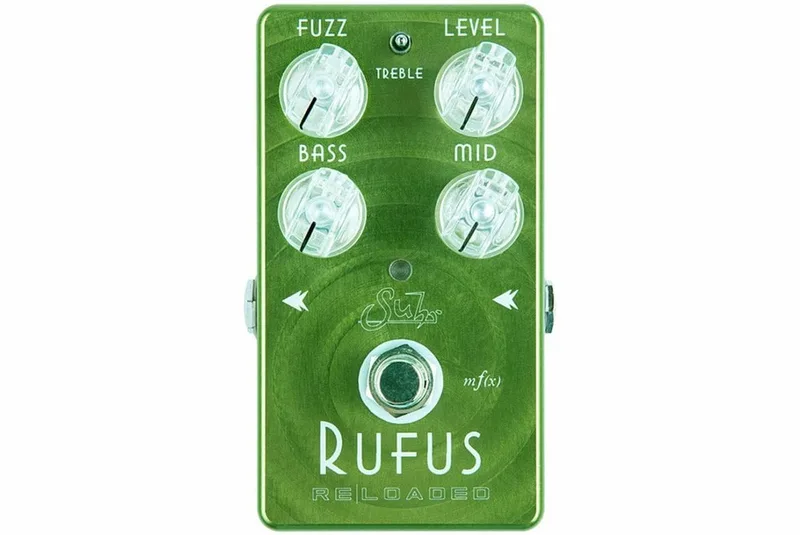


The Suhr Rufus Reloaded is a fuzz pedal built around silicon transistors, and it is really two fuzzes in one box. Green (normal) mode is voiced for a wide range of classic silicon fuzz with what Suhr describes as "the response and dynamic range of a great distortion pedal or tube amplifier"1. Red (octave-up) mode adds frequency doubling circuitry to produce what the manual calls "the iconic octave-up fuzz effect"1. Suhr says the octave-up was developed to respond evenly across all of a guitar's pickup selections and the entire fingerboard, "effortlessly delivering the iconic 'Band of Gypsys' tone at your fingertips"1.
The Reloaded edition, announced in March 2015, added the octave-up effect to the earlier Suhr Rufus design and re-voiced the circuit to balance the two modes, with more of the naturally occurring lower frequencies passing through in the bottom end21. The original Rufus circuit is now discontinued, and Suhr's current Rufus pedal uses the identical circuit and tone of the Rufus Reloaded3. Suhr sells the pedal through its network of authorized dealers3.
Controls and what they do
The control surface is deliberately simple: two knobs, a three-position treble switch, and a footswitch that does more than turn the pedal on.
| Control | What it does |
|---|---|
| Fuzz knob | Adjusts the amount of fuzz/gain applied to your signal1 |
| Level knob | Adjusts the overall output level1 |
| Treble switch, left | Cuts high frequencies for a warmer tone1 |
| Treble switch, middle | Flatter, more neutral response; lets more midrange and treble through for a classic 70's fuzz effect1 |
| Treble switch, right | Boosts high frequencies for more attack and bite; effective for scooped Grunge-era fuzz tones1 |
| Footswitch (hold) | Selects between Green (normal) and Red (octave-up) modes during a performance4 |
Suhr's manual gives concrete starting points for the Fuzz knob. At lower settings, 0 to 3, the pedal produces what the manual calls "a thick, subtle break-up effect with excellent top-end definition," suited to pushing a clean amplifier into crunch territory for blues and rock rhythm styles; the manual also suggests trying these settings in Red mode for an octave-only effect1. At higher settings, 7 to 10, it produces "a cacophonous array of over the top fuzz effects that are expressive and fun to play," aimed at 60's psychedelic blues, 70's classic rock, and 90's Grunge-era tones1.
The two modes and the mf(x) footswitch
Green (normal) mode covers the classic silicon fuzz range1. Red (octave-up) mode uses frequency doubling circuitry for the octave-up fuzz effect1. Switching between them mid-performance is done with Suhr's mf(x) footswitch technology: hold the footswitch down and the pedal moves from one mode to the other4.
The input is worth noting for anyone building a pedalboard. Unlike traditional fuzz pedals, the Rufus Reloaded's input was optimized to accept the output of a buffered device, such as a tuner or other pedal, without sacrificing the interaction between the instrument and the fuzz1. Many vintage-style fuzzes demand to be first in the chain and misbehave after a buffer; this one was designed not to.
Power, battery, and the FX Link jack
The Rufus Reloaded runs on a 9V battery or a 9V DC center-negative supply with a 2.1mm x 5.5mm connector, drawing 9mA, with a maximum voltage of 12Vdc14. It has both reverse battery protection and over-voltage protection1. Estimated battery life is approximately 60 hours of continuous use35. Connecting a cable to the input jack powers the pedal up, so the manual reminds battery users to unplug the cable when finished playing to conserve battery life1.
A battery monitor watches the voltage: if it measures lower than 5.5V, the LED flashes three times on power-up as a warning to replace the battery, and if the battery fails completely (below 5V) the pedal switches itself into true bypass so a dying battery cannot wreck the circuit's operation15.
The FX Link jack is a 1/8 inch stereo (TRS) connector with a maximum voltage of 3.3Vdc13. It is the pedal's remote-control port, and it has three internal modes3:
- Green (default): for external switching systems. Tip is on/off for normal mode, latching; ring is on/off for octave mode, latching1.
- Orange: a single momentary footswitch remotely toggles between the two mf(x) modes1.
- Red: not detailed in the Reloaded manual's mode list, but the product page's FX Link wiring shows shield-to-ring activating Red (octave) mode3.
The pedal ships in Green mode; to change FX Link modes, press and hold the footswitch while powering up1. A separate three-position FX Link switch sets the power-up state: right powers up in the ON state, center allows remote switching via the FX Link jack, and left powers up in the bypass state1.
The FX Link jack's maximum voltage is 3.3Vdc3. Remote switching contacts should stay within that limit.
Where it came from
Suhr, based in Lake Elsinore, California, unveiled the original Rufus fuzz at NAMM in January 2014 as "a versatile take on the concept, offering a wide range of fuzz tone styles"67. The original had a three-band EQ, Normal and Fat modes selectable by holding the footswitch, a buffer-friendly input, and true bypass, at a $200 MSRP7. Premier Guitar's announcement described it as "a unique fuzz pedal designed to offer a wealth of fuzz tone effects with the dynamics and tactile response of a tube amplifier"7.
The Rufus ReLoaded followed in March 2015, announced by Guitar Interactive Magazine, adding "an extremely dynamic and tactile octave-up effect" to the design2. The Reloaded replaced the original's three-band EQ with the simpler Fuzz and Level knobs plus the three-position treble switch, and re-voiced the circuit so more low end passes through1. The current Suhr Rufus carries the identical Reloaded circuit, and the original circuit is discontinued3.
What reviewers said
In the demo, Thorn walks through the three-position treble switch, the bass and middle pots, the fuzz and level controls, and the footswitch procedure for moving between green and red modes8.
Warranty
Suhr (JS Technologies) warrants the pedal for lifetime from the date of purchase by the initial retail purchaser against defects in workmanship, with electronic components covered for 5 years. The warranty policy applies only to customers in the USA; international customers handle warranty matters through their dealer or distributor19.
Videos
Suhr Custom
Suhr Custom
N Stuff Music
Questions
Is the Suhr Rufus Reloaded true bypass?
Yes. The Rufus Reloaded uses true bypass switching via a relay, which removes the effect from the signal chain entirely when it is off. The relay also lets the pedal be switched remotely through the FX Link jack, and a battery monitor drops it into true bypass automatically if the battery voltage falls too low to run the circuit correctly.
Does the Rufus Reloaded run on a battery?
Yes. It takes a 9V battery or a 9V DC center-negative power supply with a 2.1mm x 5.5mm connector. Suhr estimates around 60 hours of continuous use on a battery. Plugging a cable into the input jack powers the pedal up, so unplug the cable when you finish playing to conserve battery life.
How do you switch the Rufus Reloaded to octave mode?
Hold down the footswitch during a performance to move between Green (normal) and Red (octave-up) modes, using Suhr's mf(x) footswitch technology. You can also switch modes remotely through the FX Link jack: in Green FX Link mode the ring contact controls the octave mode's on/off state, and in Orange mode a single momentary footswitch toggles between the two modes.
What does the treble switch on the Rufus Reloaded do?
It is a three-position switch. Left cuts high frequencies for a warmer tone. Middle gives a flatter, more neutral response that lets a broader range of midrange and treble through, for a classic 70's fuzz effect. Right boosts high frequencies for more attack and bite, which Suhr points to for scooped Grunge-era fuzz tones.
Can the Rufus Reloaded be switched from a loop switcher?
Yes. The FX Link jack is a 1/8 inch stereo (TRS) connector with a maximum voltage of 3.3V DC. In the default Green mode, the tip contact handles on/off for normal mode and the ring handles on/off for octave mode, both latching, which suits external switching systems. An internal three-position switch also sets whether the pedal powers up on, off, or in remote mode.
Is the Suhr Rufus discontinued?
The original Rufus circuit is discontinued, but the pedal line continues. Suhr's current Rufus uses the identical circuit and tone of the Rufus Reloaded, so the Reloaded's design lives on in the current product. As of late October 2026 the Rufus product page listed the pedal as out of stock.
Sources (9)
- RufusReLoaded_UserGuide_REV-060718.pdf, Suhr (JS Technologies, Inc.), 2018-06-07
- Suhr Announces the Rufus ReLoaded Fuzz, Guitar Interactive Magazine, 2015-03-04
- Rufus | Suhr.com, Suhr (www.suhr.com)
- Rufus_UserGuide_070924_FINAL-.pdf, Suhr (JS Technologies, Inc.), 2024-07-09
- Rufus | Suhr.com, Suhr.com
- NAMM 2014: Suhr announces Rufus fuzz pedal, MusicRadar, 2014-01-27
- Suhr Announces the Rufus Fuzz, Premier Guitar, 2014-04-17
- Suhr Rufus Fuzz, demo by Pete Thorn/Vintage King, Pete Thorn (YouTube), 2014-05-23
- Rufus_UserGuide_091214_Final.pdf, Suhr (media.suhr.com), 2014-09-01