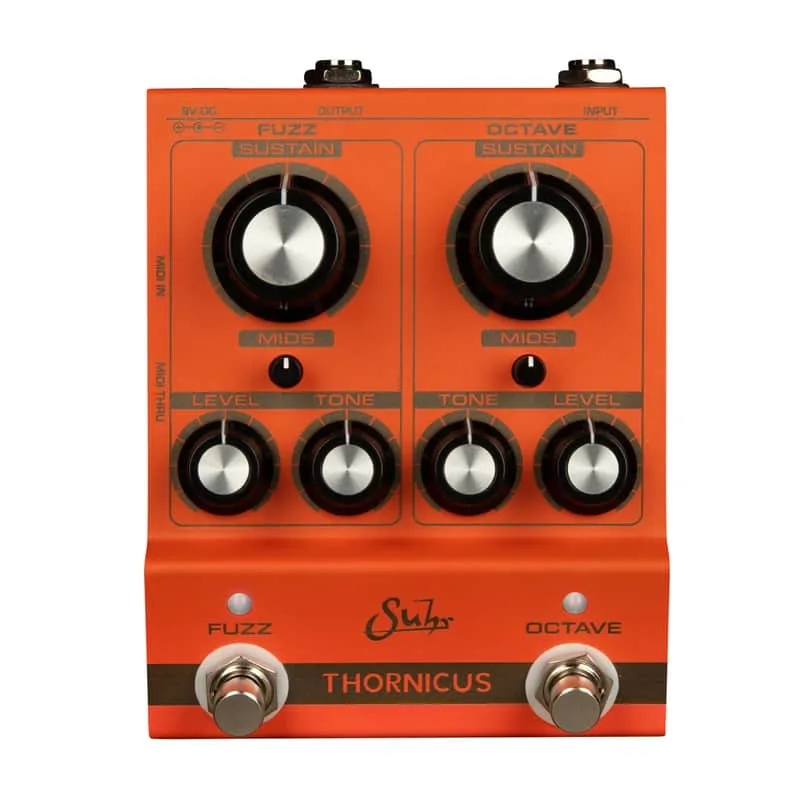


The Suhr Thornicus Fuzz is a dual-channel fuzz pedal from Suhr, built as a collaboration between guitarist Ian Thornley and Kevin Suhr. One side is a straight fuzz voiced, in Suhr's words, for "a thick, rich-sounding fuzz," and the other is an octave fuzz that Suhr says "captures the raw, blooming character Ian love[s], those gritty, unpredictable overtones that reward touch" and react to your technique, shifting from chime to controlled chaos1. The core tone comes from a multi discrete transistor fuzz circuit2.
The pedal was released for NAMM in January 2026 as the Ian Thornley Signature Thornicus Dual Channel Fuzz / Octave Fuzz, after what Suhr describes as several years of development and countless circuit refinements13.
A dual-channel fuzz with an octave side
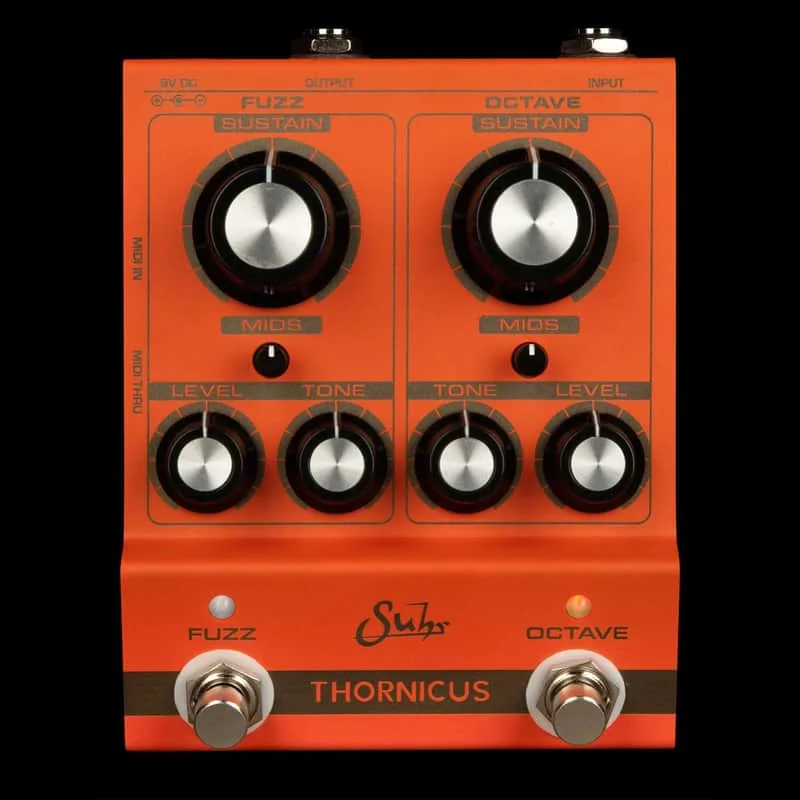
The Thornicus is laid out as two independent channels in one box: one named Fuzz, controlled by the left half of the pedal, and one named Octave, controlled by the right2. Each channel has its own dedicated tone control, which Suhr says shapes the character of each side from smooth and rounded to cutting and aggressive1.
The two footswitches are mutually exclusive: only one channel can be active at a time, so you cannot stack the straight fuzz and the octave fuzz together2. Pressing the footswitch of the currently active channel again bypasses the pedal using the internal true-bypass relay2.
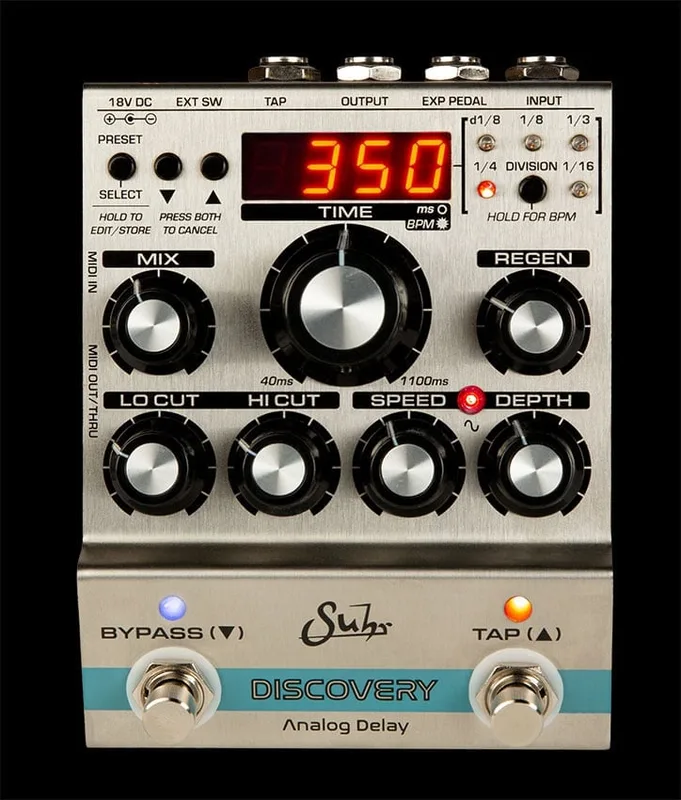
Guitar Pedal X noted the enclosure, calling it only the second Suhr circuit to use the same enclosure format as the Suhr Discovery Analog Delay, with a front portion housing the footswitches3.
The controls and footswitches
Each channel carries the same four knobs: Sustain, Mids, Level, and Tone, with separate footswitches per channel23.
| Control | What it does |
|---|---|
| Sustain | Adjusts the overall gain of the fuzz; clockwise gives more fuzzed-out tones with longer sustain2 |
| Mids | Midrange control for the channel3 |
| Level | Output level for the channel3 |
| Tone | Shapes the character from smooth and rounded to cutting and aggressive1 |
The Fuzz footswitch engages the Fuzz channel, which is governed by the knobs on the left side of the pedal; the Octave side mirrors this on the right2.
MIDI channel switching
Channel selection can be controlled via MIDI with Program Change or Controller Change messages, something Suhr built in for modern MIDI-equipped pedalboards2. The presets are deliberately narrow in scope: MIDI stores only which channel is active, and all other parameters are not stored2. In practice that means your knob settings stay analog and live on the pedal, while a MIDI controller can flip between the Fuzz and Octave sides remotely.
Designed by Ian Thornley and Kevin Suhr
The manual describes the pedal as "designed in collaboration between Ian Thornley and Kevin Suhr," and the goal, in Suhr's own words, was2:
"to create a thick, rich-sounding fuzz with the ability to switch in an octave mode for mind-bending expression"2
Guitar Pedal X reported the release as the Ian Thornley Signature model, launched alongside Suhr's Mini Brighton Treble Booster at NAMM in January 20263. Suhr's product page notes the pedal had been in development for several years1.
What reviewers said
Guitar Pedal X's Stefan Karlsson covered the NAMM release and offered a measured take on the format3:
"The Thornicus Fuzz seems a little oversized for my preferences, and part of me feels that this could have been done in a more compact and smarter edition."3
His verdict: the size is the main criticism, but the pedal remains worth a look3.
Power and setup
Setup is straightforward: plug your guitar into the input, run the output to your amp or the next effect in your chain, and power it from a standard 9V DC center-negative supply with a 2.1mm x 5.5mm barrel plug2. Current consumption is 30mA max, light enough for most isolated supplies and daisy chains rated for the voltage and polarity2. Warranty information is available at suhr.com/warranty2.
Videos
Suhr Custom
Sweetwater Soundcheck
Andy Wood Music
Questions
Can both channels of the Suhr Thornicus Fuzz run at once?
No. The manual states the footswitches are mutually exclusive, meaning only one channel, either Fuzz or Octave, can be active at a time. Pressing the footswitch of the currently active channel again bypasses the pedal through an internal true-bypass relay.
Does the Thornicus Fuzz have MIDI?
Yes. Channel selection can be controlled via MIDI using Program Change or Controller Change messages, which Suhr designed for modern MIDI-equipped pedalboards. The MIDI connection only selects which channel is active.
What do the MIDI presets store on the Thornicus?
MIDI presets store only which channel is active, Fuzz or Octave. All other parameters, such as the Sustain, Mids, Level and Tone knob settings, are not stored, so those stay wherever the knobs are set.
What power does the Suhr Thornicus Fuzz need?
It takes a standard 9V DC center-negative power supply with a 2.1mm x 5.5mm barrel plug, drawing 30mA max. There is no mention of battery operation in the manual, so plan on a pedalboard power supply.
Is the Thornicus Fuzz true bypass?
Yes. Bypassing is handled by an internal true-bypass relay. Pressing the footswitch of the currently active channel a second time takes the pedal out of the signal path.
How much does the Suhr Thornicus Fuzz weigh?
According to the manual, it weighs 1.2 lbs. Its dimensions are 4.05 inches wide by 5.33 inches deep by 2.36 inches high, the same enclosure format Suhr uses for its Discovery Analog Delay.
Sources (3)
- Thornicus Fuzz, Suhr (www.suhr.com)
- Thornicus_Manual.pdf, Suhr (J.S. Technologies Inc.), 2026-01-20
- Guitar Pedal X, Guitar Pedal X, 2026-01-26