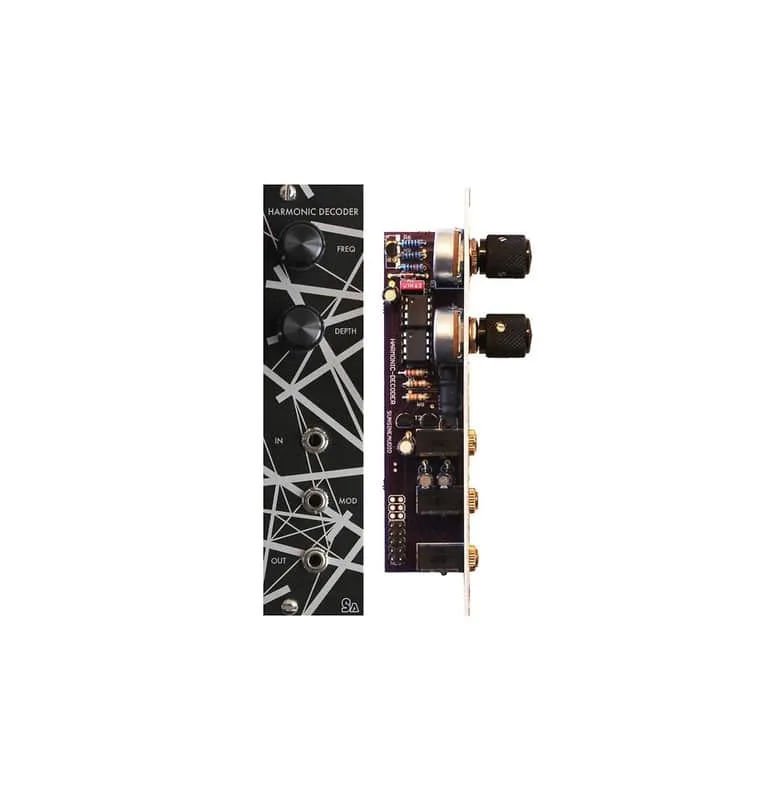


The Sunsine Audio Harmonic Decoder is a handmade analog pedal that behaves, in Premier Guitar's words, like "essentially a single-oscillator analog synth" for guitar. At its heart is a phase-lock loop circuit: a phase detector senses where your signal crosses a threshold and locks the oscillator onto the frequency and phase of the incoming signal. The result is one pedal that Premier Guitar found "can produce sounds ranging from 8-bit glitch and wah/filter to pitch shifting and fuzz," and that Pedal of the Day summed up as a unit that "can be a fuzz, an octave, a filter, a wah and much, much more"12. It sits in the wider family of PLL-style fuzz designs covered on our Fuzz Pedals page, with related ground covered by Filter Pedals, Wah-Wah Pedals and Octave & Pitch Pedals.
How the circuit works
The Harmonic Decoder is a phase-lock loop device. A phase detector senses where your guitar signal crosses a threshold and locks the pedal's oscillator onto the frequency and phase of that incoming signal. Because the oscillator is analog and tracks your note rather than processing it conventionally, the pedal produces the synth-like tracking, glitch and pitch effects that reviewers describe1.
Guitar Pedal X places it among compact and medium format Schumann PLL-style harmonizer fuzz pedals, calling it "another simplified PLL derivation"3.
The controls
The pedal keeps things simple: three knobs and one toggle switch13.
| Control | What it does |
|---|---|
| Vol | Controls the volume12 |
| Freq | Sweeps the internal clock of the oscillator and sync; Pedal of the Day notes it "makes some out-of-this-world sounds when twisted and turned while notes from your instrument are being played"12 |
| Depth | Sets how much of the effect reaches your amp; Pedal of the Day says it "affects how much of the crazy sounds are actually going to come through your amp"2 |
| Envelope/CV toggle | Switches between the internal envelope follower and external control voltage via the side jack12 |
The CV input and toggle switch
The mini-toggle selects between two modulation sources. One position uses the pedal's internal envelope follower. The other, CV, stands for control voltage and lets the Harmonic Decoder accept external modulation through a 1/8 inch jack on the side of the pedal. Premier Guitar notes this jack can take a control voltage signal from devices like the Arturia MicroBrute synth and eurorack modular synthesizers12.
Power
The Harmonic Decoder runs on a 9 Volt DC adapter with a 2.1mm negative pin connector, which is not included with the pedal. There is no battery option, so plan for a dedicated adapter or a pedalboard power supply output2.
The pedal has no battery compartment: it needs a 2.1mm 9V negative tip DC adapter, supplied separately2.
What reviewers said
Premier Guitar's 2021 review listed "Fresh new sounds" among its pros, and framed the pedal's breadth carefully: "While it does a lot, it's not a multi-effector." In other words, despite covering fuzz, octave, filter and wah territory, it is a single-purpose PLL instrument rather than a preset-driven multi-effects unit12.
Videos
sunsineaudio
gearmanndude
Music Gear Fast
Questions
Is the Sunsine Audio Harmonic Decoder analog or digital?
It is analog. Premier Guitar's reviewer described the pedal as essentially a single-oscillator analog synth, built around a phase-lock loop circuit in which a phase detector senses where your signal crosses a threshold and locks the oscillator onto the frequency and phase of the incoming signal.
Does the Harmonic Decoder come with a power supply?
No. According to Pedal of the Day, the pedal accepts any 2.1mm 9 Volt negative pin DC adapter, but the adapter is not included, and the pedal runs on DC power only with no battery option.
Is the Sunsine Audio Harmonic Decoder true bypass?
Yes. Pedal of the Day's review lists the pedal as true bypass.
What does the CV input do on the Harmonic Decoder?
The 1/8 inch jack on the side of the pedal accepts a control voltage signal from external devices, such as the Arturia MicroBrute synth and eurorack modular synthesizers. With the mini-toggle set to CV, the pedal can be modulated from outside rather than only by its internal envelope follower.
What does the toggle switch do on the Harmonic Decoder?
The toggle switch selects between an internal envelope follower and CV, which stands for control voltage. The CV position allows the Harmonic Decoder to accept external modulation through the 1/8 inch jack on the side of the pedal.
Where is the Sunsine Audio Harmonic Decoder made?
Pedal of the Day describes the Harmonic Decoder as hand made in the USA, and Premier Guitar likewise calls it a handmade pedal.
Sources (3)
- Sunsine Audio Harmonic Decoder Review, Premier Guitar, 2014-09-07
- Sunsine Audio Harmonic Decoder, Pedal of the Day, 2014-11-20
- Guitar Pedal X, Guitar Pedal X, 2019-07-05