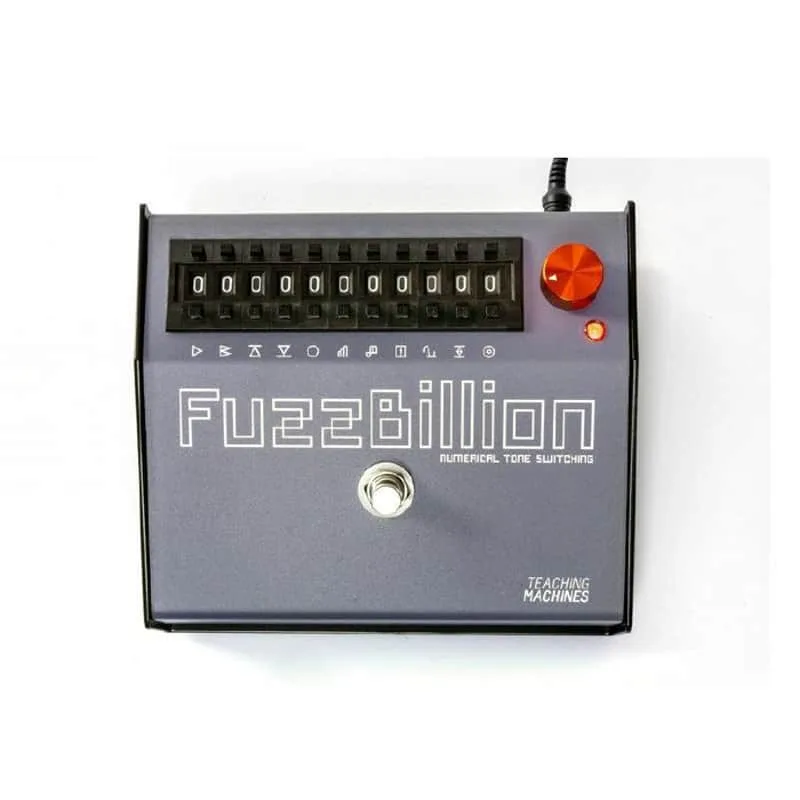


The Teaching Machines FuzzBillion is an all-analog dirt pedal that covers boost, overdrive, distortion, fuzz and octave territory in one box. Instead of knobs, its gain shaping is done with 11 rotary switches, each numbered 0 to 9, and the brand claims the result is "quite literally billions of possible permutations and combinations"1. Guitar.com's reviewer Ed Oleszko called it "a totally unique and totally analogue dirt pedal"1.
What it does: fuzz, overdrive, boost, distortion and octave
The FuzzBillion is built around combination wheels rather than variable potentiometers. Each wheel ranges from 0 (often Bypass) to 9, with 5 frequently acting as a neutral stage4. Guitar Pedal X's Stefan Karlsson counted 11 billion combinations overall, adding that "probably only 10 billion of those are properly usable"4.
The signal path runs from clean boost through fuzz to octave fuzz and PLL harmonizing. Wheel #1 handles boost: 0 is bypass, 1 to 4 give incremental clean opamp boost, 5 to 8 move to a fuzzy single mis-biased transistor boost, and 9 is a double fuzzy transistor boost2. Wheel #2 sets fuzz loop gain from minimum to max across the same 0 to 9 range2.
The octave fuzz section sits on Wheels #6 and #7. Wheel #6 is the drive control for the core octave fuzz components, from least to most drive, and is supposedly only audible if Octave Fuzz Intensity on Wheel #7 is above 02. Wheel #7 runs from least octave fuzz to most2. Wheel #8 is a PLL (phase locked loop) fuzz-harmonizer with ten settings:
- 0: Bypass
- 1: Slow PLL
- 2: Fast PLL
- 3: Slow Glitchy PLL
- 4: Fast Glitchy PLL
- 5: Cronky PLL
- 6: Cronkier PLL
- 7: Very Slow PLL
- 8: Ring Modulation PLL
- 9: Slow Ring Modulation PLL2
The 11 component wheels
Each rotary controls different types of diodes and amplification devices, from germanium to silicon and light-emitting diodes1. The full set of wheels:
| Wheel | Function | What the positions do |
|---|---|---|
| #1 | Clean Opamp and Fuzzy Transistor Boost | 0 bypass; 1-4 clean opamp boost; 5-8 fuzzy transistor boost; 9 double fuzzy boost2 |
| #2 | Fuzz Loop Gain | 0 minimum; 1-8 incremental; 9 max2 |
| #3 | Waveform Peak (upper-half) Diode Clipping | Germanium, silicon 1N60P, silicon 1N4148, LED, capacitor, no clipping, then harder versions of each2 |
| #4 | Waveform Dip (lower-half) Diode Clipping | Same clipping types as #3, with 6-9 giving more of each2 |
| #5 | Tone / Tilt EQ | 0 most bass through 8 most treble; 9 tone bypass2 |
| #6 | Octave Fuzz Drive | 0 least; 1-8 incremental; 9 most drive2 |
| #7 | Octave Fuzz Intensity | 0 least; 1-8 incremental; 9 most octave fuzz2 |
| #8 | PLL Phase Locked Loop Fuzz-Harmonizer | Bypass through ring modulation PLL settings2 |
| #9 | Bias Offset for Fuzz Loop Gain | Negative to positive bias, moving the waveform up and down so the extremities get clipped2 |
| #10 | Output Diode Clipping (2 x back-to-back diodes) | Off, various LED, silicon and germanium clipping, trading brightness and volume for sustain2 |
| #11 | Output Treble-Cut | 1 least; 2-8 incremental; 9 most treble-cut2 |
Wheels #3 and #4 shape the two halves of the waveform independently. On Wheel #3, position 0 is a germanium diode for relatively soft clipping, 1 is a silicon 1N60P diode for a louder, harsher firm clip, 2 is a silicon 1N4148 for a higher-voltage, sharper hard clip, 3 is LED diodes for harder clipping with more sustain, 4 is a capacitor in the feedback loop that cuts treble a touch, and 5 is no clipping at all, opamp only, at max volume; 6 to 9 repeat the same types with more of each2. Wheel #10, at the output, offers back-to-back diode pairs ranging from blue and green LEDs with slight clipping up to germanium diodes described as the most clip, quietest, and with the most sustain2.
Wheel #9 is the bias offset: positions 1 to 4 give negative bias with 5 the most negative, 6 the most positive, and 7 and 8 decreasing positive bias. It moves the waveform up and down so the extremities get clipped2.
The pedal itself is a rugged steel chassis with old-school plastic switches to control the rotaries, plus a big metal knob and footswitch1. Inside, it is an SMT circuit, dual layered, built up from left to right like a breadboarding device on rails4.
There are no onboard presets, no MIDI, and no way to save or recall anything other than writing the wheel numbers down1. A sound you like is a string of 11 digits.
Line-level use and connections
A button near the bottom of the right edge of the pedal switches between Guitar and Line input4. Guitar.com noted that "studio musicians will rejoice at the transformer-isolated switchable line-level ins and outs"1. The audio connections are TS in and TS out2.
How it compares
Guitar Pedal X found the FuzzBillion "slightly reminiscent" of the Joe Gore Gross Distortion, which uses two 12-position combination wheels of different diodes for a total of 156 combinations4. The FuzzBillion takes the same wheel idea and scales it up to 11 wheels and billions of claimed combinations.
What reviewers said
The review awarded the FuzzBillion a 9 out of 10 overall rating1, and its verdict on value was that "It's not cheap, but the unique things rarely are."1 The reviewer also characterized it as "a totally unique and totally analogue dirt pedal"1, and noted that Teaching Machines describes the FuzzBillions as the "last distortion pedal you ever need"1.
"It's not cheap, but the unique things rarely are."
He noted it is rare to find one pedal that covers so many bases1. Teaching Machines describes the FuzzBillion as the "last distortion pedal you ever need"1.
Guitar Pedal X's reviewer rated it 9 out of 10, calling it "a totally unique and totally analogue dirt pedal"21. On value, the reviewer's verdict was that "it's not cheap, but the unique things rarely are," noting it is rare to find one pedal that covers so many bases1. The reviewer also measured the current draw at 12 to 14 mA idle, rarely above 20 mA when active, below the 30 mA specification32, and observed that with no manual yet published there were no official technical details or specs to consult2.
Price and availability
The FuzzBillion opened for preorders at £435 excluding VAT and delivery on 1 October 20254. For UK buyers, adding VAT and at least £10 delivery brings the total to at least £5322. By December 2025 Guitar Pedal X listed it at £522 / $5803.
At the time of Guitar Pedal X's October 2025 report there was no manual yet, and therefore no official technical details or specifications beyond what reviewers measured4.
Videos
Andertons Music Co
Teaching Machines
Teaching Machines
News
Questions
Does the FuzzBillion have presets?
No. Because it is an all-analogue pedal there are no onboard presets and no way to save or recall settings other than writing the wheel numbers down. Every sound lives as a set of 11 digits, one per rotary switch, that you dial back in by hand.
Does the Teaching Machines FuzzBillion have MIDI?
No. The FuzzBillion is an all-analogue design with no MIDI and no preset storage. Its interface is 11 rotary switches numbered 0 to 9, plus a footswitch and a selector knob, so all control is done physically on the pedal itself.
How much is the FuzzBillion in US dollars?
Guitar Pedal X listed it at $580 in December 2025, alongside a UK price of £522. Earlier UK preorder pricing was £435 excluding VAT and delivery, which works out to at least £532 for UK buyers once those are added.
Can the FuzzBillion take line-level signals?
Yes. It has transformer-isolated, switchable line-level inputs and outputs, and a switch on the right edge of the pedal toggles between Guitar and Line input, so studio musicians can run it at line level as well as with a guitar.
Where is the FuzzBillion made?
It is made in Wales. The case carries the Welsh phrase 'Wedi gwneud yng Nghymru', which translates as 'Made in Wales', as noted in Guitar.com's 2026 review of the pedal.
Is the FuzzBillion like the Joe Gore Gross Distortion?
It is slightly reminiscent of it. The Gross Distortion uses two 12-position combination wheels of different diodes for a total of 156 combinations, while the FuzzBillion scales the same wheel idea up to 11 wheels and billions of claimed combinations.
Sources (4)
- Teaching Machines FuzzBillion review: the most ambitious, unique dirt pedal?, Guitar.com, 2026-05-18
- Guitar Pedal X, Guitar Pedal X, 2025-10-31
- Guitar Pedal X, Guitar Pedal X, 2025-12-11
- Guitar Pedal X, Guitar Pedal X, 2025-10-01