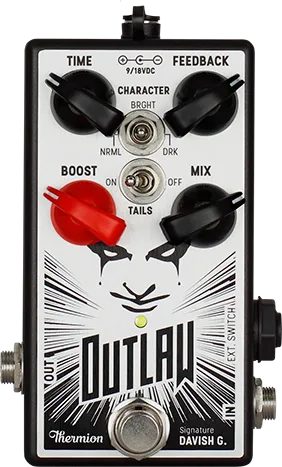


The Thermion Outlaw is a delay pedal with an integrated volume boost, made by the Spanish builder Thermion1. Thermion pitches it as a soloing tool: a delay that also lifts your level so leads cut through a mix without touching your amp. The maker describes it as "a complex analog sounding versatile delay" with a volume booster built in, aimed at players who want both ambience and level in one box2.
Pedal of the Day reviewed it in October 2022 under the name Outlaw Boosted Delay and framed its purpose the same way: it "gives you the volume boost and the ambience you need to create the most detailed and mix-cutting soloing tones, as well as complex ambient atmospheres"3.
A delay with a built-in volume boost
The idea behind the Outlaw is simple: instead of stacking a delay and a boost pedal, one box does both. The delay side gives you repeats for ambience and definition, and the Boost knob raises the output level, which Pedal of the Day said "pushes the output level right into the sweetest of spots"3. For a player whose solos get lost in a band mix, that level lift is the practical draw: you set your delay, then dial in how much louder you want to be when the pedal is engaged.
Thermion calls the circuit hybrid. The dry signal, the part of your tone that is not delayed, stays analog from input to output, and the tails are treated analog too, while a digital memory stores the repeats2. For players who care about keeping their core tone untouched, the analog dry path is the point: only the echoes pass through the digital part of the circuit.
The enclosure is finished with what Thermion calls "anodized metal printing for maximum durability"2, and at 7 x 11 x 5 cm and 250 g it is a compact pedal that fits easily on a small board2.
Controls and tails modes
The control set is straightforward. Time, Feedback and Mix comprise the delay controls, the Boost knob pushes the output level, and switches select from Normal, Bright and Dark delay modes and between true bypass, which stops the delay tails when the effect is off, and buffered bypass, which lets them continue3.
| Control | What it does |
|---|---|
| Time | Sets the delay time, up to 500ms3 |
| Feedback | Sets how many repeats you hear3 |
| Mix | Sets the balance of delayed signal against your dry signal3 |
| Boost | Raises the output level for solos3 |
| Character toggle | Selects Normal, Bright or Dark repeat characters2 |
| Tails switch | Chooses whether repeats continue or stop when the effect is switched off2 |
The Character toggle gives you three repetition voices. Normal leaves the repeats as they are, Bright adds high-end presence so echoes cut through, and Dark rolls the highs off for warmer repeats that sit behind your playing2. Pedal of the Day described these as "three different repetition characters" selected by "a toggle switch to select from Normal, Bright and Dark delay modes"3.
The tails mode is the other switchable behavior. Thermion describes it as a feature "to keep tails sounding when the effect is deactivated"2. In practice, this choice also determines the bypass type:
- Tails Off: the pedal runs in true bypass, and the repeats stop dead when you switch the effect off2
- Tails On: the pedal runs in buffered mode, and the echoes ring out naturally to their end after you switch off2
Pedal of the Day put the trade-off plainly: "You can choose to have the delay tails stop (true bypass) or continue (buffered bypass) when the effect is off"3. Players who want a completely untouched signal path when the pedal is off choose tails Off; players who want echoes that fade out musically choose tails On and accept a buffer in the chain.
Power and connections
The Outlaw runs on standard pedal power: a 9V DC center negative 2.1mm jack2. Its maximum current consumption is 100mA2, which is modest by modern standards and well within what a typical isolated power supply supplies per output, though it is more than a simple analog boost or drive pedal draws, so it is worth accounting for on a fully loaded board.
The pedal also carries protection against polarity inversion, AC connection and momentary overvoltage2, which guards it against the most common power supply mistakes. Input impedance is greater than 1MΩ and output impedance is less than 1kΩ2, so it presents a healthy load to guitar pickups and drives long cable runs or the next pedal in the chain without loading issues.
The 100mA draw and 9V center negative requirement mean the Outlaw runs from a standard power supply, but it is not a battery pedal, and its draw should be checked against any daisy-chain supply's per-output limit.
Where it came from
Thermion is the maker behind the Outlaw, and the pedal is built in an enclosure with anodized metal printing for maximum durability1. It measures 7 x 11 x 5 cm (W x H x D) and weighs 250 grams2.
Videos
Thermion
Thermion
TheGuitarGeek
Questions
Is the Thermion Outlaw analog or digital?
It is a hybrid. Thermion describes it as having an analog dry signal path and analog tails treatment, mixed with a digital memory that stores the repeats. The dry signal never goes through the conversion, while the echoes are held digitally.
How long is the delay time on the Thermion Outlaw?
The maximum delay time is 500ms, set by the Time knob. That is enough for slapback echoes, medium rhythmic repeats, and ambient washes, though it is shorter than some dedicated long-delay pedals offer.
Is the Thermion Outlaw true bypass?
It depends on the tails setting. With tails Off, the pedal runs in true bypass mode. With tails On, it runs in buffered mode so the repeats can continue sounding after you switch the effect off.
What do the Normal, Bright and Dark tails settings do?
They are repeat characters selected by a toggle switch. Normal leaves the repeats as they are, Bright gives them more high-end presence, and Dark rolls off the highs for warmer, smoother echoes that sit behind your playing.
Sources (3)
- Thermion Outlaw Delay, Delicious Audio, 2022-10-19
- Outlaw - Thermion, Thermion
- Thermion Outlaw Boosted Delay, Pedal of the Day, 2022-10-19