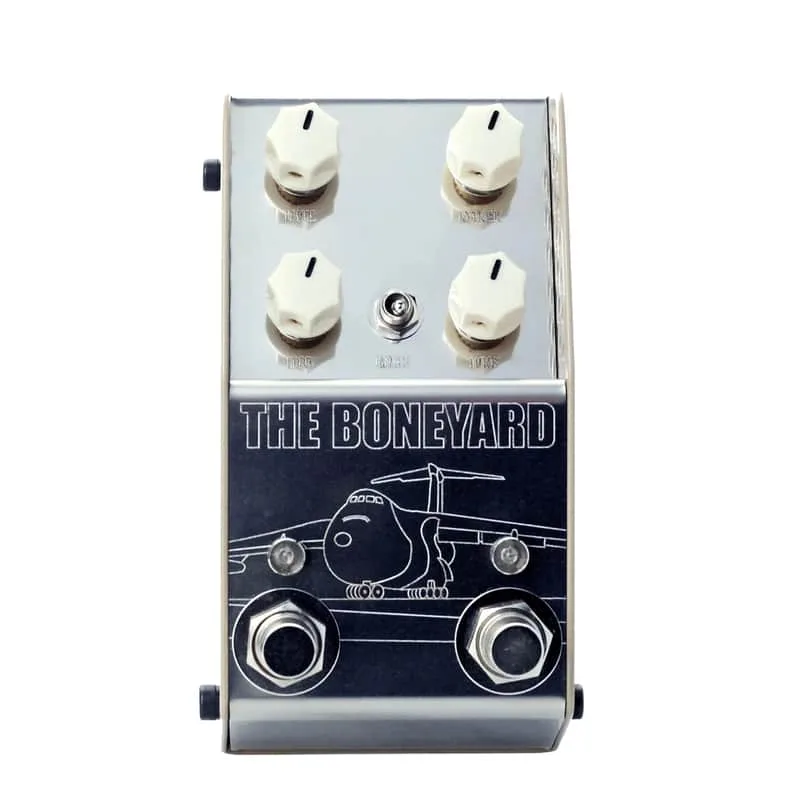


The ThorpyFX Boneyard is a compact, all-analog germanium fuzz pedal from UK effects firm ThorpyFX, built to cover the classic Tone Bender variants, MK I through MK IV, in one pedalboard-friendly unit12. It uses three rare germanium transistors, with a Mode switch that drops the circuit to two transistors for the sounds of the earliest units345. Founder Adrian Thorpe described it as "my interpretation of what the ultimate Tonebender™ would sound like"365.
The Boneyard was a limited run, and it is no longer available. It sold out soon after launch, with no plans for a restock, because of how long it took to gather the transistors7. That Pedal Show listed it as no longer available in September 20228.
One pedal for every Tone Bender variant
The Tone Bender is a well-known germanium transistor fuzz circuit from the 1960s, and it evolved through several versions with different transistor counts and voicings. The Boneyard's aim was to encapsulate all of those variants, MK I to MK IV, in one unit while staying pedalboard friendly3. Gearnews described it as combining "all the classic '60s Tonebender fuzz styles, into one compact pedal"4.
MusicRadar's Jonathan Horsley framed it as "one tweakable fuzz that takes the scenic route through the Tone Bender's evolution in sound, and one that offers a very different feel depending on your settings"5. ThorpyFX positioned the pedal as expanding on the Tone Bender legacy to deliver more volume, lower noise and more flexibility than the originals7.
Thorpe called the pedal a vanity project, saying he made it for himself as a self-confessed Tone Bender fanatic5.
The controls: Attack, Tone, Level and Feed
The Boneyard has four knobs: Level, Attack, Feed and Tone7. What each one does:
| Control | What it does |
|---|---|
| Level | Controls the volume output of the pedal4 |
| Attack | Increases the level of fuzz, from lighter fuzz through to searing fuzz4 |
| Tone | Shapes the frequency response; bypassed by the left footswitch41 |
| Feed | A master bias control, varying the voltage supplied to the whole circuit45 |
The Feed knob is the unusual one. Gearnews describes it as controlling "the voltage attributed to the entire pedal, like a master Bias control for the whole circuit," moving from voltage-starved and spitty fuzz through to full-bore, perfectly biased fuzz4. MusicRadar's Horsley put it more colorfully: it lets you "choke the fuzz and get it frothing at the mouth or have it open up"5. Guitar World noted that the Feed control "varies the voltage supplied to the circuit and thus allows the player to move between MKI and MKIV territory"1. Delicious Audio's buying guide to Tone Bender fuzzes called it "the little secret weapon here, affecting the voltage of the pedal and therefore the quality of the fuzz's character"9.
Level, Attack and Tone, by contrast, deliver predictable results3.
Two footswitches and the Mode switch
The pedal carries two footswitches and a Mode toggle:
- Right footswitch: turns the pedal on and off4.
- Left footswitch: bypasses the tone stack entirely for a different tonal response and a level boost. With it engaged, the Tone control has no effect4. Guitar World describes the result as "a wild and unfiltered fuzz sound"1.
- Mode switch: selects between the two-transistor topologies of the very early units and the more commonly found three-transistor circuits that followed5. Engaging the two-transistor mode cuts the third germanium transistor, emulating the two-transistor Vox or MK1.5 builds1.
Why it was a limited run
Germanium fuzz units are notoriously difficult and time-consuming to build, and the Boneyard was made in limited numbers for that reason6. Thorpe was direct about it:
"We cant make many of these as it took me several years to collect the transistors needed for this run43."
Adrian Thorpe, quoted by Gearnews4
MusicRadar noted that a pedal like the Boneyard "can only be limited edition because the germanium transistors are thin on the ground"5. The limited stock was available at £299, roughly $398 at the time, and Guitar.com reported that it sold out with no restock planned because of the time it took to collect the transistors71. MusicRadar's Horsley also observed that at £299, "they're not cheap"5.
Build quality and components
The pedal is housed in a polished steel enclosure with a laser-etched illustration and logo51. Inside, Thorpe used premium 1% metal film resistors, Wima and Panasonic capacitors, and Neutrik jacks for these builds45. Gearnews' reviewer, noting Thorpe's reputation for taking pedal building seriously, wrote that he was "expecting great things from this new Tonebender style effect"4.
Where it sits in the ThorpyFX range
The Boneyard itself remains the pedal that Adrian Thorpe built to be "one pedal to be able to cover off all the bender™ variants in one small pedalboard friendly footprint"3. The current version carries that idea forward in a smaller housing, delivering what ThorpyFX describes as more volume, lower noise and more flexibility in a pedalboard friendly footprint37. Adrian Thorpe, the designer behind the brand, builds these with premium 1% metal film resistors, Wima and Panasonic capacitors, and Neutrik jacks45.
Videos
AndyDemos
Sasha Ivantic
Demos In The Dark
Questions
Is the ThorpyFX Boneyard still available?
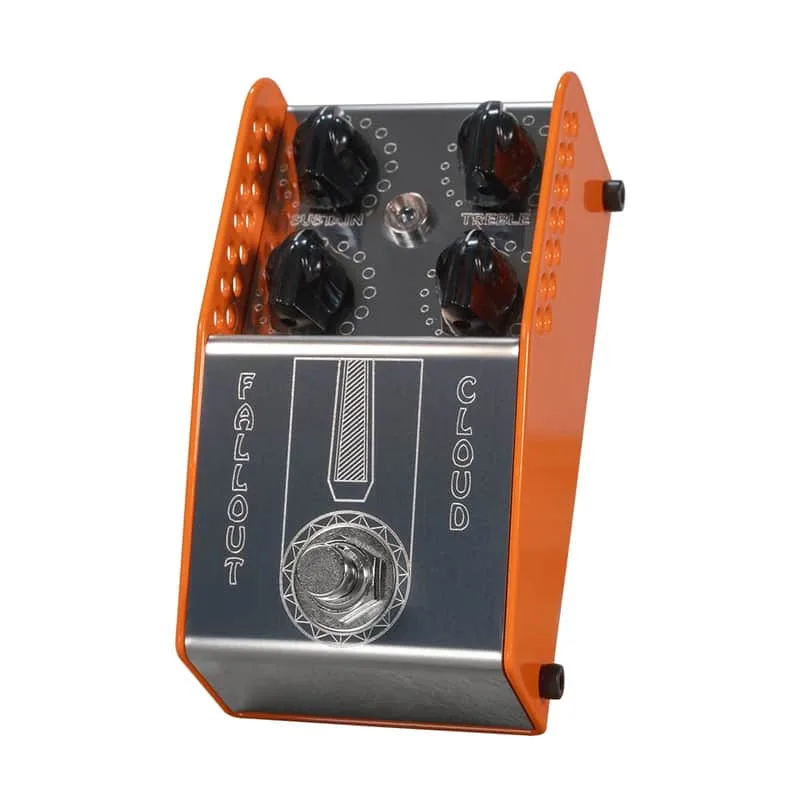
No. The Boneyard was a limited run that sold out, and there are no plans to restock it because of how long it took to collect the germanium transistors. That Pedal Show listed it as no longer available in September 2022. Players wanting a similar ThorpyFX germanium fuzz can look at the Hanami, which blends the Boneyard and Fallout Cloud circuits.
Why was the Boneyard Fuzz a limited run?
Because of the transistors. The pedal is built around rare germanium transistors, and ThorpyFX founder Adrian Thorpe said it took him several years to collect enough for the run. Germanium fuzz units are difficult and time-consuming to build, so only a limited number of Boneyards were made.
What does the Feed knob do on the Boneyard?
Feed acts as a master bias control for the whole circuit, varying the voltage supplied to the pedal. Turn it down for voltage-starved, spitty fuzz, or up for full-bore, properly biased fuzz. Guitar World described it as letting the player move between MKI and MKIV territory by manipulating the dial.
Is the Boneyard two or three transistors?
Both. The circuit uses three germanium transistors, but the Mode switch lets you run only two of them, like the early MKI and MK1.5 Tone Bender versions. So you can choose between a two-transistor fuzz and a three-transistor fuzz circuit from the same pedal.
How much did the ThorpyFX Boneyard cost?
The limited stock was available at £299 in the UK, around $398 at the time according to Guitar World's approximate conversion. MusicRadar noted that at £299 it was not cheap. It has since sold out and was never restocked.
Who designed the ThorpyFX Boneyard?
Adrian Thorpe, founder of ThorpyFX. He described the pedal as a vanity project and his interpretation of what the ultimate Tone Bender would sound like, saying he made it for himself as a self-confessed Tone Bender fanatic.
Sources (9)
- Is ThorpyFX's Boneyard Fuzz the ultimate take on the Tone Bender?, Guitar World, 2022-03-02
- Guitar Pedal X, Guitar Pedal X, 2025-05-06
- ThorpyFX The BoneYard Fuzz, Delicious Audio, 2023-01-27
- ThorpyFX Boneyard Fuzz, gearnews.com, 2022-03-01
- ThorpyFX unveils The Boneyard, a compact fuzz pedal housing every Tone Bender variant, MusicRadar, 2022-03-01
- ThorpyFx Squeezes All Tone Bender Variants into One Germanium Fuzz Pedal with the Boneyard, GuitarPlayer, 2022-03-02
- Thorpy FX unveils new compact fuzz pedal: The Boneyard, Guitar.com, 2022-03-02
- A Modern History Of Classic Fuzz Or A Weirdy-Beardy Noise-Fest, That Pedal Show, 2022-09-23
- 22 Of The Best Tone Bender Fuzz Pedals In 2024, Delicious Audio, 2024-02-13