

The ToadWorks PipeLine is a tremolo pedal, listing at a street price of $2501. It varies the volume of your signal with a Speed control that sets the rate of undulation, counterclockwise for slow and clockwise for fast, and a footswitch that takes the pedal in and out of true bypass, with the expected pop when pressed1. ToadWorks describes the sound as full and focused, with a signal-to-noise ratio the reviewer called good for a tremolo unit1.
The controls
The top panel carries three knobs and the mode switch, each with a specific job1:
| Control | What it does |
|---|---|
| Speed | Varies the frequency of undulation, or more correctly the period of the wave. Counterclockwise is slow, clockwise is fast. |
| Waveform | Varies the undulating wave from sinusoidal (smooth) to sawtooth (choppy) and all forms in between. |
| Intensity | Varies the wet/dry mix of effected and non-effected signal. Counterclockwise is dry, clockwise is wet. |
| Mode switch | Mini-toggle between Tremolo and Harmonic Vibrato. |
| LF cutoff mini-pot | Hidden inside: removing the back panel gives access to this control of the LF cutoff frequency. |
The Speed knob drew criticism. Premier Guitar's reviewer found it difficult to use: "When starting at minimum speed and traveling to maximum speed nothing much happens until about 3 o'clock, then it accelerates from two beats per second to a 'helicopter flutter.'" An expression pedal plugged into the side jack controls speed, but the reviewer noted a quirk: speed is slowest with the pedal down and fastest with the pedal up1.
Power, stereo outputs and expression
Power comes from a 9V regulated supply through a 2.1mm barrel jack on the front, and there is a 9V battery connection inside the back panel. The reviewer recommends always having a battery installed1.
The two outs on the left side are what set the PipeLine apart from most tremolo pedals. After phase inversion, the high-frequency band and low-frequency band may be split into a stereo output, each band with a separate out routable to separate amps1. Run one cable and it behaves as a mono pedal; run two and the harmonic vibrato mode opens up across two amplifiers.
Where the harmonic vibrato comes from
Premier Guitar's review places the PipeLine's second mode in a lineage: Fender engineers, responding to Magnatone's vibrato, built a tremolo system they called "Harmonic Vibrato"1. For contrast, vibrato as an effect is when the signal from your instrument shifts in pitch from the note you are playing, as EarthQuaker Devices' pedalboard primer puts it2. The harmonic vibrato approach was, per Premier Guitar's NAMM demo, short lived due to its complexity and cost, "and no adequate substitute existed - until now"3.
How it compares
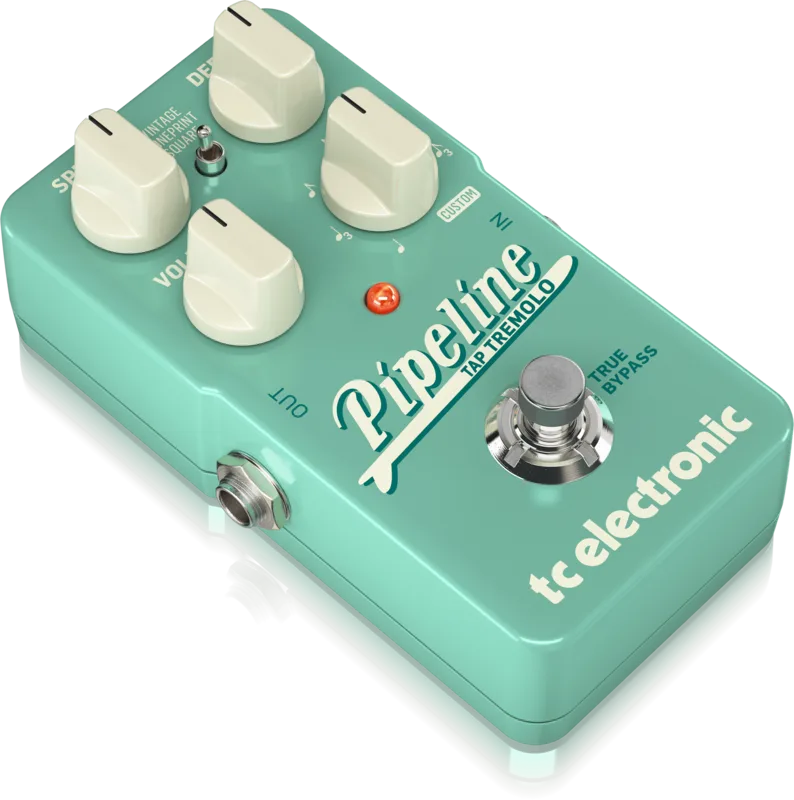
The name invites comparison with the TC Electronic Pipeline Tap Tremolo, a different pedal that offers soft Vintage sine waves and solid Square blocks switchable at the flick of a switch4. The ToadWorks PipeLine instead pairs a conventional tremolo with the band-splitting harmonic vibrato and adds stereo outs and an expression jack. Both sit in the wider family of tremolo pedals, and players chasing pitch-shift effects rather than volume modulation would look at vibrato pedals instead.
Build and sound
The PipeLine is a well-built and compact unit with a nicely painted cast metal case, in light green1. On tone, Premier Guitar's reviewer found the signal-to-noise ratio good for a tremolo unit, noting that they all make noise, and described the sound itself as full and focused, pleasant to the ear1.
Videos
Premier Guitar
Ryan Dunn
ZenGugs
Questions
Is the ToadWorks PipeLine true bypass?
Yes. Premier Guitar's reviewer notes that the footswitch takes the pedal in and out of true bypass mode, with the expected pop when the switch is pressed. That means your guitar's signal passes through the pedal untouched when it is off, which matters if you run long cable runs or a chain of pedals.
Can the ToadWorks PipeLine run on a battery?
Yes. Inside the back panel there is a battery connection for 9V power, and the reviewer recommends always having a battery installed. The pedal can also be powered from a 9V regulated supply through a 2.1mm barrel jack on the front of the unit.
Does the ToadWorks PipeLine work in stereo?
It can. After phase inversion, the high-frequency band and the low-frequency band may be split into a stereo output, each band with its own out, routable to separate amps. The pedal has two outs on its left side for this, and it works as a normal mono tremolo when only one is used.
What does the hidden mini-pot inside the PipeLine do?
Removing the back panel gives access to a mini-pot that controls the LF cutoff frequency. It sets where the split falls between the low and high bands that the harmonic vibrato mode pulses against each other, so it shapes the character of that effect rather than the tremolo.
Where does the PipeLine's harmonic vibrato sound come from?
Premier Guitar traces the mode back to Fender's Brownface amp tremolo system, which Fender engineers called Harmonic Vibrato, itself a response to Magnatone's vibrato. According to Premier Guitar's NAMM demo, that form of tremolo was short lived due to its complexity and cost, and no adequate substitute existed until the PipeLine.
Sources (4)
- ToadWorks PipeLine Tremolo Pedal Review, Premier Guitar, 2010-03-18
- A Beginners Guide To Pedalboards Pt. 1: Choosing Your Pedals, EarthQuaker Devices, 2021-12-06
- NAMM - ToadWorks PipeLine Tremolo & Fat City Demos - Premier Guitar, Premier Guitar, 2010-02-16
- TC Electronic Lays Down a Pipeline Full of Tremolo, Guitar Interactive Magazine, 2017-06-14