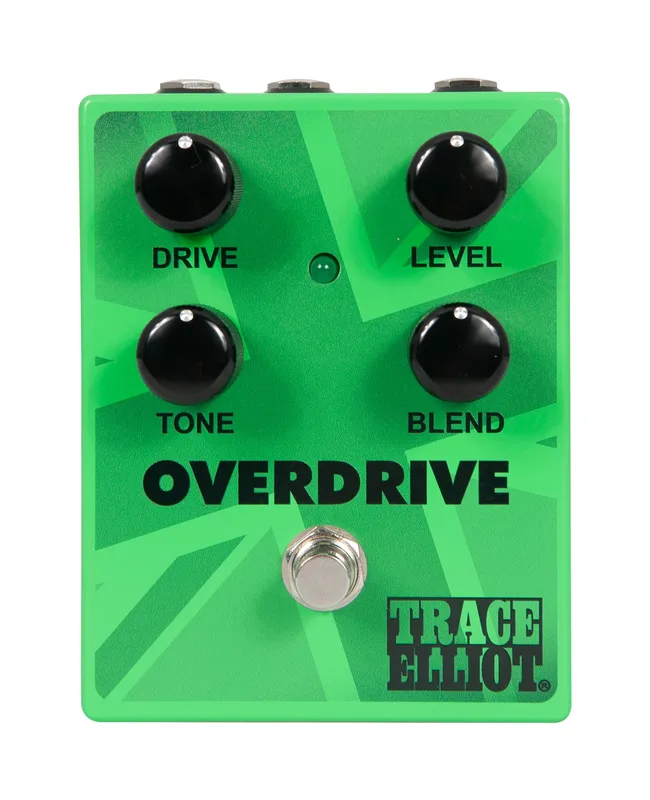
The Trace Elliot Overdrive is a true bypass overdrive pedal built specifically for bass guitar, announced by Trace Elliot in January 202612. Trace Elliot describes it as a "classic full range overdrive specific for bass guitar" with a "vintage, tube-like drive"2, and the maker says it enhances the bass tone "with harmonic excitement for more weight, impact, and detail"1.
What sets it apart from most bass pedals in its class is the combination of a BLEND knob for mixing clean and overdriven signal, a separate DRY OUT jack for splitting your clean and dirty signals to different destinations, and an internal transformer that gives the signal more headroom, especially on lower frequencies1.
A tube-like overdrive built for bass
Trace Elliot positions the Overdrive as a full-range overdrive tuned for bass rather than a guitar overdrive pressed into service. The maker says the goal is a vintage, tube-like drive that "always sounds musical"2, and that the pedal adds harmonic excitement to the bass signal for more weight, impact, and detail1.
Two design choices are aimed squarely at bass players. First, the BLEND control lets you keep part of your clean signal in the mix, so the low end does not disappear under the drive. Second, the internal transformer gives the signal more headroom, which Trace Elliot says matters most on lower frequencies, where overdrive circuits can otherwise run out of room and lose definition1.
The pedal is built with rugged construction and premium components for stage use, and Trace Elliot says it is built for long lasting durability and performance2.
The controls: Drive, Level, Tone and Blend
Four knobs control the pedal, and their jobs are straightforward2:
| Control | What it does |
|---|---|
| DRIVE | Controls the amount of overdrive on the signal2 |
| LEVEL | Dictates the overall output volume of the pedal2 |
| TONE | A basic EQ helping players define their overall tone2 |
| BLEND | Mixes the clean and overdrive signals2 |
The BLEND control is the one that matters most for bass. By mixing clean signal back in with the driven signal, you can push the DRIVE up for grit and harmonics while keeping the fundamental low notes solid underneath. The TONE control is described by the maker as a basic EQ rather than a multi-band tone stack, so expect a single tilt rather than surgical shaping2.
Inside the circuit: transformer and asymmetrical clipping
The heart of the pedal is what Trace Elliot calls a proprietary high-overhead soft asymmetrical clipping circuit2. Asymmetrical clipping means the circuit clips the top and bottom halves of the waveform differently, which is a characteristic of overdriven tubes and contributes to the vintage, tube-like character the maker claims2.
The second piece of the design is the internal transformer. Trace Elliot says it gives more headroom to the signal, ensuring better signal quality especially on lower frequencies1. For a bass player, that headroom is what keeps low notes from turning to mush when the drive is pushed.
The power section supports this design: the pedal runs a bipolar 18V internal supply from a standard 9V DC supply or battery2. The higher internal voltage is part of how the circuit keeps its overhead on demanding low-frequency signals.
Outputs and the Dry Out
Alongside the traditional 1/4" input and outputs, the pedal carries a separate DRY OUT jack, which Trace Elliot presents as a feature that helps it stand out among other overdrives2. The jack gives you a split:
The maker's suggested use is sending the dirty signal to a separate amp while the dry signal goes to front of house or into another effects chain1. Bass Musician Magazine's announcement highlighted the same idea: with the separate DRY OUT, the player can run the dirty signal to one amp and the dry signal to the desk or an effects chain5.
For a gigging bassist, this is a bi-amp style setup in a single pedal: the engineer gets a clean DI-style feed from the Dry Out while your amp carries the driven sound, with no need for a separate splitter512.
Price and availability
The Trace Elliot Overdrive was announced in January 2026 with a $199.99 USD street price in the United States3, a figure also reported by Premier Guitar4. Peavey's UK site lists the pedal at £152.00 GBP2. Peavey offers toll-free support in the US at 877-732-83911.
News
Questions
Does the Trace Elliot Overdrive run on a battery?
Yes. The pedal runs a bipolar 18V internal supply from a standard 9V DC power supply or a battery, so a 9V battery works on its own2.
Is the Trace Elliot Overdrive true bypass?
Yes. Trace Elliot specifies true bypass operation, so with the pedal off, your signal passes through without the circuit in the way2.
Can you use the Trace Elliot Overdrive on guitar?
Trace Elliot describes it as a classic full-range overdrive optimized for bass guitar1. Nothing in the maker's description limits it to bass, but its Blend control, Dry Out and low-frequency headroom are all aimed at keeping a bass's low end intact.
What is the Dry Out on the Trace Elliot Overdrive for?
It sends your clean signal to front of house or an effects chain while the overdriven signal goes to a separate amp1.
How much is the Trace Elliot Overdrive in the US?
It launched at a $199.99 USD street price in January 20263. Peavey's UK site lists it at £152.00 GBP2.
Sources (5)
- Trace Elliot® Overdrive Pedal, Peavey
- Trace Elliot® Overdrive Pedal, Peavey
- Trace Elliot Introduces Bass Overdrive Pedal, Bass Magazine, 2026-01-14
- Trace Elliot Introduces Bass Overdrive Pedal, Premier Guitar, 2026-01-14
- New Gear: Trace Elliot Introduces Bass Overdrive Pedal, Bass Musician Magazine, 2026-01-15