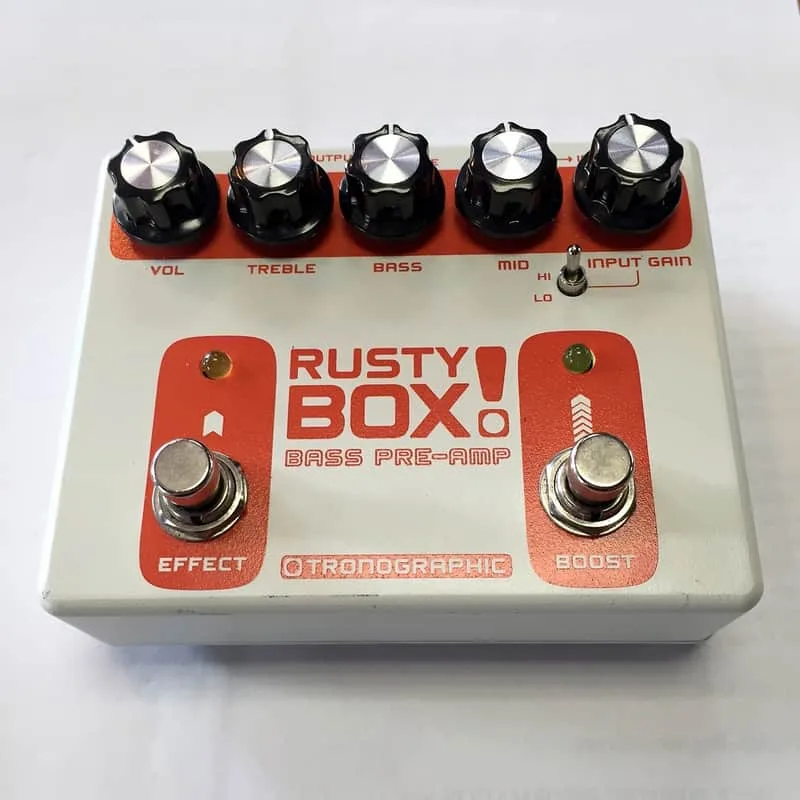


The Tronographic Rusty Box is a bass preamp pedal that clones the preamp section of the Traynor TS-50B, a solid-state bass amplifier made by Yorkville and first released in 197912. Tronographic released the pedal in 2007, and it is still in production1. EarthQuaker Devices' Aaron Rogers describes the design goal plainly: the Rusty Box "is built to emulate the sound of 70s solid state Traynor amps, which have a distinct, biting" character3.
For a player, that means a pedal that behaves like the front end of an old amp: a gain stage you can push into overdrive or distortion, a three-band EQ, a master volume, and a boost footswitch, all in a white and orange enclosure24. It is true bypass and carries a balanced output, so it can double as a direct box2.
Where the circuit comes from
The Rusty Box is a pedal adaptation of the Traynor TS-50B preamp. Aion FX documents the TS-50B as "a solid-state bass amplifier that was first released in 1979"1, and the Guitar FX Layouts analysis of the pedal confirms the lineage, discussing why Yorkville used a JFET in "the TS-50b amp - of which the rusty box is based on"2.
Inside, the circuit runs from a 9V supply converted to bipolar rails by a charge pump voltage converter2. The power supply uses 15V zeners, with the NTE5024A referenced in the parts discussion2. In the DIY vero layout, all ground is common, confirmed by tracing the build photos against the schematic's four marked grounds, and the layout omits the balanced output of the original2.
The controls and footswitches
The Rusty Box's front panel covers the same ground as an amp's front end. The controls are input gain, bass, middle and treble EQ, and master volume, plus two footswitches: one for on/off bypass and one for boost24.
| Control | What it does |
|---|---|
| Input Gain | Controls the amount of drive or distortion the pedal has5 |
| Bass, Middle, Treble | Select the low, mid and high ranges25 |
| Master volume | Sets the overall output level2 |
| Hi/Lo toggle | Toggles between the equivalent of high and low input jacks on an amplifier; Hi has a bit more volume, Lo decreases the volume slightly5 |
| Boost footswitch | Adds an extra punch to the input gain section when activated5 |
| On/off footswitch | True bypass switching24 |
The Hi/Lo toggle is worth a note for players used to modern pedals: it works like the high and low input jacks on an amplifier head, giving you two input sensitivity options rather than a gain control5.
Aaron Rogers, writing on EarthQuaker Devices' blog about his own bass rig, uses the Lo position with Input Gain around 10 o'clock, which for his setup sits at the edge of clipping, Bass boosted around 3 o'clock, and Vol around 9 o'clock for near unity gain3. He places the pedal right after his compressor and treats it as his onboard active preamp, since he plays passive basses3.
"I play passive basses, so I almost think of this pedal as my 'onboard active preamp.'"
Outputs and rig use
The pedal has a main output for the next pedal in line and a 1/4" line output. In Aaron Rogers' rig, "The ¼" line output feeds a passive Radial DI used to send my mostly clean tone to the PA, and the main output goes to the" rest of his pedalboard3. Combined with the balanced output noted in the technical analysis2, this makes the Rusty Box usable as the hub of a live bass rig: one feed to the PA, one to your amp or downstream effects.
What reviewers and builders said
Pedal of the Day reviewed the pedal twice. In 2015, Mike B found that with the Boost on and Gain past about noon, "this pedal will get good and distorted, while remaining crystal clear in tone and producing some big, fat sounds"5. His overall verdict:
"while it is geared toward bass, it sounded awesome through a guitar setup"
The 2014 review by Aaron Rogers praised the Traynor-based tone and DI use while noting gripes about the 1/4" line out and the wall wart power requirement4. On the DIY side, builder Saladi, writing on Guitar FX Layouts, was impressed by the EQ:
"I've never came across such an organic, great sounding EQ section."
Saladi described the knobs as interdependent, letting you adjust overdrive in three bands, from clean to slightly crunchy2. The same builder noted the pedal "seems quite hissy when boosted - maybe to be expected or maybe charge pump related"2.
DIY notes
The Rusty Box has a following among home builders, and the Guitar FX Layouts vero thread carries several practical findings2:
- A vero build using the JFET does not pop on boost, while omitting the JFET has been reported to cause a pop when engaging the boost switch2.
- The vero layout omits the balanced output of the original2.
- The zeners on the voltage converter are 15V, with the NTE5024A referenced in the parts discussion2.
- All ground is common in the build, confirmed by tracing build photos against the schematic's four marked grounds2.
- One builder noted a cut count discrepancy: 48 cuts on the vero where the text says 472.
Videos
tronographic
Zach Wish
nosebleed academy
Questions
Is the Tronographic Rusty Box true bypass?
Yes. The Rusty Box is a true bypass pedal, and it also has a balanced output so it can serve as a direct box. That makes it usable both as a preamp at the front of a chain and as a DI-style feed to the PA, with the effect fully out of the signal path when bypassed.
Does the Rusty Box work on guitar?
It is geared toward bass, but reviewers found it works with guitar too. Pedal of the Day's Mike B called it a really nice preamp in pedal form and said that while it is geared toward bass, it sounded awesome through a guitar setup. The three-band EQ and input gain give you room to dial it in for either instrument.
What Traynor amp is the Rusty Box based on?
The Rusty Box is based on the preamp section of the Traynor TS-50B, a solid-state bass amplifier made by Yorkville and first released in 1979. Tronographic's circuit clones that preamp to emulate the sound of 70s solid-state Traynor amps, which EarthQuaker Devices describes as having a distinct, biting character.
Can the Rusty Box run on a battery?
No. The commercial pedal requires a wall wart power supply. Inside, it runs from a 9V supply that a charge pump voltage converter splits into bipolar rails to power the op amp and transistor stages, so it is built around external power rather than an internal battery.
Why does my Rusty Box build pop when I engage the boost?
DIY builders on the Guitar FX Layouts vero build thread have reported a pop when engaging the boost switch after omitting the JFET. A builder who made a vero version using the JFET reported that it does not pop, so if your build pops on boost, check whether the JFET stage is present and correctly installed.
Sources (5)
- TS-50 Bass Preamp / Traynor TS-50B, Aion FX, 2022-06-02
- Guitar FX Layouts: Tronographic Rusty Box, Guitar FX Layouts (tagboardeffects.blogspot.com), 2014-03-19
- Get In Line: Pedal Order 101, EarthQuaker Devices, 2017-11-30
- Tronographic Rusty Box Bass Preamp, Pedal of the Day (www.pedal-of-the-day.com), 2014-03-04
- Tronographic Rusty Box Bass Pre-Amp, Pedal of the Day (www.pedal-of-the-day.com), 2015-06-05