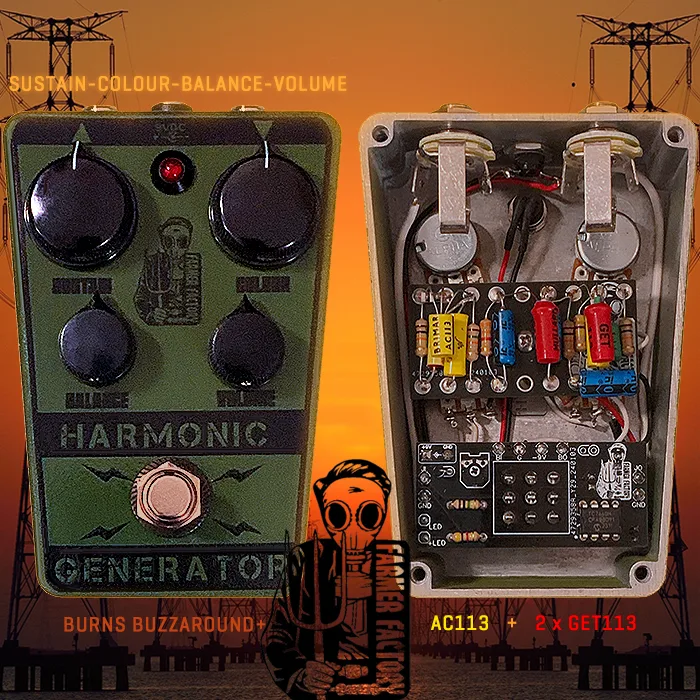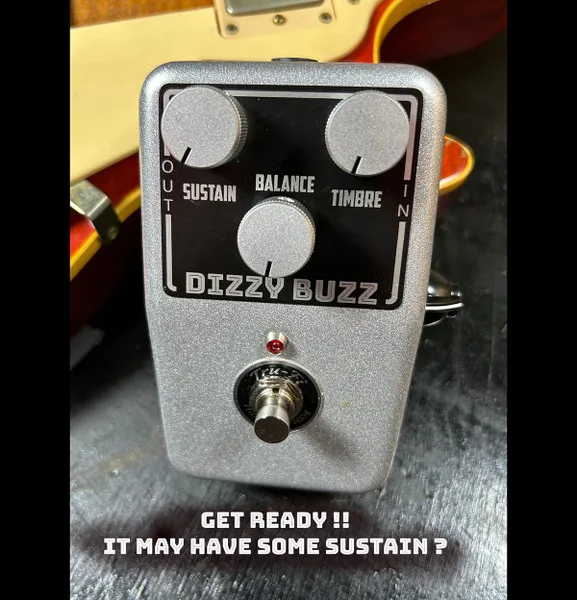

The Tru-Fi Dizzy Buzz is a fuzz pedal from Tru-Fi that reproduces a circuit with a long history: the maker traces it back to the 1966 GP Harmonic Generator, which the Burns company then produced as the more famous Baldwin Burns Buzzaround, and which Elka later made as the Dizzy Tone in 1969. Tru-Fi builds it to the spec of the original, with one addition: a side-mounted Volume pot.1
The controls: Sustain, Timbre, Balance and Volume
The Dizzy Buzz carries four controls, two of them named in the old-circuit way31:
| Control | What it does |
|---|---|
| Sustain | Fuzz, listed by Guitar Pedal X as Gain1 |
| Timbre | Tone1 |
| Balance | A Bias control that Tru-Fi says will make it raspy and more interesting1 |
| Volume | Side-mounted level control, added by Tru-Fi1 |
The side-mounted Volume is the one departure from the originals. Tru-Fi added it because the originals were incredibly loud with no way to tame them, so the level knob sits on the side of the pedal rather than on the face, leaving the layout close to the vintage units.1
Guitar Pedal X's round-up of the year's new fuzz pedals summarized the layout as "Controls - Sustain (Gain), Balance (Bias), Timbre (Tone), Level (on side)."3
"Balance is a Bias that will make it raspy and more interesting"
From the Harmonic Generator to the Dizzy Buzz
The lineage Tru-Fi gives runs through three pedals. The story starts with the GP Harmonic Generator, a fuzz box from G. P. Electronics that the maker's history article places among the very earliest offerings in the UK. According to that account, it began after somebody referred Gerry Pope to an "American recording" of a fuzz sound. Burns then copied the circuit as the Baldwin Burns Buzzaround, and Elka did their own take on it, which became the Dizzy Tone.124
Tru-Fi reproduces that circuit as the Dizzy Buzz. Guitar Pedal X called it "A fantastic take on the combined evolutionary might of the G.P. Electronics Harmonic Generator, Baldwin Burns Buzzaround" and Elka Dizzy Tone.3
How it sounds
Tru-Fi describes the Dizzy Buzz as very aggressive with TONS of sustain, and calls it a very modern fuzz for the time the original was released. The maker draws a contrast with the Maestro style of fuzz, which it characterizes as a raspy buzz fuzz; the Dizzy Buzz is not that. The Balance control is where the rasp can be dialed in if a player wants it.1
Tru-Fi offers an optional upgrade to OC71 type transistors for $25 on the Dizzy Buzz.1
Videos
モリタシノブ
Questions
What is the Tru-Fi Dizzy Buzz based on?
Tru-Fi traces the Dizzy Buzz back to the 1966 GP Harmonic Generator, a very early UK fuzz box. Burns copied that circuit as the Baldwin Burns Buzzaround, and Elka later produced it as the Dizzy Tone in 1969. Tru-Fi reproduces that circuit as the Dizzy Buzz, built to the spec of the original but with a side-mounted Volume pot added.
What does the Balance control do on the Dizzy Buzz?
Tru-Fi describes Balance as a Bias control. Turning it changes the bias of the circuit, which the maker says will make the fuzz raspy and more interesting. Guitar Pedal X lists it alongside Sustain (Gain), Timbre (Tone) and the side-mounted Level.
Why does the Dizzy Buzz have a side-mounted volume knob?
Tru-Fi added a side-mounted Volume pot to the Dizzy Buzz because the original pedals were incredibly loud with no way to tame them. The Volume control sits on the side of the pedal rather than on the top face, keeping the layout close to the original.
How much is the Tru-Fi Dizzy Buzz Fuzz?
Guitar Pedal X listed the Tru-Fi Dizzy Buzz Fuzz at $199 in its December 2024 round-up of the year's best new fuzz pedals. Tru-Fi also offers an optional upgrade to OC71 type transistors for $25.
How is the Dizzy Buzz different from the Maestro fuzz sound?
Tru-Fi describes the Dizzy Buzz as very aggressive with tons of sustain, and calls it a very modern fuzz for the time the original circuit was released. The maker contrasts it with the Maestro, which it characterizes as a raspy buzz fuzz, so the two sit in different corners of the fuzz family.
Sources (4)
- Dizzy Buzz Fuzz NEW, tru-fi.com
- Elka Dizzy Tone and Buzzround, tru-fi.com
- Guitar Pedal X, Guitar Pedal X, 2024-12-18
- Guitar Pedal X, Guitar Pedal X, 2024-06-28