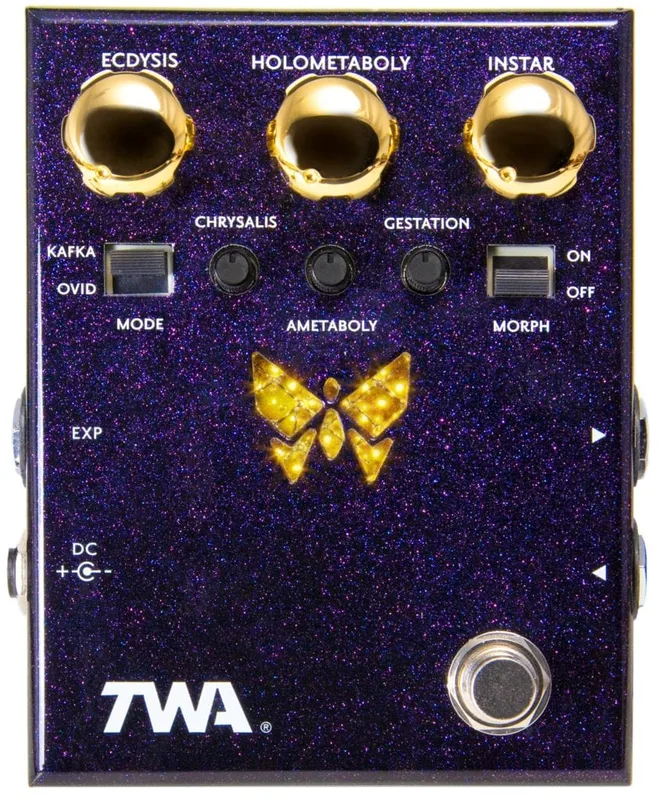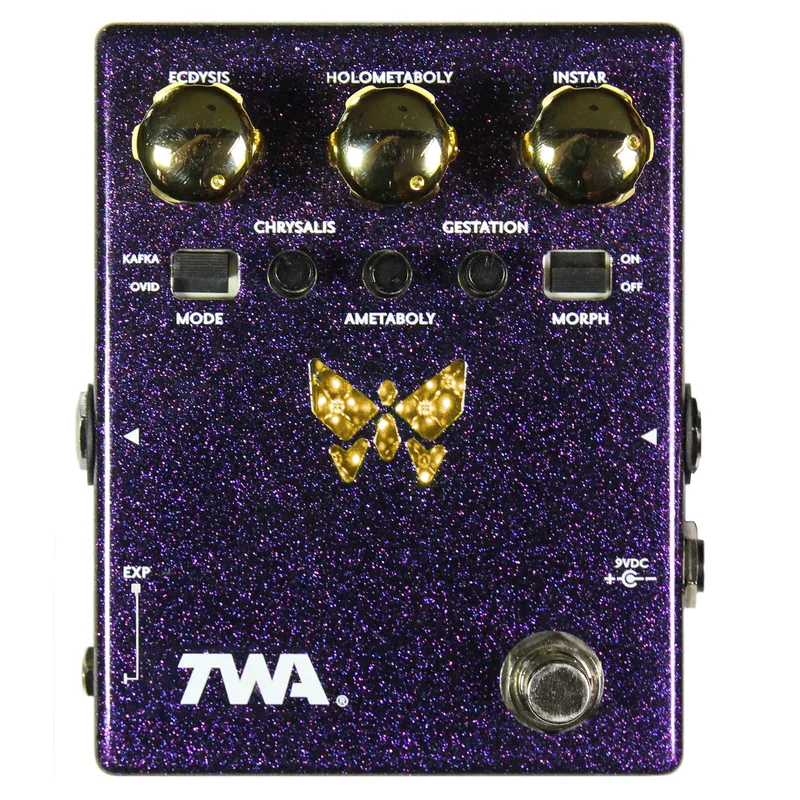


The TWA DM-02 Dynamorph is a reactive foldback distortion pedal from TWA, also known as Totally Wycked Audio, distributed in the US by Godlyke Distributing1. Instead of the hard or soft clipping found in most distortion and fuzz pedals, it pushes your signal through a string of full-wave rectifiers, which reshapes the waveform itself rather than simply chopping off its peaks. TWA describes the result as distortion, fuzz, filter and synth effects in one pedal1.
How the circuit works: preamps into full-wave rectifiers
Most distortion pedals clip the signal with diodes arranged so that everything above a threshold gets cut off. The Dynamorph does something different. At the heart of the circuit is a string of full-wave rectifiers, and in front of this diode array sit two high-gain preamps in series, whose output levels are set by the Drive and Gain controls1.
As the diodes are hit with increasing signal level from the preamps, they bias either positive or negative, or not at all, depending on how hard they are driven1. That is what makes the pedal reactive: the waveshaping changes with your picking dynamics and with where the controls are set, rather than applying one fixed clipping character. TWA says the circuit creates multi-layered, highly complex waveforms that twist and morph the instrument's harmonic structure in ways the maker calls bizarre yet decidedly musical1.
The Gain control (labeled Chrysalis) sets the output level of the first high-gain preamp, which makes the Drive control hit the rectifiers harder. TWA says this yields more complex, thick harmonics with compression and increased sustain1.
Controls and connections
| Control | What it does |
|---|---|
| CHRYSALIS (Gain) | Output level of the high-gain preamp before the rectifier array; higher settings make Drive hit the rectifiers harder, giving thicker harmonics, compression and sustain1 |
| AMETABOLY (Dry Level) | Output level of the dry signal; turn clockwise for more dry signal1 |
| INSTAR (Threshold) | With Morph on, sets the trigger point at which the drive level rises from zero to the Drive control's setting1 |
| MORPH (ON/OFF) | Turns the pedal's envelope-detector function on and off1 |
| MODE (OVID/KAFKA) | Selects between two overall EQ curves: Ovid is fuller-sounding, Kafka emphasizes the high frequencies1 |
The control names follow a metamorphosis theme, and the Ovid/Kafka switch doubles as what Premier Guitar's press release called an obscure literary reference3.
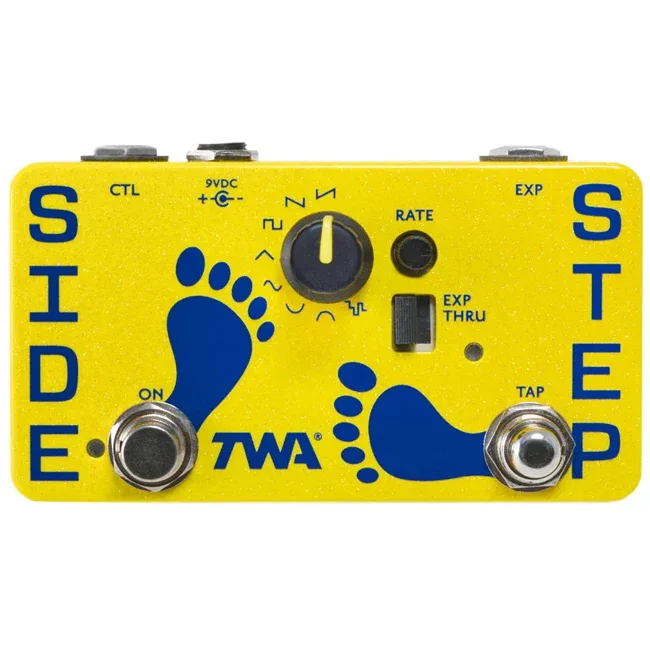
The EXP jack is a 1/8" TRS jack for an external expression pedal, with the Roland EV-5 recommended. It controls the amount of drive hitting the circuit's diode array, and TWA advises setting the Instar control to zero, fully counterclockwise, when using one1. Connecting a TWA SIDE STEP adds additional LFO features1.
Morph, modes and expression
With the Morph switch on, the pedal's envelope detector takes over: the Instar control sets the trigger point at which the drive level increases from zero to wherever the Drive control is set, so harder playing opens up more distortion1. Guitar Interactive Magazine described the switchable Morph function as allowing envelope control of the distortion effect4.
The Morph function can also be controlled manually with an external expression pedal, which TWA says allows notes to be swelled in and out to create synth pads1. The Ovid/Kafka mode switch gives two different EQ curves, Ovid fuller-sounding and Kafka brighter, which shapes how those swelled notes sit in a mix1.
Bypass, power and reliability
The Dynamorph uses TWA's proprietary S3 "Shortest Send Switching", a form of relay-based true bypass1. The S3 switching also automatically reverts the pedal to bypass mode if power is lost, which TWA calls an essential fail-safe for live gigging1.
The current version of the Dynamorph has an improved envelope function over earlier units, and it is built to order: the maker's page lists it as in stock with a build and test time of up to 7 business days1.
What reviewers and players said
Pedal of the Day reviewed the pedal in July 2017 and found it hard to pin down5:
"this is one exciting, adventurous and unpredictable effect"
The same review advised readers to consult the manual to figure the pedal out, a fair warning given its unconventional control set5. Premier Guitar's 2017 press release noted the optional expression pedal control of gain level for additional effects, the Made in USA construction, and a $299 street price3. Guitar Interactive Magazine reported the 3-year warranty when covering the pedal's release4.
On the maker's product page, a player named Veronica W reports using it mostly on guitar and says it delivers on both guitar and bass1, which makes it worth a look for bass players as well as guitarists.
Where it sits in the TWA range
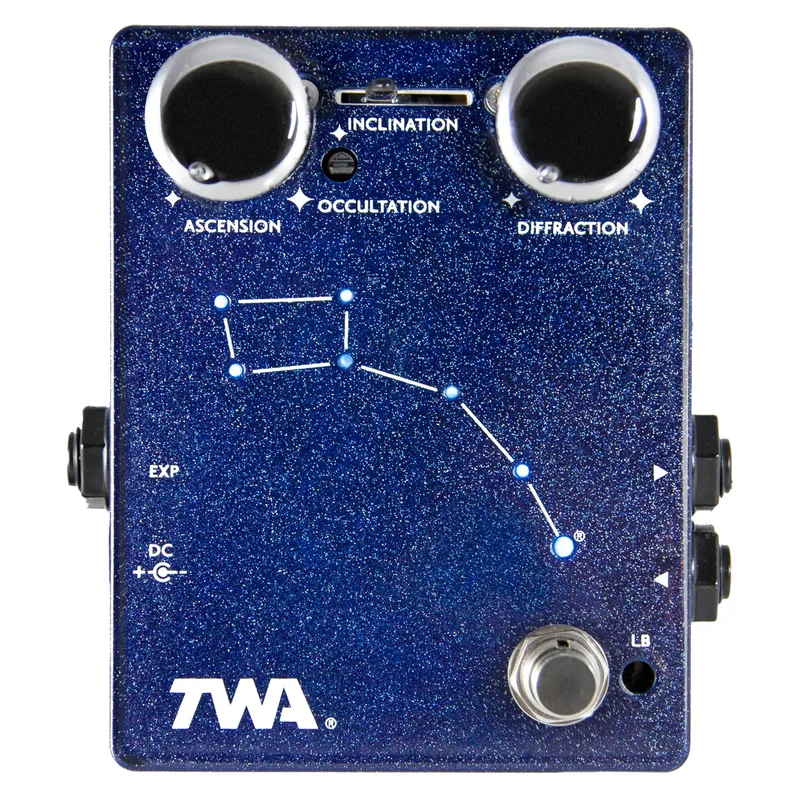
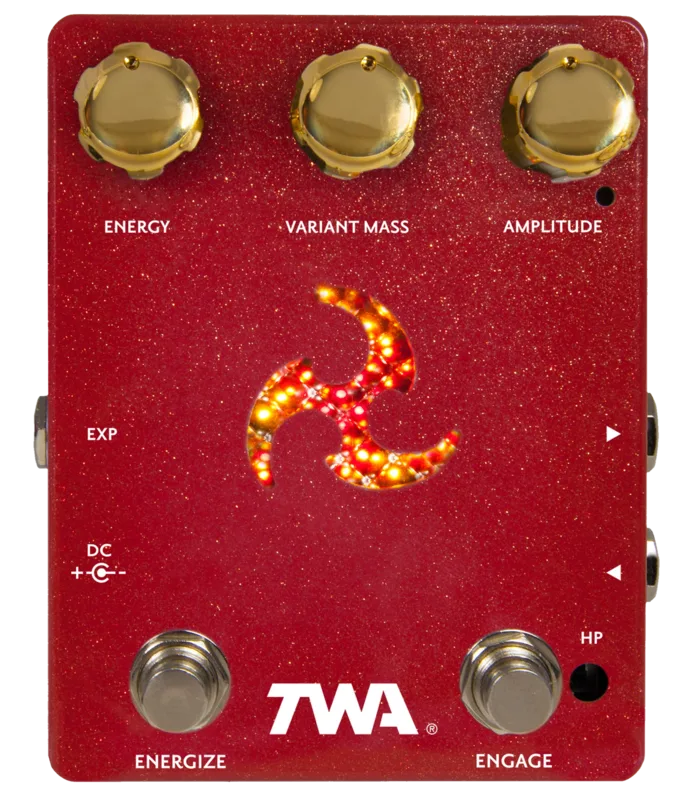
The Dynamorph is one of the more unusual entries in TWA's lineup of filter and waveshaping pedals. Players who want a more conventional envelope-filter experience can look at the TWA Little Dipper 2.0, while the TWA Triskelion 2.0 Harmonic Energizer takes a band-pass frequency and gain-shaping approach, and the TWA LF-01 Ladditude is a ladder-filter design. The Dynamorph remains the one that reshapes the waveform directly through its rectifier array1.
Videos
ProGuitarShopDemos
Nate Navarro
Godlyke Inc.
Questions
Is the Dynamorph a fuzz or a filter?
It is neither one thing nor the other. TWA describes it as a reactive foldback distortion whose rectifier circuit produces distortion, fuzz, filter and synth-like effects in a single pedal. Pedal of the Day called it an exciting, adventurous and unpredictable effect that cannot really be categorized.
Does the Dynamorph work on bass?
Yes. Veronica W, a player quoted on the maker's product page, uses it mostly on guitar and reports that it delivers on both guitar and bass. The Ovid mode position on the mode switch is the fuller-sounding of the two EQ curves, which suits lower-tuned instruments.
What expression pedal works with the TWA Dynamorph?
The EXP jack is a 1/8 inch TRS jack for an external expression pedal, and TWA recommends the Roland EV-5. It controls the amount of drive hitting the diode array. Set the Instar control to zero, fully counterclockwise, before using an expression pedal.
What does the Morph switch do?
The Morph switch turns the pedal's envelope-detector function on and off. With Morph on, the Instar control sets the trigger point at which the drive level increases from zero to wherever the Drive control is set. The Morph function can also be controlled manually with an expression pedal to swell notes in and out like synth pads.
Who distributes TWA pedals in the US?
Godlyke Distributing handles TWA, also known as Totally Wycked Audio, in the United States. The Dynamorph is sold through the Godlyke webstore, and the current version carries a 3-year warranty.
What changed in the current Dynamorph version?
The current version has an improved envelope function compared with earlier units. It is built to order: the maker's page lists it as in stock with a build time of up to 7 business days for testing before shipping.
Sources (5)
- DYNAMORPH®, Godlyke Distributing, Inc.
- Totally Wycked Audio DM-02 Dynamorph™ Distortion Fuzz Filter, Pedal of the Day, 2017-07-06
- TWA Releases the DM-02 Dynamorph Harmonic Generator, Premier Guitar, 2017-03-27
- TWA Releases New DM-02 Dynamorph Pedal, Guitar Interactive Magazine, 2020-08-02
- TWA DM-02 Dynamorph Fuzz Filter Synth Distortion, Pedal of the Day, 2017-07-12