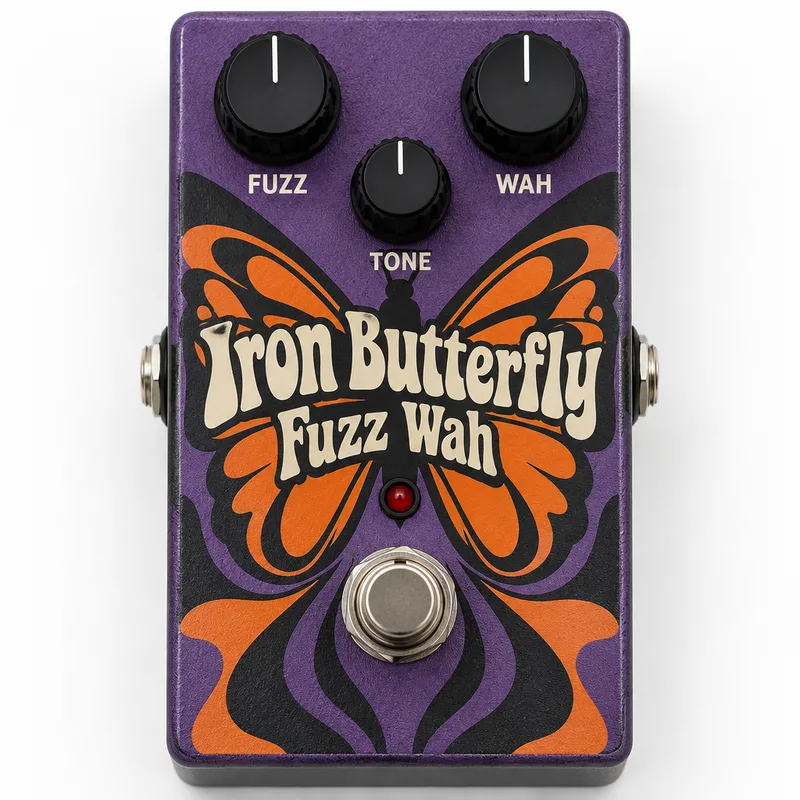
The Iron Butterfly Fuzz Wah is a rare fuzz wah pedal from the early 1970s. Jeds Peds, a maker of pedal kits and boards, describes it as "a rare slice of early-'70s fuzz history" and says it was "released in 1970 as the Iron Butterfly Fuzz Wah"1. It combines two effects in one enclosure, sitting between the fuzz and wah families, and original examples are scarce enough that even its manufacturer is a mystery.
A pedal with no confirmed maker
The clearest statement about the pedal's origins comes from the Guitar FX Layouts blog, an independent technical resource, where the author wrote: "Not much info on this one, not even who actually made it"2. A commenter on that post offered one theory: "This would suggest it was designed by Ed Sanner and never actually produced commercially due to the deal falling through"2. That remains a suggestion from a commenter, not a confirmation from any maker, so Ed Sanner's involvement should be read as unverified.
Sound
Published description of the pedal's sound is thin. One commenter on the Guitar FX Layouts post gave the blunt verdict: "wow, that is a truly hideous sounding pedal"2. That is one player's judgement rather than a reviewer's measured assessment, but it is the only documented reaction to the original circuit's tone.
Power
The pedal runs at +9V from a battery. In the Guitar FX Layouts comments, a commenter confirmed: "correct, the iron butterfly wah was battery driven and runs at +9V, just as the layout indicates"2. No current draw, adapter polarity or input and output details are documented.
The DIY layout and its circuit
For players who want to hear one without hunting down a 55-year-old original, Guitar FX Layouts published a vero (stripboard) layout in July 2017. The author explained the motive: "Figured I'd tale a shot at a vero since I did so many other wahs"2. The schematic behind it has its own history:
- The schematic was found at DIYSB, where it "was reversed with the help of none other than dino"2
- The layout uses NPN transistors; a commenter asked which specific type to use, noting "NPN doesnt help me very much"2
- An early version of the layout carried an error: "Q2 appears to be coupled from Q1's base, rather than collector as you would expect"2
- That coupling was later corrected in the layout2
If you build from the Guitar FX Layouts vero, use a corrected version of the layout. The original had Q2 coupled from Q1's base instead of its collector, which the author later fixed2.
Videos
jermsfuzz
Questions
Who made the Iron Butterfly Fuzz Wah?
No one has confirmed who made it. A commenter on the Guitar FX Layouts write-up suggested it may have been designed by Ed Sanner and never produced commercially because a deal fell through, but that remains a suggestion rather than a confirmed fact. Jeds Peds describes it as a rare slice of early-70s fuzz history, released in 1970 as the Iron Butterfly Fuzz Wah.
Does the Iron Butterfly Fuzz Wah run on a battery?
Yes. In the comments on the Guitar FX Layouts page, a commenter confirmed that the Iron Butterfly wah was battery driven and runs at +9V, matching the published layout. No adapter or current draw specification is documented.
Where did the Iron Butterfly Fuzz Wah schematic come from?
The author of the Guitar FX Layouts post wrote that he found the schematic years ago over at DIYSB, where it was reversed with the help of dino. From that schematic he worked up a vero, or stripboard, layout for DIY builders.
Is there a DIY layout for the Iron Butterfly Fuzz Wah?
Yes. Guitar FX Layouts published a vero (stripboard) layout in July 2017, with the author saying he took a shot at a vero since he had done so many other wahs. A correction followed: Q2 is coupled from Q1's base rather than the collector as you would expect, and the layout was later corrected.
Sources (2)
- Mental Moth, Jeds Peds (jedspeds.co.uk)
- Guitar FX Layouts: Iron Butterfly Fuzz Wah, Guitar FX Layouts (tagboardeffects.blogspot.com), 2017-07-17