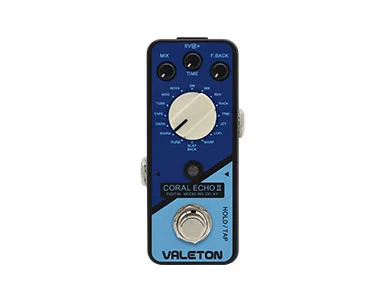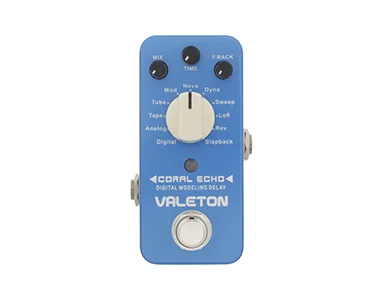


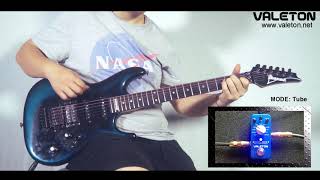
The Valeton Coral Echo is a digital modeling delay pedal from Valeton, built to put 11 delay algorithms in one compact stompbox. Instead of committing to a single delay character, it models a range of them: clean digital repeats, warm vintage-style analog delay, reverse delay, a sweeping filter delay and a lo-fi, sample-reducing mode, among others. Valeton describes the pedal's overall character as "pristine tone with low noise level"1.
The pedal is discontinued. Valeton's product page lists it as discontinued as of August 2026, and its successor, the Coral Echo II, is listed as discontinued too12. Both remain relevant on the second-hand market, and the Coral Echo's small size and wide mode selection keep it interesting for players building a compact board.
A digital modeling delay with 11 algorithms
The Coral Echo's pitch is variety in a small box: 11 delay algorithms selectable from one knob, in an aluminum-alloy die cast casing sized for a crowded pedalboard. Valeton calls it a digital modeling delay, meaning every mode, including the Analog mode, is a digital model rather than a discrete analog circuit. The digital design is what lets one pedal cover ground that would otherwise take several1.
The mode list covers the main delay families a player usually reaches for:
| Mode | What it does |
|---|---|
| Digital | A pure, accurate delay effect |
| Dynamic | Pure delay tone with dynamic delay volume variation |
| Analog | A warm, vintage delay effect |
| Rev | A delay tone with reversed feedback |
| Sweep | A delay tone with a sweeping filter |
| Lofi | A delay tone with sample-reducing feedback |
Valeton's own descriptions of each mode are brief, but they map to familiar territory: Digital for clean, uncolored repeats; Analog for the darker, warmer feel of vintage bucket-brigade delays; Rev for reverse-style effects; Sweep and Lofi for more experimental textures1.
The controls and delay modes
The Coral Echo keeps its control set minimal. Three knobs and a mode selector do the work12:
| Control | What it does |
|---|---|
| MODE | Selects the delay type |
| TIME | Controls the delay time |
| F.BACK | Controls the feedback of the delay |
That is the whole panel. There is no tap tempo on the original Coral Echo, no separate mix knob, and no presets: TIME sets how far apart the repeats sit, F.BACK sets how many repeats you hear, and MODE picks the algorithm1. Players who want tap tempo or a dedicated mix control are pointed toward the Coral Echo II, which Valeton equipped with MIX, TIME and F.BACK knobs plus a tap tempo function for real-time delay time control2.
Maximum delay time is 838ms across the modes, with two exceptions: Rev mode is limited to 420ms and Slapback mode to 100ms1. For context, 838ms is roughly a beat and a half at 72 bpm, enough for ambient-style spacing, though short of the two-second ceiling the Coral Echo II later offered2.
Power, bypass and hardware
The Coral Echo runs on 9V DC with a center-negative plug, the standard arrangement for most modern pedalboard power supplies, and draws 135mA1.
At 135mA the Coral Echo draws more current than many analog pedals. A single 100mA isolated output will not cover it, so check your power supply's per-output rating before plugging in.
The bypass is true bypass, which Valeton describes as delivering "crystal-clear signal thru" when the pedal is off1. The enclosure is an aluminum-alloy die cast casing, and the whole pedal weighs 175g at 93mm deep, 50mm wide and 46.5mm high1.
Versions and editions: the Coral Echo and the Coral Echo II
The Coral Echo line has two generations, and both are discontinued. The original Coral Echo carries the 11 algorithms described above. The Coral Echo II, reviewed by Pedal of the Day in November 2020, expanded the pedal to 16 delay effects in what the reviewer called a super-small enclosure, on what Valeton describes as an advanced 24-bit digital platform compared to the first generation32.
The II's 16 modes, as listed by Pedal of the Day, are Pure Echo, Warm Echo, Dark Echo, Tape Echo, Tube Echo, Mod Echo, Nova Echo, DM Echo, MM Echo, Rev Echo, Rack Echo, Trm Echo, Jet Echo, Lofi Echo, Warp Echo and Slap Back3. Several of those names point at classic delay designs, giving the II a broader modeling reach than the original's six described modes.
Side by side, the two generations differ in more than algorithm count:
| Coral Echo | Coral Echo II | |
|---|---|---|
| Delay algorithms | 111 | 162 |
| Max delay time | 838ms (Rev 420ms, Slapback 100ms)1 | 25ms to 2000ms (Slap Back 25ms to 200ms)2 |
| Bypass | True bypass1 | Buffer bypass2 |
| Current draw | 135mA1 | 100mA2 |
| Dimensions | 93 x 50 x 46.5mm1 | 93.5 x 42 x 52mm2 |
| Weight | 175g1 | 150g2 |
| Tap tempo | No1 | Yes2 |
The Coral Echo II also switched from true bypass to a specially designed buffer bypass circuit, which Valeton says keeps the sound pristine2. Players who feel strongly about true bypass when a pedal is off may prefer the original for that reason alone; players who want longer delay times, tap tempo and more modes will find the II the more flexible design.
Pedal of the Day's reviewer came away positive about the II, writing:
"This one sounds great"
The same review called it "an excellent option for beginners and pros alike" and noted it "sounds pretty damn good for its price range"3.
Valeton also publishes a manual for the Coral Echo, version V01_150325, created and updated on 30 May 2025, covering the pedal's operation in English4.
Videos
Pedal of the Day and Valeton
MusicSoundGear
GuitarFX
Questions
Is the Valeton Coral Echo discontinued?
Yes. Valeton lists the Coral Echo as discontinued on its product page, as of August 2026. The Coral Echo II that followed it is also listed as discontinued. Both pedals may still be found second-hand or at remaining retailers.
What is the maximum delay time of the Coral Echo?
The maximum delay time is 838ms in all modes except two: Rev mode tops out at 420ms and Slapback mode at 100ms. That is enough for most playing, though the Coral Echo II later extended its range to 2000ms.
Is the Valeton Coral Echo true bypass?
Yes. The Coral Echo has a true bypass footswitch, which Valeton describes as giving a crystal-clear signal pass-through when the pedal is off. The Coral Echo II differs here, using a buffer bypass circuit instead.
What power supply does the Coral Echo use?
It runs on 9V DC with a center-negative plug, drawing 135mA. A standard pedalboard power supply with a center-negative output works. The current draw is high enough that a small isolated output is a safer choice than a daisy chain.
What is the difference between the Coral Echo and the Coral Echo II?
The Coral Echo II moved to a 24-bit digital platform, expanded from 11 to 16 delay effects, added tap tempo, and extended delay time to 2000ms. It also switched from true bypass to a buffer bypass and draws slightly less current at 100mA.
Is the Coral Echo analog or digital?
It is digital. Valeton describes it as a digital modeling delay with digital circuit design, and its Analog mode is a digital model of a warm vintage delay rather than an actual analog delay circuit.
Sources (4)
- Coral Echo, Valeton, 2026-08-27
- Coral Echo II, Valeton, 2026-07-27
- Valeton Coral Echo II Digital Modeling Delay, Pedal of the Day, 2020-11-29
- Coral Echo_Manual_EN_V01_150325, Valeton, 2025-03-15