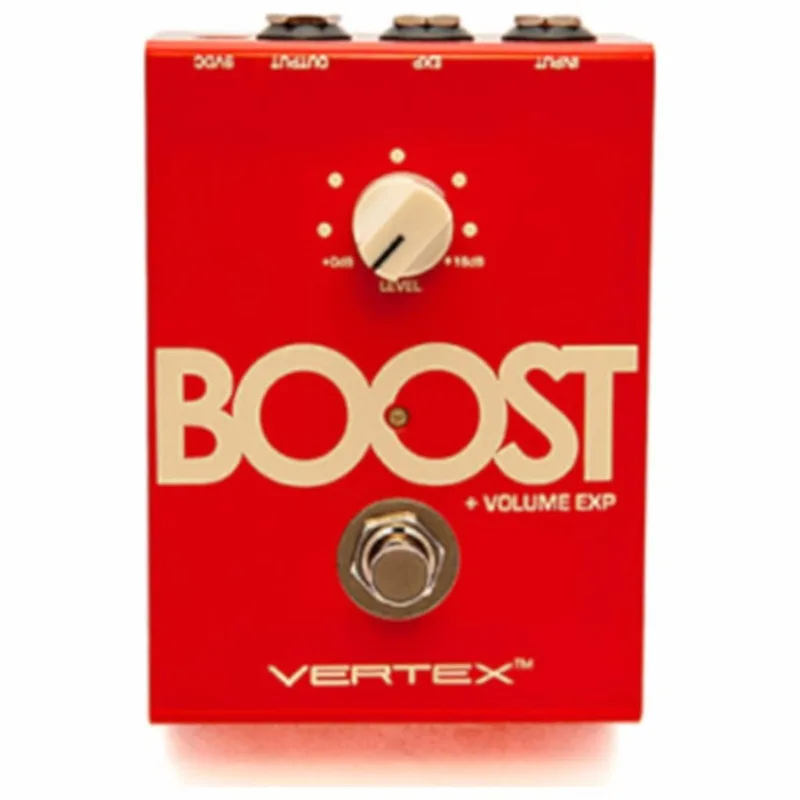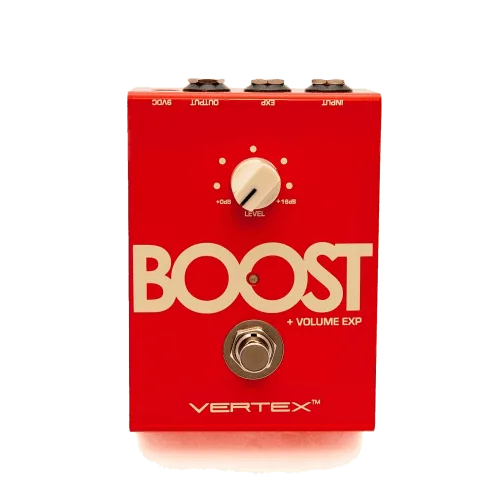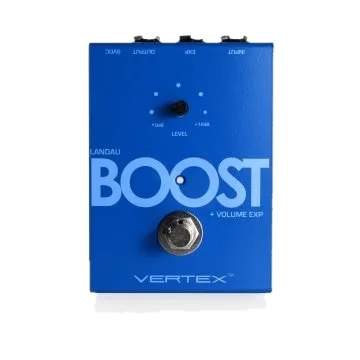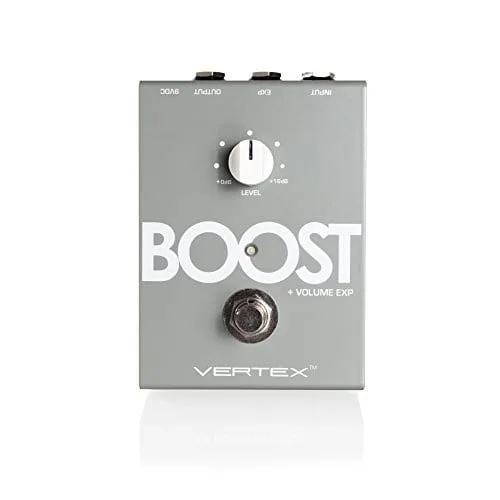
The Vertex Boost is a boost pedal from Vertex Effects that combines three jobs in one box: a clean boost, a buffer, and a volume pedal when paired with an external expression pedal. Vertex describes it as "expertly crafted to be a clean boost, buffer and volume pedal in one," with 100% analog circuitry and buffered bypass rather than true bypass1.
The buffer is central to the design. Vertex calls it an ultra-linear buffer that conditions your line with "ZERO tonal coloration, even with dozens of pedals in the chain," and says the result feels like you are plugged straight into your amp12. The original Boost hit shelves in 20143.
How it works with an expression or volume pedal
The Boost's expression input is what turns it into a volume pedal. Connect any expression or volume pedal and you get total control of the output level2. What the expression pedal controls depends on whether the Boost is engaged:
| Boost state | What the EXP or volume pedal does |
|---|---|
| Boost ON | Controls the boosted volume, sweeping from silent to wherever the Level knob is set12 |
| Boost OFF | Functions as a volume pedal, sweeping from silent to unity gain1 |
The Level knob sets the ceiling: it determines the boosted volume level the expression pedal sweeps up to, as Pedal of the Day explained in its 2016 review, noting the sweep runs "from silent to wherever you have set the Level control"5. Delicious Audio covered the same behavior in 2018, describing the off-state sweep from silent to unity gain6.
Who designed it, and who uses it
The Boost was designed by Mason Marangella, owner of Vertex Effects4. Its best-known player is Robben Ford, who uses and endorses the pedal and appeared in a video explaining it1. In an open letter hosted on the Vertex site, Ford wrote:
"I use Mason's Boost pedal. It's the most important pedal on my board"41
Robben Ford4
Versions and the Boost MKII
The original Boost has also been offered in a limited edition Fiesta Red finish, listed as the LTD Edition Fiesta Red2. Players comparing finishes will find the standard version's feature set centers on the expression input and buffer arrangement described above, while the limited edition shares the same clean boost concept in a different colorway. ===
What reviewers said
Pedal of the Day reviewed the Boost in October 2016, covering its expression jack, buffer and analog circuitry, and concluded:
"this is definitely an 'always on' pedal, and a great match with any rig"5
Pedal of the Day5
Questions
Is the Vertex Boost true bypass?
No. The Vertex Boost uses buffered bypass, and the buffer is a core part of the design. Vertex describes it as an ultra-linear buffer that conditions your line with zero tonal coloration, even with dozens of pedals in the chain.
What is the difference between the Vertex Boost and Boost MKII?
The original Vertex Boost was released in 2014. The Boost MKII, announced in 2021, is a slimmer single-knob version of the same clean boost concept, built into a more compact enclosure for tighter pedalboards.
Can I use the Vertex Boost as a volume pedal?
Yes. Connect any expression or volume pedal to its EXP input. With the Boost off, the expression pedal sweeps from silent to unity gain like a normal volume pedal. With the Boost on, it sweeps from silent up to wherever the Level knob is set.
Who designed the Vertex Boost?
The Vertex Boost was designed by Mason Marangella, owner of Vertex Effects. Guitarist Robben Ford, who uses the pedal, describes it as a boost pedal designed by Marangella and calls it the most important pedal on his board.
Where is the Vertex Boost made?
The Vertex Boost is assembled in California by Vertex Effects. It carries a lifetime warranty from the maker, plus a 30-day money back guarantee return policy.
Sources (6)
- Vertex Boost, www.vertexeffects.com
- Vertex Boost, www.vertexeffects.com
- Vertex's Boost MKII is a slim, single-knob “boost plus”, Guitar World, 2021-04-01
- Open letter from Robben Ford regarding Vertex Effects, vertexeffects.com
- Vertex Boost, Pedal of the Day, 2016-10-27
- Vertex Boost (+ Volume Exp), Delicious Audio, 2018-11-20